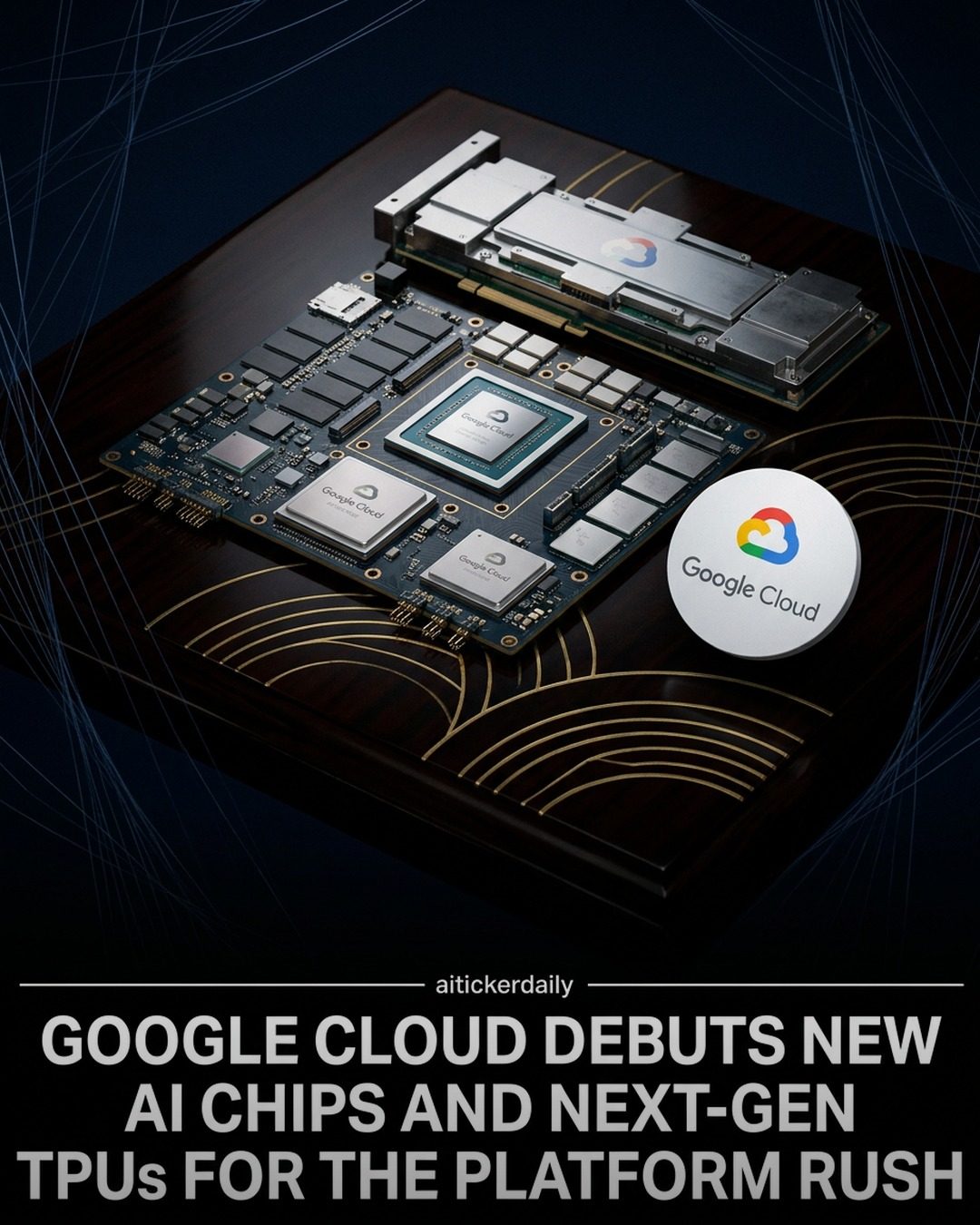
Google Cloud's New AI Chips and TPUs: A Deep Dive
Google Cloud has unveiled its latest tensor processing units (TPUs) and AI chips, signaling a significant push in the AI infrastructure landscape. These new TPUs are designed to enhance the platform's capabilities in terms of capacity, pricing, and the software stack that bridges models to hardware. This development comes at a time when custom silicon is increasingly integrated into the broader narrative of AI and cloud computing.
Why This Matters
The introduction of new AI chips and TPUs by Google Cloud is a pivotal moment for several reasons. First, it underscores the growing importance of custom silicon in AI acceleration. Second, it highlights Google Cloud's commitment to providing a comprehensive suite of tools and services for AI developers and researchers. Finally, it sets the stage for a more competitive landscape in AI infrastructure, as companies vie to offer the best solutions for AI workloads.
Main Discussion
The Role of TPUs in AI Infrastructure
Tensor Processing Units (TPUs) are specialized hardware accelerators designed to perform the complex mathematical operations required for machine learning, particularly for training and inference tasks. These units have been instrumental in Google's AI and machine learning efforts, enabling faster processing and more efficient use of computational resources.
Key Features of Google Cloud’s New AI Chips
While the specific details of the new AI chips and TPUs may vary, several key features are likely to be emphasized:
- Performance: The new TPUs are expected to offer significant performance improvements over their predecessors, with higher throughput and lower latency. This is crucial for applications that demand real-time processing, such as autonomous vehicles, live video analytics, and interactive AI systems.
- Efficiency: Improved energy efficiency is another key area of focus. As AI workloads grow in complexity and scale, the need for efficient hardware that can handle these tasks without excessive power consumption becomes increasingly important.
- Integration: The new TPUs are designed to integrate seamlessly with Google Cloud's existing infrastructure, including other AI and machine learning services. This ensures that developers can easily deploy and scale their models without having to overhaul their existing workflows.
- Software Support: Google Cloud is also placing a strong emphasis on the software stack that supports these new chips. This includes tools for model development, deployment, and management, as well as support for popular AI frameworks like TensorFlow.
The Broader Implications
The introduction of new AI chips and TPUs has broader implications for the AI infrastructure landscape. It signals a shift towards custom silicon solutions, which offer advantages in terms of performance, efficiency, and integration. This trend is likely to continue as more companies invest in custom hardware to meet the growing demands of AI and machine learning.
Tooling, Availability, and Support
For buyers, the real test lies in how well these TPUs integrate into Google’s stack. Factors like tooling, availability, and support play a crucial role in determining the success of these new chips. These elements must align in a way that makes migration straightforward and credible against existing GPU baselines. Teams often rent GPUs by the hour, and any new solution must provide clear benefits in terms of cost, performance, and ease of use.
Comparing TPUs and GPUs
GPUs (Graphics Processing Units) have traditionally been the go-to hardware for AI workloads due to their parallel processing capabilities and broad industry support. However, TPUs offer a more specialized approach, optimized specifically for the types of computations required in machine learning. This specialization can lead to significant performance gains, especially for large-scale training and inference tasks.
Practical Tips
Evaluating TPUs for Your Workloads
When considering whether to use TPUs for your AI workloads, it’s important to evaluate several factors:
- Workload Characteristics: Evaluate the nature of your AI tasks. TPUs are particularly well-suited for workloads that require extensive matrix operations, such as training large neural networks.
- Cost Analysis: Conduct a cost analysis to determine whether the performance gains justify the cost of using TPUs. Consider both the upfront cost of the hardware and the ongoing operational costs.
- Compatibility: Ensure that your existing software stack is compatible with TPUs. This includes checking for support in AI frameworks, libraries, and other tools you use.
- Scalability: Assess how easily you can scale your workloads on TPUs. Consider factors like network latency, data transfer rates, and the ease of deploying models across multiple TPUs.
Migrating to TPUs
If you decide to migrate to TPUs, here are some practical tips:
- Plan Ahead: Start by planning your migration path. This includes evaluating your current infrastructure, identifying potential bottlenecks, and determining the necessary changes to your software stack.
- Use Available Tools: Leverage the tools and resources provided by Google Cloud to facilitate the migration process. This includes documentation, tutorials, and support services.
- Pilot Testing: Conduct pilot testing to validate the performance and compatibility of your workloads on TPUs. This will help you identify any issues early and make necessary adjustments.
Optimizing Performance
Optimizing the performance of your workloads on TPUs involves several best practices:
- Code Optimization: Optimize your code for TPU execution. This may involve rewriting certain algorithms or using TPU-specific libraries and functions.
- Model Optimization: Optimize your models to take full advantage of TPUs. This can include techniques like model pruning, quantization, and applying specific architectural changes.
- Data Management: Efficient data management is crucial. Ensure that your data is properly formatted and efficiently transferred to and from TPUs.
Important Takeaways
-
Custom Silicon Matters: The rise of custom silicon, as seen with Google Cloud’s new AI chips and TPUs, is a significant trend in the AI infrastructure landscape. These specialized hardware solutions offer performance and efficiency advantages over general-purpose hardware like GPUs.
-
Integration and Support: Successful adoption of new AI chips depends on seamless integration and comprehensive support. This includes tooling, availability, and support contracts that make migration straightforward and credible.
-
Evaluate for Your Needs: Before migrating to new AI chips, thoroughly evaluate your workload characteristics, cost considerations, and software compatibility. Ensure that the benefits of using these new solutions align with your specific needs and constraints.
-
Optimization is Key: Optimizing your code, models, and data management practices is essential to fully leverage the capabilities of new AI chips. This involves a combination of technical expertise and strategic planning.
Conclusion
Google Cloud's new AI chips and TPUs represent a significant advancement in AI infrastructure. These new solutions offer substantial performance and efficiency gains, making them a valuable addition to the AI toolkit. However, successful adoption requires careful planning, thorough evaluation, and a commitment to optimization. By focusing on these key areas, developers and organizations can fully harness the power of these new AI chips and drive innovation in the field.
Watch the Reel
Questions readers ask
What are the key benefits of Google Cloud's new TPUs and AI chips?
The new TPUs and AI chips from Google Cloud offer improved performance, enhanced efficiency, and better software integration. These advancements allow for more powerful AI infrastructure and services, making it easier for users to bridge models to hardware.
How do Google Cloud's next-gen AI chips impact the AI infrastructure landscape?
The introduction of these advanced AI chips underscores the importance of custom silicon in AI acceleration. By integrating these chips, Google Cloud aims to create a more competitive environment in AI and cloud computing, providing users with more robust and efficient tools.
What advantages do the new TPUs offer in terms of capacity and pricing?
The new TPUs are designed to enhance the platform's capabilities in terms of capacity, which means users can handle larger and more complex AI workloads. Additionally, the improved pricing structure makes these powerful tools more accessible to a wider range of users, from startups to large enterprises.
Why is custom silicon becoming more important in AI and cloud computing?
Custom silicon, like the new TPUs and AI chips from Google Cloud, are tailored specifically for AI tasks, offering superior performance and efficiency compared to general-purpose hardware. This specialization is crucial for handling the complex and resource-intensive demands of modern AI applications.
How do the new AI chips and TPUs improve the software stack for AI?
The new AI chips and TPUs from Google Cloud come with an improved software stack that integrates seamlessly with the hardware. This integration ensures that models can be deployed and run more efficiently, allowing users to focus more on innovation and less on the technical intricacies of hardware management.
What makes Google Cloud's AI hardware different from other cloud providers?
Google Cloud's AI hardware, including the new TPUs and AI chips, is designed with a focus on custom silicon and advanced software integration. This approach allows for superior performance and efficiency, setting it apart from other cloud providers who may rely more on general-purpose hardware for AI tasks.
How will the new TPUs and AI chips affect AI cloud computing?
With the introduction of these next-generation TPUs and AI chips, Google Cloud is setting a new standard in AI cloud computing. The improved performance, efficiency, and integration capabilities will likely drive innovation and make AI more accessible, pushing the boundaries of what can be achieved in the cloud.
Related deep dives
Similar reads based on topic and creator.




Recent articles
Fresh deep dives from the latest Reels we unpacked.




Comments
Be the first to comment.