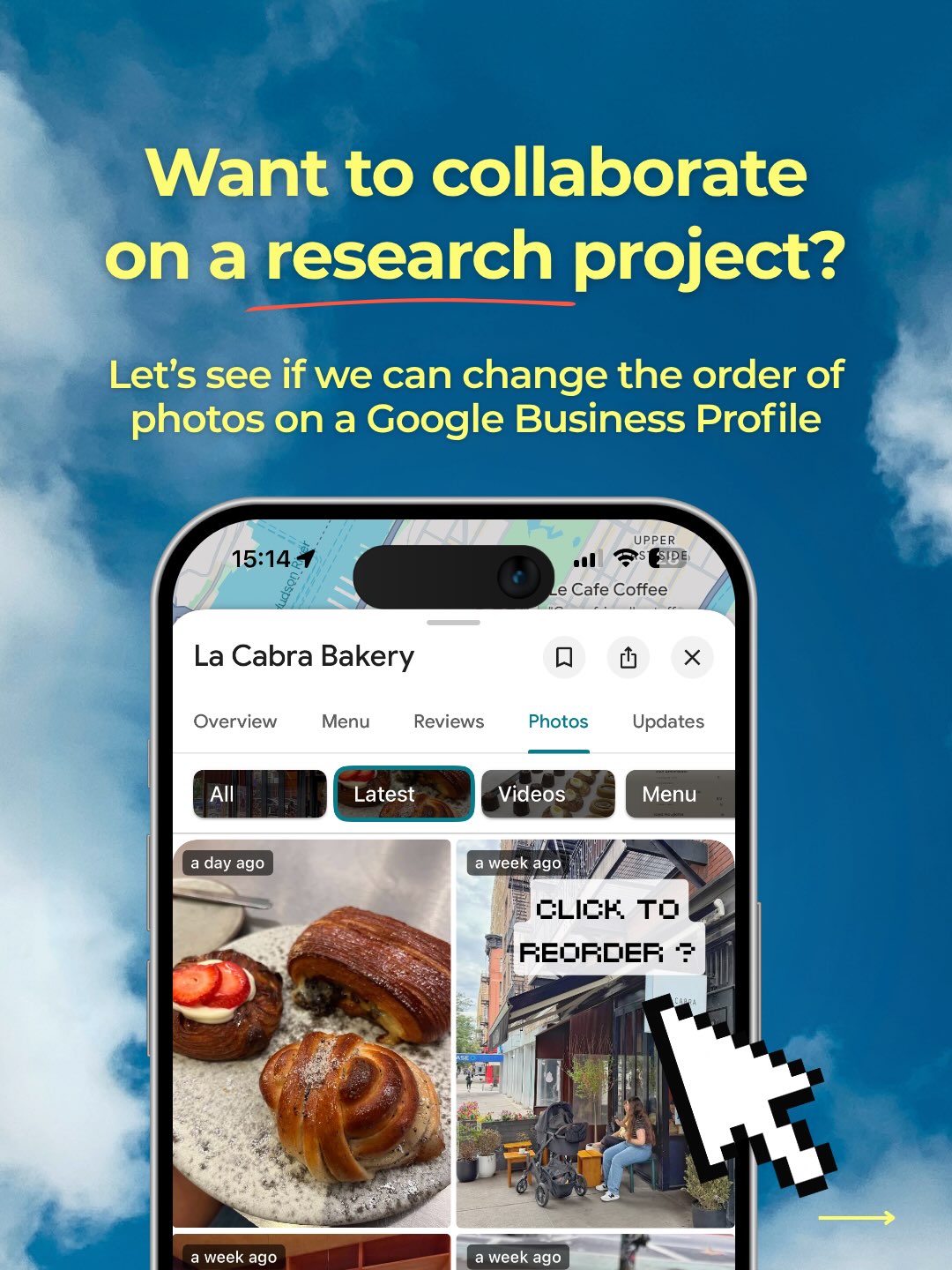
The Google Business Profile photo reordering experiment
It's well known that businesses can upload photos to their Google Business Profiles to show up on Maps and Search. But what if business owners could choose the order of these photos? Could they prioritise their best shots? Could they bury a bad photo? WhiteSpark is conducting a study to find out what happens. They've asked people to perform specific tasks on a business profile in a series of tests, which could change the order of the photos (more on that in the tests).
What’s the Google Business Profile Photo Reordering Study?
The Google Business Profile Photo Reordering Study aims to determine if a user's interactions with a business's photos on its Google Business Profile affect the photo order. This study is based on the hypothesis that user engagement with photos — such as clicking and dwelling — could influence the displayed order of the photos. Imagine that a business owner has seven photos on their Google Business Profile. The current order shows the most recent photo first. But maybe the business owner wants to prioritise an older photo, which shows a beautiful sunset at their location. They’d want to test if they could change the order by engaging with it and see if it could be displayed first. This study stands out because it’s a live experiment. It is not a controlled lab study. The tasks are simple to perform, and participants can complete them in a short amount of time. The study uses real profiles and interactions, so it could uncover new insights into how Google's algorithms work with business profile page content. No previous research has taken this approach, so the findings could open a lot of new opportunities for businesses. WhiteSpark is providing a free service, but they've also used this study to promote themselves. All participants are directed to a webpage explaining the study and inviting them to participate. A “click to order” button appears if you have enough data to participate and it lets you configure your testing.
The human element in image selection
The study touches on a broader trend of manipulating search algorithm results to maximize visibility and engagement. Google is constantly optimizing its image retrieval algorithms to prioritize the user experience. But the user experience isn't fixed. Photographers could help the algorithm surface more engaging images by promoting better photographs to prioritized positions. Many companies don’t know how to manipulate their SEO rankings. Over half of businesses think SEO is about keywords, so they invest a ton of money into keyword-optimized content. But keywords are only the beginning of the process. The data shows that many businesses don't know how to optimize their Google Business Profile.
Getting Technical
The study's research protocol: clicks and dwells
The study's first test is to test if clicking on a photo and looking at it for a specific amount of time changes the order. Participants are instructed to click on a photo and interact with it for 15 seconds. The goal is to see if this focused interaction — the "dwell" — could change the photo's order and rank. This aspect of the study is based on research that shows Google pays attention to how long a user engages with a piece of information and uses it to rank sites. But the sources do not clarify how long an engagement needs to be to have an impact on the ranking. This test could reveal how user engagement is influencing photo order and whether there's a way to accelerate the position of a particular photo. But WhiteSpark hasn’t explained what makes this interaction significant to the study.
Can copying a photo's share link make it more visible?
The second test involves copying a share link from a photo without lingering on the photo. The goal is to see if copying the link makes the photo more visible by increasing its click rate. Perhaps this demonstrates that sharing links boosts click rates. The study is unique because it's testing if the act of copying a link to a photo could increase the visibility of that photo on the business's profile. This observation adds value to the study because it can be useful for businesses to know whether they should encourage users to copy the link of a specific photo or not. But the study doesn’t specify how this would work. If this is the case, then many businesses could take advantage of it to increase the visibility of their best photos.
Guidance for trial participants
WhiteSpark guides users throughout the study process. They direct participants to a specific part of the Business Profile, La Cabra Bakery. This ensures that participants are looking in the right place and not attempting to test the study on random profiles. This heavy hand guiding is good. Shortly before one of the photos is selected, participants are shown an example and instructed on the timing and the exact steps to replicate.
The white paper waiting in the wings
The study invites participants to perform two tests on two business profiles and an unspecified number of photos on each. It’s plausible that different profiles and images will receive varying results. This could make the research less replicable. But it’s plausible that making the study a little more difficult to replicate might be helpful.
Our four steps to trial participation
- Knowledge: Logging into your Google profile and navigating to the profile you are tasked with interacting on are the basics. WhiteSpark has provided the example. This is the major prerequisite for the photos.
- Task: Determine the most impactful photo to prioritize for visibility. Once you have identified the photo, navigate to that photo on the site before clicking on it. That photo will include a “CLICK TO REORDER” button.
- Timing: Spend 15 seconds interacting with the Business Profile on Google. This means you can't be logged out while staring at the photos. If you do, then you will not be able to change the order of your photo.
- Replication: Navigate to the second Business Profile and copy its share link.
Final thoughts
Google Business Profile Photo Reordering Study: WhiteSpark is collecting user data to answer a question that has never been asked in a scientific study. This research will be invaluable to businesses, who could use it to get the most from their Google Business Profile photos. The results come from a real world experiment, so the data could come from any source. The study will be run using real users and real results, so it will have real consequences.
Watch the Reel
Questions readers ask
How exactly do participants engage with the photos in the Google Business Profile Photo Reordering Study?
Participants are asked to click on specific photos and view them for 15 seconds. This interaction, known as a 'dwell,' is being tested to see if it changes the order in which the photos appear on the Google Business Profile.
Does the study only involve clicking on photos, or are there other interactions being tested?
The study primarily focuses on clicking and dwelling on photos. Participants are instructed to click on a photo and view it for a specific amount of time to see if this interaction changes the photo's order and rank.
Can any business owner participate in this study, or are there specific criteria?
The study is open to participants who have enough data to contribute meaningful results. Business owners who want to participate can visit the study's webpage, where they can configure their testing if they meet the criteria.
What kind of insights could this study provide for businesses?
The study could provide insights into how user interactions with photos on Google Business Profiles might influence the order in which those photos appear. This information could help businesses optimize their profiles to showcase their best photos first, potentially increasing engagement and visibility.
Is this study the first of its kind, or have similar experiments been conducted before?
This study is notable because it is a live experiment using real profiles and interactions, unlike controlled lab studies. It is the first to test if user engagement with photos on Google Business Profiles can change their order, making it a pioneering effort in this area.
How does this study relate to broader trends in search algorithm optimization?
The study touches on the broader trend of manipulating search algorithms to maximize visibility and engagement. It explores whether user interactions can influence how Google's algorithms prioritize images, which could help businesses optimize their online presence beyond traditional SEO methods.
Recent articles
Fresh deep dives from the latest Reels we unpacked.



Comments
Be the first to comment.