Nuclear Warheads
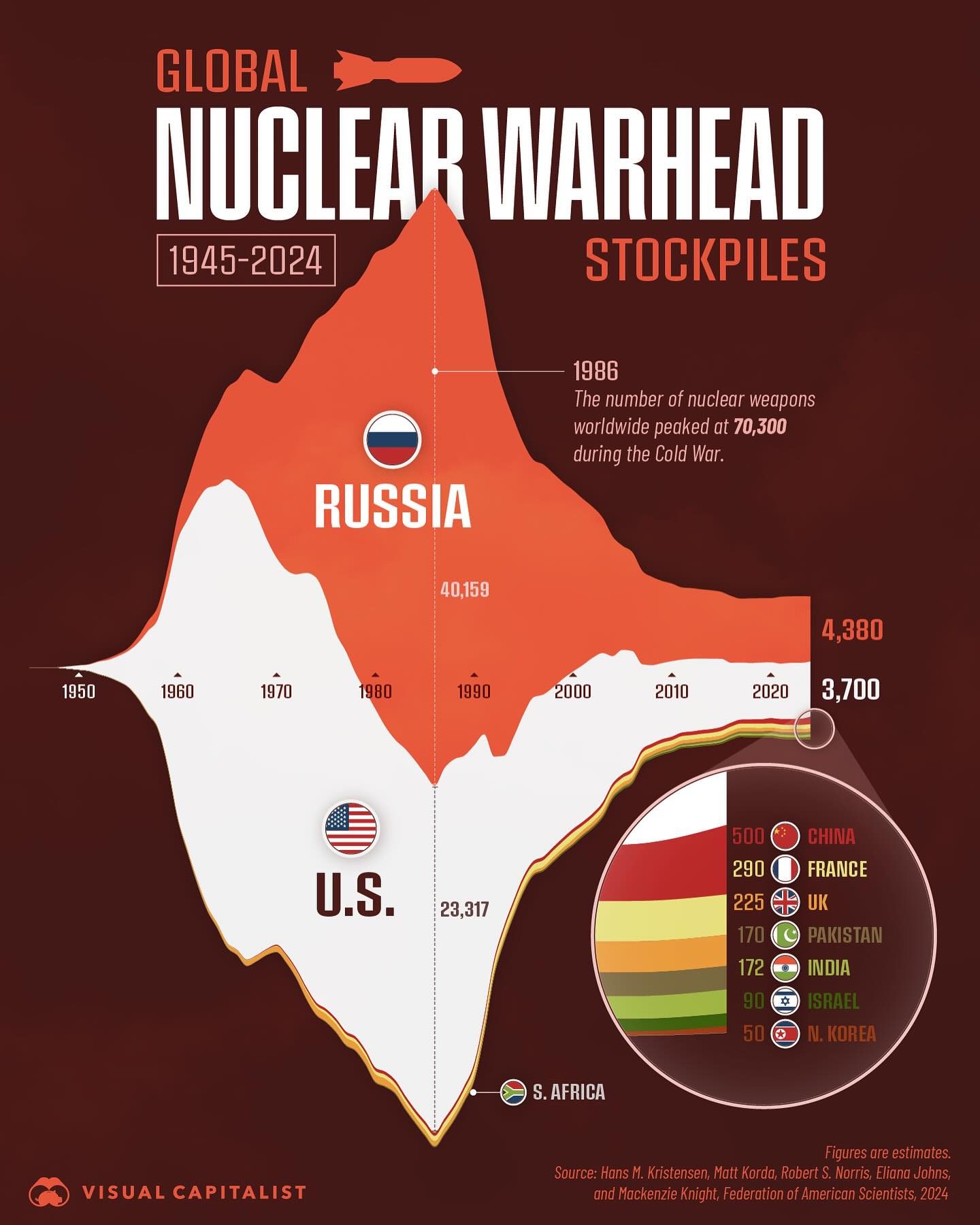
The global nuclear arsenal, though reduced since the Cold War, remains substantial. As of early 2024, nine countries possess approximately 12,121 warheads. The United States and Russia hold the lion's share, accounting for 88% of the world's nuclear weapons. Understanding the current state and historical trends of nuclear stockpiles is crucial for grasping the geopolitical landscape.
Why This Matters
The global nuclear arsenal is a critical component of international security and geopolitics. The current stockpiles reflect decades of strategic decisions, arms races, and diplomatic efforts. The U.S. and Russia, which hold the majority of the world’s nuclear weapons, are key players in global nuclear disarmament discussions.
The possession of nuclear weapons has significant implications for international relations, military strategy, and global security. It influences the balance of power, shapes alliances, and impacts the policies of non-nuclear states. The historical trends and current status of nuclear stockpiles provide valuable insights into the evolving dynamics of global military power.
Global Nuclear Stockpiles
Historical Overview
The worldwide nuclear warhead stockpiles peaked during the Cold War, reaching an estimated 70,300 warheads. This period marked a significant arms race between the United States and the Soviet Union, with both nations rapidly expanding their arsenals. However, since the end of the Cold War, there has been a steady decline in the number of warheads.
The timeline of global nuclear stockpiles from 1945 to 2024 shows a gradual reduction, though the presence of nuclear weapons in multiple countries continues to be a factor in global security. The peak during the Cold War era was driven by the strategic rivalry between the U.S. and the Soviet Union, while the subsequent reduction reflects efforts at nuclear disarmament and arms control.
Current Stockpiles
As of 2024, Russia holds 40,159 warheads. This represents a significant portion of the global nuclear arsenal, emphasizing Russia's military power and strategic influence. The U.S. follows with 23,317 warheads, maintaining its position as a leading nuclear power.
China has the third-largest nuclear arsenal, with 4,380 warheads. This figure underscores China’s growing military capabilities and its role as a major power in the global nuclear landscape. Other countries with notable nuclear stockpiles include:
- United Kingdom (225)
- France (290) France's arsenal may be smaller, but it remains a crucial component of its military strategy and nuclear deterrence.
- Pakistan (170) Pakistan's nuclear weapons are a key factor in the geopolitics of South Asia, particularly in its rivalry with India.
- India (90)
- Israel (50)
- North Korea (50)
South Africa is also mentioned, but there are no estimates for the number of warheads it possesses. This could imply that South Africa has no nuclear weapons, which is consistent with its known disarmament efforts.
The Role of Nuclear Weapons in Geopolitics
The possession of nuclear weapons significantly impacts the geopolitical dynamics of international relations. Nuclear-armed states hold considerable influence in global affairs due to the threat of nuclear deterrence. This influence is evident in various geopolitical contexts, from arms control negotiations to regional conflicts.
For instance, the nuclear arsenals of the U.S. and Russia are central to discussions on global nuclear disarmament. The Strategic Arms Reduction Treaty (START) and the Intermediate-Range Nuclear Forces (INF) Treaty are examples of efforts to limit the number of nuclear weapons and prevent their spread. These agreements highlight the importance of diplomatic efforts in managing the global nuclear arsenal.
China's growing nuclear capabilities add another layer to these dynamics. As China continues to develop its military power, it impacts regional security and global geopolitics. The strategic calculations of other nuclear-armed states, such as India and Pakistan, are also influenced by China's nuclear posture.
Practical Tips for Understanding Nuclear Stockpiles
- Stay Informed: Keep up-to-date with the latest estimates and reports from organizations like the Federation of American Scientists. Their data provides a reliable source of information on global nuclear stockpiles.
- Contextualize Historical Data: Understanding the historical context helps in interpreting current trends. The Cold War era, for example, marked a significant arms race, which influenced current stockpiles.
- Analyze Regional Dynamics: Regional conflicts and alliances shape the nuclear postures of various countries. For instance, India and Pakistan's nuclear arsenals are heavily influenced by their regional rivalry.
- Follow Diplomatic Efforts: Monitor ongoing diplomatic efforts and treaties aimed at limiting and reducing nuclear weapons. These efforts are crucial for understanding the direction of global nuclear disarmament.
- Consider Strategic Implications: Understand the strategic implications of nuclear weapons on global security. The threat of nuclear deterrence plays a crucial role in international relations and military strategy.
Important Takeaways
The global nuclear arsenal, though reduced since the Cold War, remains a significant factor in geopolitics. The U.S. and Russia hold the majority of the world’s nuclear weapons, with China, the UK, France, Pakistan, India, Israel, and North Korea also possessing notable arsenals.
Understanding the historical trends and current status of nuclear stockpiles provides valuable insights into the evolving dynamics of global military power. The possession of nuclear weapons continues to influence international relations, military strategy, and global security, making it a critical aspect of geopolitics.
Conclusion
The global nuclear arsenal, with nine countries holding approximately 12,121 warheads as of 2024, is a key component of international security. The historical trends and current status of nuclear stockpiles offer important insights into the geopolitical landscape.
Nuclear weapons play a significant role in shaping the balance of power, influencing military strategies, and impacting global security. Staying informed about the latest data, historical context, and strategic implications is essential for understanding the role of nuclear weapons in today’s world.
Watch the Reel
Questions readers ask
How many countries currently possess nuclear warheads?
As of 2024, there are nine countries with nuclear stockpiles. The United States and Russia possess the largest portions, while the other seven nations—including the United Kingdom, France, China, India, Pakistan, Israel, and North Korea—hold the remainder.
What was the extent of global nuclear stockpiles during the Cold War?
During the Cold War, global nuclear stockpiles reached their peak, with the United States and the Soviet Union (now Russia) amassing tens of thousands of nuclear warheads each. This period was marked by a significant arms race, leading to a much higher number of nuclear weapons compared to today's estimates.
How many nuclear warheads does the United States have in 2024?
In 2024, the United States possesses approximately 5,480 nuclear warheads. This number represents a significant reduction from the Cold War era but still constitutes a substantial portion of the global nuclear arsenal.
What is the current status of nuclear disarmament efforts?
Nuclear disarmament efforts have made progress, as evidenced by the reduction in global nuclear stockpiles since the Cold War. However, the process is complex and slow, with ongoing discussions and treaties aimed at further reducing nuclear weapons and preventing their proliferation.
Which country has the second-largest nuclear arsenal in 2024?
Russia has the second-largest nuclear arsenal, possessing approximately 5,889 warheads. This makes Russia the country with the second-most nuclear weapons, following the United States. Together, these two countries hold the vast majority of the world's nuclear weapons.
How have global nuclear stockpiles changed since 1945?
Since 1945, global nuclear stockpiles have fluctuated significantly. They peaked during the Cold War and have since declined due to various arms control agreements and unilateral reductions. As of 2024, the total number of nuclear warheads has decreased to about 12,121 from a high of over 70,000 during the Cold War.
Related deep dives
Similar reads based on topic and creator.




Recent articles
Fresh deep dives from the latest Reels we unpacked.




Comments
Be the first to comment.