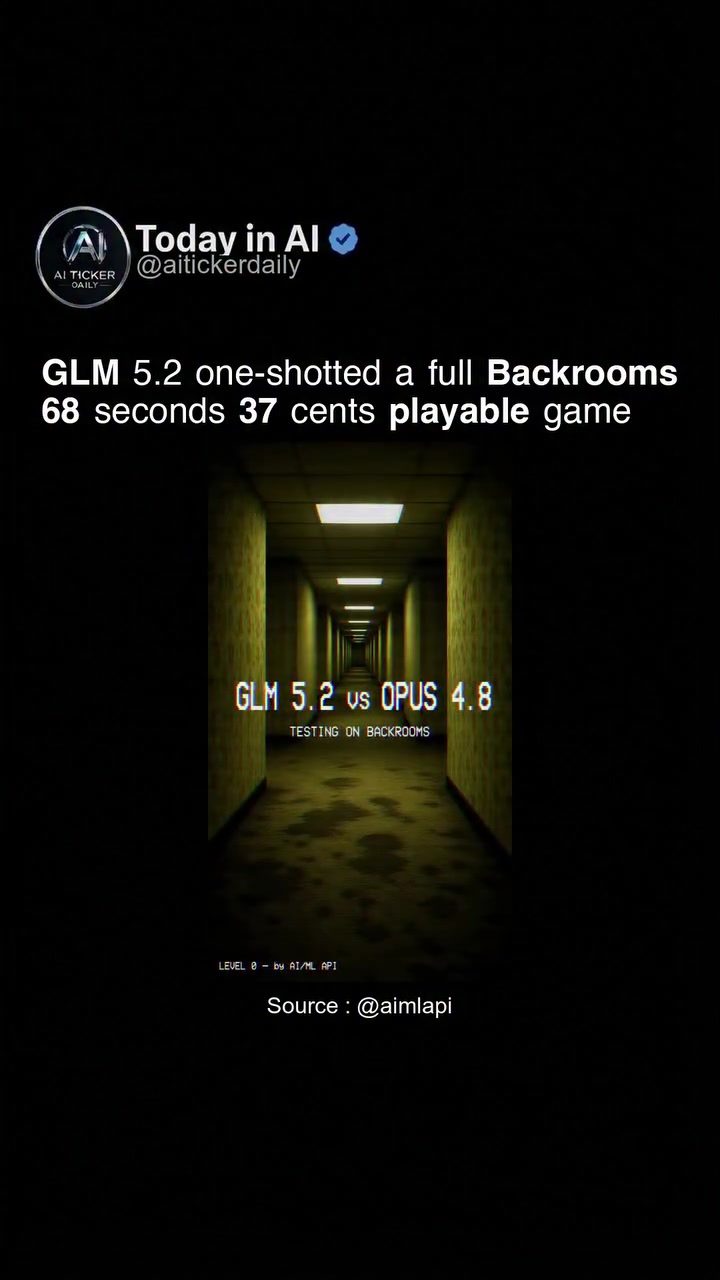
AI Model Comparison: GLM 5.2 vs. OPUS 4.8 in Backrooms
AI models are becoming increasingly pivotal in game development, offering new ways to prototype and create immersive environments. A recent comparison between two prominent AI models, GLM 5.2 and OPUS 4.8, provides insights into their capabilities and cost-effectiveness, particularly in the context of the Backrooms environment.
Why This Matters
Understanding the performance differences between AI models is crucial for developers aiming to optimize their workflows and costs. The comparison between GLM 5.2 and OPUS 4.8 highlights key metrics such as token usage and cost, which are essential for making informed decisions in game development. By examining these models, developers can choose the best tools for their projects, ensuring efficiency and cost-effectiveness.
GLM 5.2 vs. OPUS 4.8: A Detailed Comparison
Performance Metrics
The comparison focuses on the time taken and cost incurred by each model to complete the Backrooms environment. GLM 5.2 completes the task in 68 seconds at a cost of 37 cents, whereas OPUS 4.8 takes 2 minutes and 30 seconds and costs $1.66.
Token Usage
Token usage is a critical factor in AI models, as it directly impacts the cost and efficiency of the model. GLM 5.2, for instance, uses 149 input tokens and 64,312 output tokens, costing $1.408 for input and $0.3815 for output. In contrast, OPUS 4.8 uses 76,887 input tokens and 88,296 output tokens, with input costing $1.126 and output costing $1.66.
Cost Analysis
The cost difference between the two models is significant. GLM 5.2's total cost for the task is $1.7895, while OPUS 4.8's total cost is $2.786. This substantial difference makes GLM 5.2 a more cost-effective choice for developers looking to optimize their budget.
Practical Tips for Choosing the Right AI Model
Evaluate Your Needs
When selecting an AI model, it's essential to evaluate your specific needs. Consider the complexity of the environment you're building and the resources you have available. For straightforward tasks, GLM 5.2 may be the more efficient choice, while OPUS 4.8 might be better suited for more complex projects.
Consider Cost and Efficiency
Cost and efficiency are crucial factors in choosing an AI model. GLM 5.2's lower cost and faster completion time make it an attractive option for developers on a tight budget. However, if the additional features and capabilities of OPUS 4.8 align with your project's requirements, the higher cost may be justified.
Experiment with Different Models
Before committing to a particular model, experiment with different options to see which one best meets your needs. This can help you make an informed decision and ensure you're using the most effective tool for your project.
Important Takeaways
- Efficiency and Cost: GLM 5.2 is more efficient and cost-effective than OPUS 4.8 for simple tasks.
- Token Usage: GLM 5.2 uses fewer tokens, making it a more economical choice.
- Model Selection: Choose the model that best aligns with your project's requirements and budget.
- Experimentation: Testing different models can help you find the best fit for your needs.
Conclusion
AI models like GLM 5.2 and OPUS 4.8 offer powerful tools for game development, but understanding their performance and cost metrics is crucial for making informed decisions. Whether you prioritize speed, cost, or specific features, evaluating these models' capabilities can help you optimize your workflow and achieve the best results for your projects.
Watch the Reel
Questions readers ask
What are the key performance metrics to consider when comparing AI models like GLM 5.2 and OPUS 4.8 in Backrooms game development?
When comparing AI models, focus on token usage, cost, and time efficiency. These metrics help you understand how much data the model processes, how much it costs to run, and how quickly it generates outputs. These factors are crucial for optimizing workflows and managing resources effectively in game development, especially in creating immersive environments like the Backrooms.
How do GLM 5.2 and OPUS 4.8 differ in terms of token usage and cost?
GLM 5.2 and OPUS 4.8 have different token usage and cost structures. GLM 5.2 tends to be more efficient with tokens, processing more information with fewer tokens, while OPUS 4.8 might offer different pricing models that could be more cost-effective depending on the specific use case. Developers should analyze their project's needs to determine which model offers better value.
What are the advantages of using AI models in Backrooms game development?
AI models like GLM 5.2 and OPUS 4.8 offer significant advantages in game development, including faster prototyping, enhanced creativity, and the ability to generate immersive environments. These models can simulate various scenarios, create detailed textures, and optimize game mechanics, helping developers bring their visions to life more efficiently.
Which AI model is more time-efficient for generating content in the Backrooms environment?
The time efficiency of GLM 5.2 and OPUS 4.8 can vary. Generally, GLM 5.2 is noted for its quick processing times, making it a strong candidate for developers who need rapid content generation. However, OPUS 4.8 might offer different strengths in terms of output quality and consistency, so it's important to evaluate both models based on specific project requirements.
How can developers determine the best AI model for their Backrooms project?
To determine the best AI model, developers should conduct a thorough analysis of their project's specific needs, including the complexity of the environment, desired output quality, and budget constraints. Testing both GLM 5.2 and OPUS 4.8 with sample tasks and comparing the results in terms of token usage, cost, and time efficiency can provide valuable insights. Additionally, considering the input-output ratio and API compatibility is crucial for seamless integration into the development workflow.
What are the implications of high token usage in AI models for game development?
High token usage in AI models can lead to increased costs and longer processing times, which can be significant drawbacks in game development. Models that are less efficient with tokens may require more data to generate the same output, leading to higher operational costs and potential delays in the development process. Therefore, it's important to choose models that balance performance with cost-effectiveness.
Related deep dives
Similar reads based on topic and creator.




Recent articles
Fresh deep dives from the latest Reels we unpacked.




Comments
Be the first to comment.