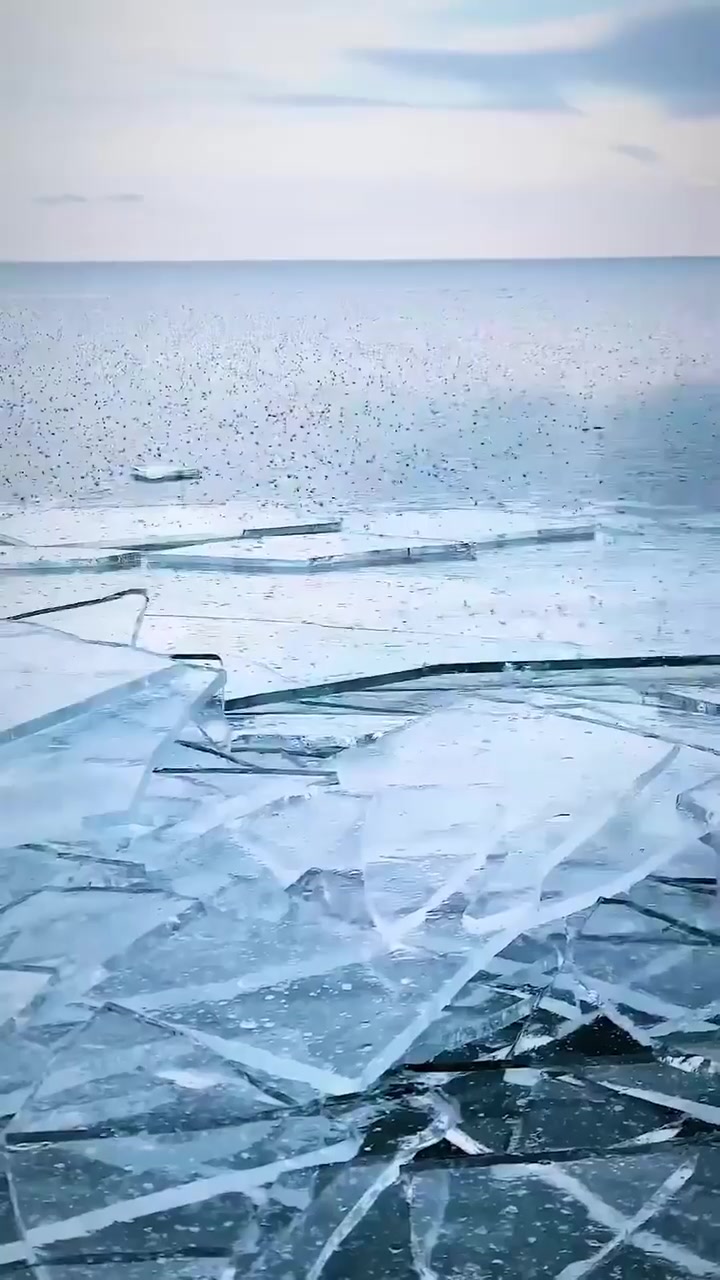
If always been hard to capture the true majesty of nature, it shows its most dramatic face on a frozen lake – with intricate ice formations and massive, craggy spires. That is the subject of this video. I'm glad the video title says that time-stamped chords of appreciation and sadness never distracted the camera.
The Fractured Mirror of a Frozen Lake
A frozen lake transforms into a sculptural landscape of broken mirrors. Ice melt dynamics and a prolonged period of cold were likely unmitigated by the designer. Globular ice masses form and break under their own weight. One shape — the teardrop — is ubiquitous, and its shadows create a playful harmony with the glassy surface. The lake turns three-dimensional. The camera pans across this surface, revealing a vast expanse of fractured ice and a distant shoreline. The ice formations create a visually striking pattern. Here, the ice froze in different layers, each with its own texture and character. These layers compress and crack over time, and sometimes, as the wind calls the water from below, the ice bends and twists. From a distance, the cracking ice sheet looks like shattered marble, its veins mapped out in stark, jagged lines. Close-up, one can see the ice's crystalline symmetry, glassy and crystalline. It is a study in contrasts — macroscale chaos and microscale order. The cold might have roved around the mainland edges, but this intimate study shows only the lake's mirror images breaking down.
The Frozen Lake and a World Apart
The frozen lake is a tabula rasa, a frozen saturated surface. For seasoned outdoors people, spring starts at the lakes. Sunlight can melt, thaw, and reflect everywhere. For photographers, the frozen lake is a canvas of patterns. Ice melting only gives a glimpse of the greater complexity of the lake's ecology. Ice forms only at night, and the ice prevents natural or artificial turbulence from reaching the water. Once the snows retreat, the ice can’t melt quickly, and thrives without wind or sunlight. The ice changes its color, temperature, and texture as the year progresses. These color changes result from the growth of algae that flourish when light penetrates the ice.
The Ebb of Ice Breakers
Where the ice meets the water, the ice forms a sharp line. Mistakes and turbulence in the ice make cracks. Frozen ice forms thin, long, breakable pieces. The decay, caused by melting, creates large sections of ice that twist on top of one another. Just as easily, ice can form seamless and unbroken surfaces, setting off the most intricate lines. These surfaces are some of the most visually stunning places on the frozen lake.
The Frozen Lake Landscape
The ice forms an intricate network. The lake is covered in ice that forms intricate patterns with the water. This rapidly freezing water is the perfect substrate for the growth of bubbles trapped in between layers of ice. What starts out as a gentle wave can quickly develop into dramatic, jagged shapes. The ice near the lakeshore cracks and breaks, meaning that it is being positively affected by freezing and breaking. As ice grows thicker, the cracks can settle to a deeper level. When the ice melts, the ridges are exposed. The ice sensations and reflections are an affirmation of nature’s power. To capture the frozen lake on film is to bear witness to the enchantment of nature.
The Call of the Chords
These chilling songs of ice formations shape the frozen landscape. Unlike the distant shoreline, the ice formations are closer to the main subject of the lake. The music is an indication of emotions of sadness. Viewers will hear this melody and feel a connection to the sight. This musical choice brings out a contrasting element to the ice formations. The chilling music is a reminder of the stark contrast in the frozen lake's beauty and ruggedness.
The Solitary Winter's Song
The silent world of a frozen lake is easily disrupted by the smallest of sounds. The accompanying sad music turns the lake's utter silence into a quiet song. The music is a symbol of the sorrow and remorse such a place can evoke, especially in winter. The sadness does remind the viewer of the power of nature in its beauty.
No ice, Then What?
As the ice melts, the surface begins to change. That's the cue to return to the deep beauty of the lake and see how far the ice has travelled. The lake’s surface is revealed in all of its uneven majesty, with slivers of water separating the chunks of ice. The ice has been rent, ripped, and churned and carved. Even as the ice retreats, revealing the lake beneath, it is a form of fighting, and a battle to understand the frozen lake is a long one.
Watch the Reel
Questions readers ask
What causes the intricate ice formations on a frozen lake?
The intricate ice formations on a frozen lake are caused by a combination of factors. The dynamics of ice melting and freezing, along with the natural weight and pressure of the ice, lead to the creation of various shapes and patterns. The teardrop shape, for instance, is a common formation that adds to the visual harmony of the frozen landscape.
How does the ice on a frozen lake change over time?
The ice on a frozen lake undergoes significant changes over time. Initially, it forms in layers with different textures and characters. As it freezes and thaws, these layers compress and crack, creating a visually striking pattern. The ice's color, temperature, and texture also change as the year progresses, influenced by factors like algae growth and sunlight penetration.
What makes a frozen lake a unique subject for photography?
A frozen lake is a unique subject for photography because it serves as a canvas of intricate patterns and contrasts. The ice formations, which can range from jagged spires to smooth, glassy surfaces, offer a variety of textures and shapes. Additionally, the interplay of light and shadow on the ice creates a dynamic and visually striking landscape that is perfect for capturing dramatic and serene images.
What role does algae play in the color changes of ice on a frozen lake?
Algae play a significant role in the color changes of ice on a frozen lake. When light penetrates the ice, it allows algae to grow, which in turn changes the color of the ice. This natural process adds to the visual complexity and beauty of the frozen landscape, making it a fascinating subject for both scientific study and photography.
How does the ice on a frozen lake interact with the water below?
The ice on a frozen lake interacts with the water below in several ways. As the ice forms, it prevents natural or artificial turbulence from reaching the water, creating a calm and still environment. The interaction between the ice and water is also evident at the shoreline, where the ice forms a sharp line and cracks due to turbulence and melting, creating visually stunning patterns.
What are some of the most visually stunning features of a frozen lake?
Some of the most visually stunning features of a frozen lake include the intricate ice formations, such as the teardrop shapes and the glassy, crystalline surfaces. The interplay of light and shadow on these formations creates a dynamic and contrasting landscape. Additionally, the seamless and unbroken surfaces of ice, which can form intricate lines, are particularly striking.
What is the significance of the teardrop shapes formed by the ice?
The teardrop shapes formed by the ice are significant because they are a common and recognizable formation on a frozen lake. These shapes create a playful harmony with the glassy surface of the ice, adding to the overall visual appeal of the frozen landscape. The teardrop shapes, along with other ice formations, contribute to the three-dimensional and sculptural quality of the frozen lake.
Related deep dives
Similar reads based on topic and creator.

Recent articles
Fresh deep dives from the latest Reels we unpacked.


Comments
Be the first to comment.