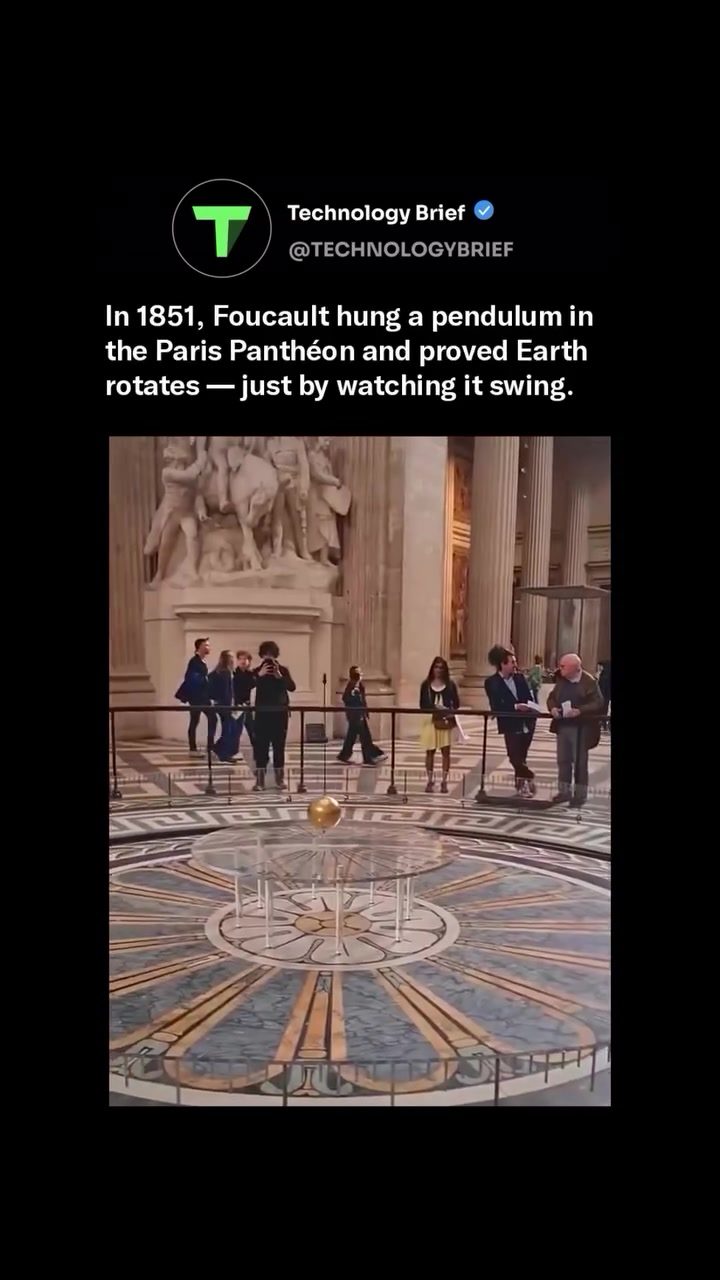
Foucault's Pendulum
It's hard to overstate the impact of French physicist Léon Foucault's 1851 experiment using a simple pendulum to demonstrate the Earth's rotation. By suspending a 28-kilogram brass-coated lead ball from a 67-meter wire under the dome of the Panthéon in Paris, Foucault provided one of the first clear, public proofs that the Earth spins on its axis.
The pendulum's path seemed to slowly rotate, shifting about 11 degrees every hour. This shift was not due to any change in the pendulum's direction, but rather because the pendulum's swing stayed fixed in space while the Earth turned beneath it. The ground rotating underfoot caused any change in the pendulum's path as seen from the floor.
The Panthéon installation became a landmark demonstration, drawing crowds from across Paris. Today, an exact copy of the original pendulum has been hanging inside the Panthéon since 1995, and versions of it can be found in science museums around the world.
Why this matters
Foucault's experiment was groundbreaking for several reasons. Before his demonstration, many people, including scientists, believed the Earth was stationary. The pendulum provided a dramatic, visual proof that the Earth was rotating. This experiment helped shift public and scientific understanding of the Earth's motion. It also marked a significant step in the development of experimental physics, showcasing how simple tools can be used to prove complex theories.
The Science behind the pendulum
The physics of the pendulum
The Fourier Pendulum operates on a fundamental principle of physics: conservation of angular momentum. The pendulum itself does not change direction; it swings in a fixed plane. However, as the Earth rotates beneath it, the plane of the pendulum's swing appears to change. This is because the Earth's rotation causes the reference frame from which the pendulum is observed to change.
The role of the Panthéon
The choice of the Panthéon as the site for the demonstration was strategic. The large, open space under the dome allowed the pendulum to swing freely, and its central location in Paris made it accessible to a wide audience. The Panthéon's architectural features, such as its high dome and large floor space, enhanced the visual impact of the demonstration. Today, the Panthéon remains a popular site for visitors to observe the Foucault Pendulum in action.
The evolution of the pendulum
Foucault's original pendulum was not the end of the story. Over the years, various versions of the pendulum have been created and installed in different locations around the world. These versions can vary in size and design, but they all operate on the same basic principles demonstrated by Foucault. The pendulum at the Panthéon has been a landmark in the history of scientific demonstrations, inspiring generations of scientists and engineers.
Practical tips
If you're interested in observing a Foucault Pendulum or even building one, consider these practical tips:
Where to see
Many science museums and observatories have Foucault Pendulums on display. These installations can provide a fascinating opportunity to observe the Earth's rotation in action. Some notable locations include the Pantheon in Paris, the Griffith Observatory in Los Angeles, and the Science Museum in London. Be sure to check the operating hours and any specific viewing guidelines before visiting.
Building your own
If you're feeling ambitious, you can even build your own Foucault Pendulum. Here are some basic steps to get you started:
- Find a suitable location: Look for a high-ceilinged space where you can suspend the pendulum freely. This could be a school gymnasium, a warehouse, or even a large room in your home.
- Gather materials: You'll need a heavy weight (such as a bowling ball or a lead weight), a long, lightweight string, and a sturdy point from which to suspend the weight.
- Suspend the weight: Attach the string to the weight and suspend it from the ceiling or a beam. Make sure the weight is high enough to swing freely without hitting the ground or any obstacles.
- Observe the swing: Once the pendulum is suspended, give it a gentle push to start it swinging. Observe the plane of the swing over time to see how it appears to rotate.
Understanding the results
When observing a Foucault Pendulum, it's important to remember a few key points:
- The pendulum itself does not change direction; it swings in a fixed plane.
- The Earth's rotation causes the plane of the pendulum's swing to appear to change.
- The rate of change in the pendulum's swing depends on the observer's latitude. At the poles, the pendulum's plane of swing rotates once every 24 hours. At the equator, the plane of swing does not rotate at all. This is why Foucault Pendulums are particularly effective at demonstrating the Earth's rotation in mid-latitude locations.
Important takeaways
Earth's rotation
Foucault's Pendulum provides a clear, visual demonstration of the Earth's rotation. By observing the pendulum's swing, viewers can gain a deeper understanding of how the Earth moves through space.
Scientific demonstrations
This experiment showcases the power of simple yet effective scientific demonstrations. Foucault's use of a pendulum to prove a complex theory is a testament to the value of hands-on, visual experiments in communicating scientific concepts.
Historical significance
The original installation of Foucault's Pendulum at the Panthéon in 1851 marked a significant turning point in scientific understanding. It provided one of the first clear, public proofs of the Earth's rotation, helping to shift public and scientific opinion on the matter.
Conclusion
Foucault's Pendulum remains a fascinating and effective demonstration of the Earth's rotation. From its origins in the Panthéon to its modern incarnations in science museums around the world, the pendulum continues to captivate and educate viewers. Whether you observe it in person or build your own, the Foucault Pendulum offers a unique opportunity to witness the power of simple scientific principles in action.
Watch the Reel
Questions readers ask
Why did Foucault choose to conduct his pendulum experiment at the Panthéon in Paris?
Foucault selected the Panthéon for its large, open interior space, which was ideal for demonstrating the pendulum’s swing. The building's dome allowed the pendulum to swing freely, and its public accessibility drew large crowds, maximizing the experiment's impact.
How did the pendulum's behavior change over time to demonstrate the Earth's rotation?
The pendulum's path appeared to rotate clockwise at a rate of about 11 degrees per hour. This rotation was not due to a change in the pendulum's direction but because the Earth was turning beneath the pendulum. The pendulum's plane of swing remained fixed in space while the Earth rotated underneath.
What was the significance of Foucault's Pendulum experiment in 1851?
Foucault's Pendulum was significant because it provided a clear, public demonstration of the Earth's rotation. Before this, many people believed the Earth was stationary. The experiment helped shift scientific and public understanding, contributing to the acceptance of the Earth's movement.
How long did the pendulum take to complete one full rotation in the experiment?
The pendulum took approximately 32.7 hours to complete one full rotation relative to the Earth. This period is slightly longer than a full day due to the Earth's rotation in the same direction as the pendulum's apparent rotation.
What materials were used in the construction of Foucault's Pendulum?
Foucault's Pendulum consisted of a 28-kilogram brass-coated lead ball suspended from a 67-meter wire. The use of these materials was crucial for providing the necessary weight and durability for the pendulum to swing freely and maintain its motion over long periods.
Can Foucault's Pendulum experiment be replicated today, and if so, how?
Yes, the experiment can be replicated today in various locations around the world. Modern replicas of Foucault's Pendulum can be found in science museums and other public spaces. The key to replicating the experiment is to have a large, open space to allow the pendulum to swing freely and observe the Earth's rotation over time.
How did the public react to Foucault's Pendulum demonstration at the Panthéon in 1851?
The public reaction to Foucault's Pendulum demonstration was overwhelmingly positive and drew large crowds. People were captivated by the visual proof of the Earth's rotation, which challenged the prevailing belief in a stationary Earth. The demonstration became a significant public event, attracting visitors from across Paris and beyond.
Related deep dives
Similar reads based on topic and creator.




Recent articles
Fresh deep dives from the latest Reels we unpacked.




Comments
Be the first to comment.