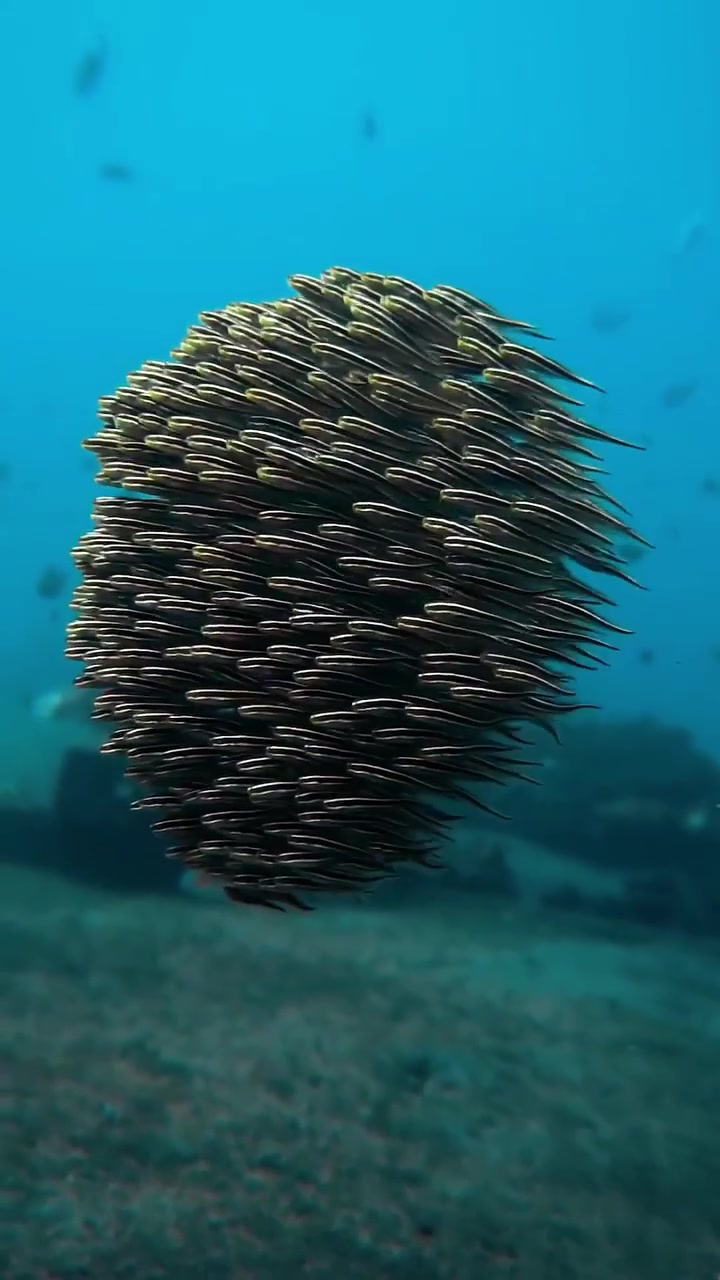
School underwater, thousands of fish form a floating sphere, as if in formation. But the fish aren't in a drill — this is no TED talk performance. It's a schooling behavior. Schooling itself isn't rare, but schooling this distinctively is. This ball is a display of aquatic organization.
The Sphere
A school of fish is a loose term for a group that swims together. Schools can be small, but they can also reach hundreds, as with the anchovies that roam along the California coast. Most schools move downstream in a synchronized pattern. The schooling here is distinctive "is to form a spherical shape underwater." Instead of swimming as a clump or a line, these fish form a ball. The vision data confirms that this school is "densely packed together" to form a sphere. Schooling is not always so neat — the fish may swim side by side or scatter in a haphazard way. . Fish can't just teleport into a sphere. Research suggests that schooling of any kind has evolved as a defense mechanism — the larger the group, the better the chances are for any individual to escape a predator. In this case, the sphere formation is a more advanced version of this defense strategy. It makes it harder for a predator to pick out an individual. How they form a fish ball is another puzzle. Scientists have yet to discover a reliable language to decode fish behavior. Some schools are formed through a series of unexpected events. The fish concept of a sphere is still not conclusively known. The size of the sphere is equally unknown. Since the fish are densely packed, the measurement can be easily approximated. The sphere is a compact wall of fish. There is no leader, just a group that knows when to push to the side, or move in unison downstream. As long as the school is coordinated, the sphere-formation of school will remain. The sphere forms from schools of fish like sardines, anchovies, and herring. The fish sphere is what we know today as fish ball. It's one giant school of fish swimming in formation. "The underwater environment is clear" to allow for the spheres to be this distinct. The sphere can only happen in this emerald blue hued water. The fish will square their tails and form a protective ball so that these predators don't attack them.
How fish find each other
Fish are not taught how to school — they are born knowing it. They've evolved to follow the school movement. As an adult, the fish will follow the school through instinct. This instinct leads them to forage, feed, or find their mates. Swimming together helps to avoid predators and find food. When one fish moves in a certain direction, the other fish will follow. A fish school can have hundreds of fish, moving in the same direction. Fish can go from a school, a group, to a sphere instantaneously. This is known as "sphere school". This rapid shape shift is a form of communication. The fish are not actually communicating with their eyes. They are relying on their sense of touch to stay in formation. Predators and currents are the main culprits throwing off the formation. The school is being disturbed by currents and predators.
The Pursuit of Spheres
Humans have been fascinated by schooling phenomena. When it comes to marine wildlife, the school of fish is a prime example. In the ocean, a fish school can be a coordinate, or a group that swims together. The sphere is a unique example of schooling. It is one giant school of fish swimming in formation. The school is a coordinated movement. The fish can form a ball. It can be a vision of beauty, or an alert for predators. There are different types of schooling behaviors. Fish may swim as a single clump of fish, or form a line. They may form a sphere, a ball. They can form a circle, a spiral, or an oval. They can form a triangle or a square. A fish will swim in harmony. The school is not always in order. They are constantly shifting to form different formations. This is known as a "school shift". The sphere is a common example of school shift. The fish will organize themselves into a sphere. They will change the formation. The ball formation is a signal that the fish are in danger.
Engineering Spheres
To tier spheres of fish is a single school. The sphere formation relies on a single animal moving. However, when one moves, the entire school is affected. Even if the fish are all swimming in the same direction, the formation could be affected. The fish can go from a school to a sphere instantaneously. How? The fish are constantly shifting to form different formations. The sphere is a unique example of this. The sphere can only be created when the school is moving. The fish are evolving. They are learning the advantage of maintaining formation. The fish can form a ball. The sphere is a signal that the fish are in danger. The sphere is a unique formation. It is a signal that the fish are in danger. The sphere is a signal that the fish are in danger. The sphere is a signal that the fish are in danger. It is the ultimate form of coordination.
Ingredients for Schooling
A school of fish needs a few things to form. First, the fish must be able to see each other. The fish must be able to see each other. The fish must be able to see each other. Vision is essential. The sphere can only form in clear underwater areas. Second, the fish must be able to communicate with each other. The fish must be able to communicate with each other. Communication is essential. The sphere can only form when the fish are communicating. Third, the fish must be able to move in the same direction. The fish must be able to move in the same direction. Movement is essential. The sphere can only form when the fish are moving.
Sphere-Spotting
Squads of fish are hard to spot. Fish spheres are a challenge to track. The fish are constantly moving. The formation constantly shifts. The fish are constantly moving. The formation constantly shifts. Why? They are attempting to evade predators. The sphere is a signal that they are in danger. The sphere is a signal that they are in danger. The sphere is a signal that they are in danger. It is the ultimate form of coordination. Learn about schools of fish and the benefits of schooling. Schools of fish are a group of fish that swim together. They swim in coordination. They swim in formation. They swim in harmony. The fish are constantly moving. The formation constantly shifts. If you want to find a school of fish, look for a disturbance. Look for bubbles, waves, or splashes. Look for a disturbance. Look for bubbles, waves, or splashes. Look for a disturbance. Look for bubbles, waves, or splashes. Look for a disturbance. Avoid touching or harassing the fish if the formation changes. The fish are in danger. The fish are in danger. The fish are in danger. If you see a school of fish, it is best to observe from a distance. A school of fish can exist in the ocean or a river. It can exist in a lake or a pond. A fish school is a group of fish that swim together. They swim in coordination. They swim in formation. They swim in harmony. They can form a school, a group, or a sphere. It all starts with the sphere.
Watch the Reel
Questions readers ask
What species of fish typically form these spherical schools?
The article mentions that fish like sardines, anchovies, and herring are known to form these spherical schools, often referred to as 'fish balls'. These schools can be quite large, with thousands of fish swimming together in a densely packed formation.
How do fish manage to form such a precise spherical shape underwater?
The exact mechanism behind the formation of these spherical schools is still not fully understood. Research suggests it's an evolved defense mechanism, making it harder for predators to single out an individual fish. The fish use a combination of instinct and their sense of touch to maintain the formation.
Can this spherical formation happen in any underwater environment, or are there specific conditions required?
The article specifies that the underwater environment needs to be clear, with an emerald blue hue, for these spheres to form distinctly. This clarity allows the fish to see and coordinate their movements effectively.
What role does the size of the school play in the formation of a sphere?
The size of the school can impact the formation of a sphere. Larger schools are more likely to form distinct spherical shapes due to the increased number of fish contributing to the dense packing. However, the exact size that triggers this formation isn't conclusively known.
Is there a leader in the school that directs the formation of the sphere?
There isn't a designated leader in the school. Instead, the fish coordinate their movements instinctively. They push to the side or move in unison downstream, maintaining the spherical formation as long as the school remains coordinated.
What are the advantages of this spherical formation for the fish?
The spherical formation serves as a defense mechanism. By forming a densely packed ball, the fish make it harder for predators to pick out and attack an individual. This increases the chances of survival for the group as a whole.
How do fish communicate to maintain this formation, especially when they can't see each other?
The fish rely on their sense of touch to stay in formation. They are not actually communicating with their eyes. Predators and currents are the main threats that can disrupt the formation, but the fish's instinctive behavior helps them quickly reorganize.
Related deep dives
Similar reads based on topic and creator.


Recent articles
Fresh deep dives from the latest Reels we unpacked.


Comments
Be the first to comment.