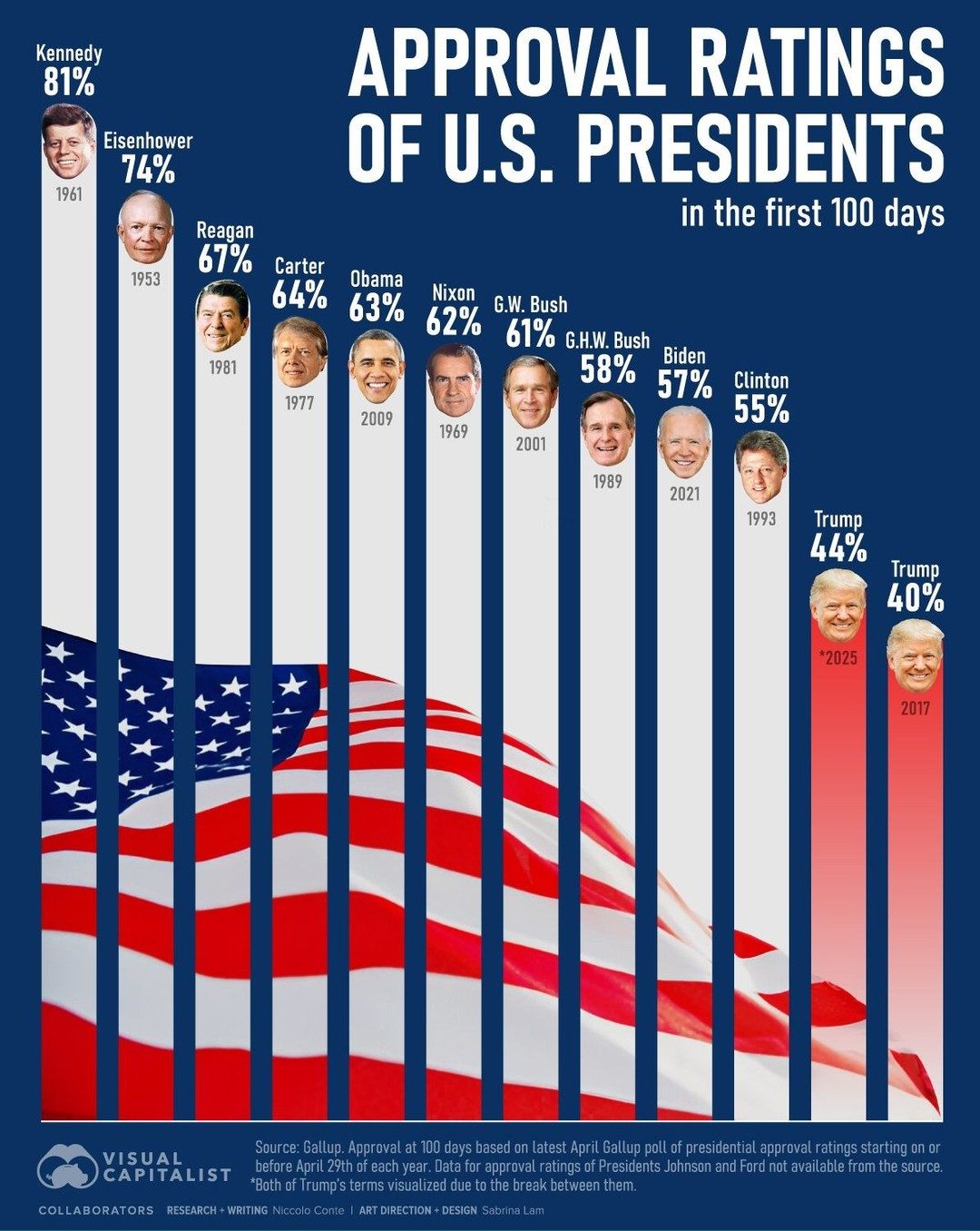
Presidential Approval Ratings: A Historical Perspective
Approval ratings are a crucial metric for evaluating a president's early performance in office. Since 1953, these ratings have provided valuable insights into public sentiment and political landscapes. Let's delve into the approval ratings of U.S. presidents during their first 100 days, highlighting key trends and notable performances.
Why This Matters
Understanding the first 100 days of a president's term is essential for several reasons. This period sets the tone for the administration's policies and public perception. High approval ratings can indicate strong public support and potential political capital. Conversely, low ratings may signal challenges and resistance to the president's agenda.
Historical Context
The average first-quarter approval rating since 1952 is 60%. The 100-day mark has been a significant milestone for many presidents, often serving as a litmus test for their early effectiveness. Approval ratings during this period can be influenced by a variety of factors, including political climate, economic conditions, and major events.
Notable Performances
Dwight D. Eisenhower
Eisenhower holds the highest approval rating at 81% in 1961. This remarkable start can be attributed to his leadership during the Korean War and his presidency at a time of relative economic stability. Eisenhower's popularity was reinforced by his military background and his perceived effectiveness in managing international relations.
John F. Kennedy
John F. Kennedy had an impressive 81% approval rating. His charisma, youthful energy, and strategic handling of the Bay of Pigs crisis and the Cuban Missile Crisis contributed to his strong initial approval. Kennedy's performance during these critical moments established him as a capable and decisive leader in the eyes of the American public.
Ronald Reagan
Ronald Reagan had a 74% approval rating. Reagan's optimistic vision for America and his strong conservative leadership style resonated with many voters. His ability to communicate effectively and his strategic handling of domestic and foreign policy issues contributed to his positive public perception.
Bill Clinton, George W. Bush, and Barack Obama
These presidents all had notably high approval ratings in their first 100 days, reflecting the public's initial support and confidence in their leadership. Clinton had a 57% approval, while George W. Bush had a 61% approval, and Barack Obama had a 63% approval. These ratings underscore the importance of a strong start in building public trust and support.
Donald Trump
Donald Trump's 44% approval rating marked one of the weakest starts to a presidential term in modern U.S. history. This low rating can be attributed to controversies surrounding his election and a series of divisive policies that polarized the public. Trump's subsequent term had a similar start with a 40% rating, indicating that his initial challenges persisted.
Joe Biden
Joe Biden's 58% approval rating reflects a more moderate start to his presidency. His initial focus on handling the COVID-19 pandemic and his efforts to promote bipartisan cooperation contributed to his relatively strong approval. However, his approval rating has seen fluctuations due to ongoing political challenges.
Factors Influencing Approval Ratings
Several factors influence a president's approval rating during the first 100 days. These include:
Economic Conditions
The state of the economy can significantly impact a president's approval rating. Economic growth, job creation, and low unemployment rates typically lead to higher approval ratings, while economic downturns can result in lower ratings.
Crisis Management
Effective crisis management, whether during natural disasters, economic crises, or international conflicts, can boost a president's approval. Conversely, poor handling of crises can lead to a significant drop in ratings.
Policy Initiatives
The success and popularity of a president's policy initiatives can influence their approval rating. If the public supports the initiatives and sees positive outcomes, the president's rating is likely to rise. However, if the initiatives are unpopular or fail to deliver on their promises, the rating may decline.
Public Perception and Media Coverage
Media coverage and public perception play a crucial role in shaping a president's approval rating. Positive media coverage and a favorable public image can enhance approval, while negative coverage and a poor public image can lead to a decrease in ratings.
Practical Tips for Analyzing Presidential Approval Ratings
Presidential approval ratings provide valuable insights into public sentiment and political dynamics. Here are some practical tips for analyzing these ratings:
- Contextual Understanding: Always consider the historical, economic, and political contexts when analyzing approval ratings.
- Trend Analysis: Look at trends over time to identify patterns and shifts in public opinion.
- Comparison with Previous Presidents: Compare a president's approval ratings with those of their predecessors to gain a broader perspective.
- Media and Polling Sources: Use reliable sources for media coverage and polling data to ensure accurate analysis.
Important Takeaways
Presidential approval ratings during the first 100 days offer crucial insights into public sentiment and political dynamics. Key takeaways include:
- High approval ratings can indicate strong public support and potential political capital.
- The first 100 days set the tone for the administration's policies and public perception.
- Economic conditions, crisis management, policy initiatives, and media coverage significantly influence approval ratings.
- Historical comparisons provide a broader perspective on a president's performance and public opinion.
Conclusion
The first 100 days of a president's term are pivotal in shaping public perception and political dynamics. High approval ratings, as seen with Eisenhower and Kennedy, indicate strong public support and effective leadership. Conversely, low ratings, such as those of Trump, highlight significant challenges and resistance to the president's agenda. By understanding the factors that influence these ratings and analyzing historical data, we can gain valuable insights into the complex dynamics of presidential leadership and public opinion.
Watch the Reel
Questions readers ask
Which U.S. presidents had the highest approval ratings during their first 100 days in office?
Dwight D. Eisenhower and John F. Kennedy both achieved the highest approval ratings during their first 100 days, with each reaching 81%. Their strong starts set a significant benchmark for subsequent presidents.
What is the average approval rating for U.S. presidents in their first 100 days since 1952?
Since 1952, the average approval rating for U.S. presidents during their first 100 days is approximately 60%. This average provides a baseline for understanding public sentiment and expectations for new administrations.
How did Donald Trump's approval ratings compare to other presidents during the first 100 days?
Donald Trump's approval rating during his first 100 days was around 45%, which was considerably lower than the historical average and placed him among the lower-ranking presidents in this metric.
What trends can be observed in presidential approval ratings during the first 100 days?
Trends in presidential approval ratings during the first 100 days often reflect the public's initial reactions to a president's policies, leadership style, and the broader political climate. High approval ratings generally indicate strong public support, while lower ratings may signal opposition or skepticism.
Why are the first 100 days of a presidency so significant?
The first 100 days are crucial because they set the stage for the administration's agenda and public perception. During this period, presidents often introduce key policies and initiatives, which can significantly impact their approval ratings and political capital throughout their term.
Which president had the lowest approval rating during their first 100 days?
The president with the lowest approval rating during this period was not specified. However, presidents who have struggled with low ratings early on, such as Donald Trump, often face challenges in implementing their agenda and garnering public support.
Related deep dives
Similar reads based on topic and creator.


Recent articles
Fresh deep dives from the latest Reels we unpacked.




Comments
Be the first to comment.