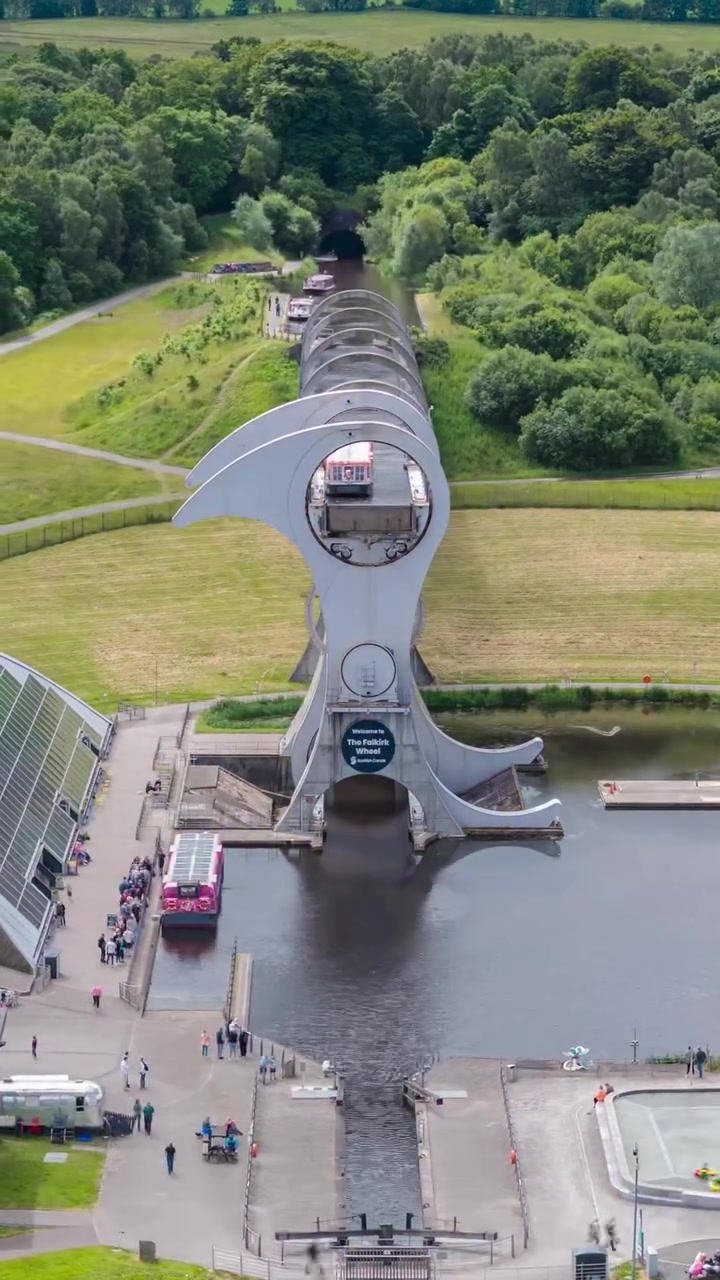
The Falkirk Wheel sits in central Scotland, and this is the largest rotating boat lift in the world. Intended to connect the Forth and Clyde Canal with the Union Canal, it does so with an elegant solution.
A Boat Lift Engineered for Efficiency
The Falkirk Wheel is a marvel of modern engineering, designed to overcome the 35-meter difference in height between the two canals and transport boats from one to the other. Unlike a traditional lock system that requires filling and emptying chambers with water, the Falkirk Wheel uses a rotating structure to lift boats. The wheel itself is 35 meters in diameter, making it the largest rotating boat lift in existence. Instead of passing through a series of locks that could take up to 13 hours or require pumping 300 tonnes of water, this lift lowers or raises boats in 30 minutes using a series of careful balances and hydraulic power. The lift also features two sets of gondolas that hold the boats. Each gondola rotates on an inclined plane. Both gondolas hold up to 600 litres of water, which helps balance the wheel and ensures the remotely controlled mechanism can lift or lower the boats. The wheel turns a full 180 degrees. Boats travel through its gondolas without needing to move relative to the gondolas because the gondolas are large enough to hold a standard-sized boat. The two gondolas are counterbalanced, which means their weights are equal; so the wheel does not require high power capacity to rotate. A hydraulic motor drives the rotation, and it is carefully controlled to ensure smooth and reliable operation. This rotational design distinguishes the Falkirk Wheel from linear canals, which require more extensive canals and larger ponds in lock systems. The entire structure has been designed to avoid labor-intensive, high energy-consuming locks, and it is aesthetically striking. This makes it the only canal lift system that affords spectacular sightseeing of the Scottish countryside.
The Viking-inspired Design
The Falkirk Wheel ingeniously incorporates structural features and colouring that evoke Viking-era engineering. The design is more than a nod to the rich Scottish history; it is functional. The focus on efficiency ensures minimal water usage, and the aerodynamic shape reduces the load on the wheel at high speeds. The Viking-inspired design helps the lift withstand harsh weather conditions without breaking down. It seamlessly fits into the Scottish landscape, blending with the traditional canal route. The wheel's vibrant colors make it a standout feature in the surrounding area while retaining the historically relevant architectural roots.
The Lonely Journey
Many Scottish waterways are remote. Once a boat enters the Falkirk Wheel, it is often isolated from the rest of the canal system for hours at a time. Though it is a major attraction, the Wheel could be considered a lonely feat. It is isolated from major city routes, and as a result, the paths around it are less busy than major city canals.
A Necessary Tool for Canal Routes
Historically, central Scotland’s waterways provided a lifeline for travel and trade. Before the Falkirk Wheel was built, boats had to navigate through busy urban areas to get from one canal to another. Tourists and locals alike can enjoy the natural beauty of the canals around the Wheel. The Falkirk Wheel is a vital part of the transport route because it allows boats to bypass areas with limited service and construction while still enjoying the natural beauty of the Scottish countryside. The Falkirk Wheel offers a memorable experience. The landscape around the wheel is lush with greenery and vibrant with birdsong. The path overlooks the surrounding countryside, creating an idyllic scene for an afternoon boat ride.
Pan-looks of the Falkirk Wheel
Lift-Off the Locks
The Falkirk Wheel can lift a boat for an equivalent of six lock systems while using 30% less energy. This energy efficiency is the outcome of careful water management. Every boat ride through the wheel saves thousands of tons of water. The wheel uses balanced water levels in the canals for its gondolas' movement, providing a cost-effective and energy-efficient way to transport boats.
Gondolas in Motion
Boats are transported through the wheel in gondolas that can carry up to 3 boats at once. The gondolas are equipped with innovative mechanisms that allow them to pivot, ensuring a smooth transition from the lower gondola to the upper gondola and vice versa. The gondolas act as a central axis of the wheel, ensuring that it can complete its crucial function efficiently.
Stepping into Memory
The Falkirk Wheel is a place for sightseeing, but it also offers educational opportunities. Schools and organizations can plan tours to learn about the wheel's engineering. The history of the wheel is also rich, reflecting the ingenuity of Scottish engineering. The wheel is not just a marvel of modern engineering but also a testament to the power of innovation and creativity in overcoming logistical challenges.
If You Are Boating
- Take a Boat Tour: To get an up-close experience of the wheel’s function, book a boat tour to experience the lift-through.
- Plan a Picnic:
- Advise amateurs to opt for the simple gondola system experience. This can be a fun option for families. The tour guide will also provide information.
- Visit the Wheel: A full tour of the wheel itself is possible.
- Tours and Trails: There are well-maintained walking trails around the wheel. The views of the wheel and surrounding countryside are scenic.
Engineer's Gaze
The Falkirk Wheel deserves to be considered the pinnacle of engineering innovation. It solves a particular canal problem with an exceptional solution while also serving as a tourist attraction. This design is a marvelous blend of engineering and nature.
Watch the Reel
Questions readers ask
How does the Falkirk Wheel compare to traditional lock systems?
The Falkirk Wheel is far more efficient than traditional lock systems. Traditional locks require filling and emptying chambers with water, a process that can take up to 13 hours and use 300 tonnes of water. In contrast, the Falkirk Wheel lifts or lowers boats in just 30 minutes using a rotating structure and hydraulic power, making it much faster and more water-efficient.
What makes the Falkirk Wheel stand out aesthetically?
The Falkirk Wheel's design is not only functional but also visually striking. Its Viking-inspired architecture and vibrant colors make it a standout feature in the Scottish landscape. The wheel's aerodynamic shape and efficient design allow it to blend seamlessly with the traditional canal route while offering a spectacular view of the surrounding countryside.
Can the Falkirk Wheel handle different types of boats?
Yes, the Falkirk Wheel is designed to accommodate standard-sized boats. Each gondola is large enough to hold a boat without the need for the boat to move relative to the gondola. This ensures a smooth and reliable operation for various types of boats.
How does the wheel's rotation work, and what powers it?
The Falkirk Wheel rotates on an inclined plane using a hydraulic motor. The two gondolas are counterbalanced, meaning their weights are equal, which allows the wheel to rotate smoothly without requiring high power capacity. The rotation is carefully controlled to ensure reliability and efficiency.
What is the significance of the wheel’s Viking-inspired design?
The Viking-inspired design of the Falkirk Wheel is more than just an aesthetic choice; it serves functional purposes. The design helps the lift withstand harsh weather conditions and reduces the load on the wheel at high speeds. It also fits well with the Scottish landscape, blending historical relevance with modern engineering.
Related deep dives
Similar reads based on topic and creator.

Recent articles
Fresh deep dives from the latest Reels we unpacked.



Comments
Be the first to comment.