AI-powered CAD Design
CAD design, or computer-aided design, is a cornerstone of modern engineering and manufacturing. It allows professionals to create precise 2D and 3D models, which are essential for producing anything from simple components to complex machinery. Traditionally, CAD design has been a time-consuming process, often requiring weeks of work to complete intricate designs. However, recent advancements in AI are revolutionizing this field by significantly reducing the time and effort required to create detailed CAD models.
Why This Matters
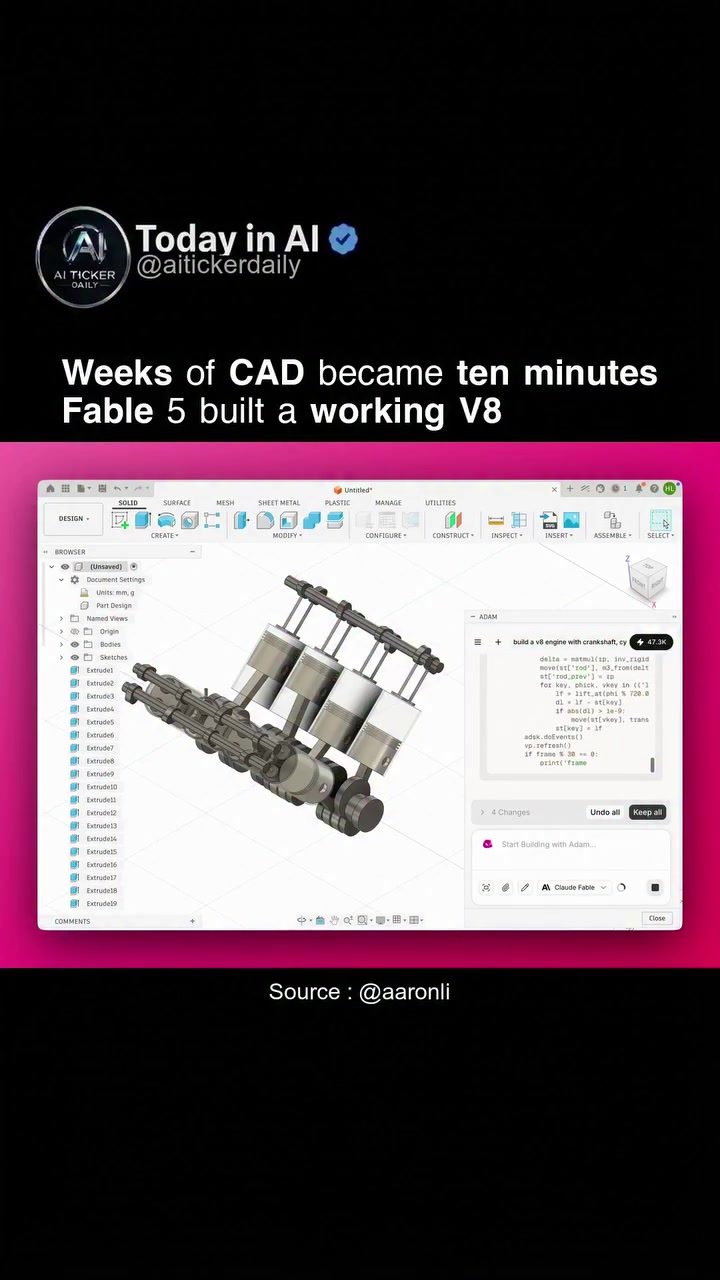
The integration of AI into CAD software is a game-changer for professionals in various industries. AI can automate repetitive tasks, optimize design processes, and generate accurate models in a fraction of the time it would take a human designer. This not only boosts productivity but also allows engineers and designers to focus on more creative and strategic aspects of their work. The potential for AI to accelerate CAD design is evident in tools like Fable 5, which demonstrates the creation of a complex engine model in just minutes.
Main Discussion
The Evolution of CAD Design
CAD software has evolved significantly since its inception. Early CAD systems were limited to 2D drafting and required extensive manual input. Over time, advancements in technology allowed for the creation of 3D models, which provided a more comprehensive visualization of designs. However, these advancements also increased the complexity of the design process, making it more time-consuming.
The Role of AI in CAD Design
AI is poised to transform CAD design by automating many of the manual tasks involved. For instance, AI can generate initial design concepts, optimize geometries for performance, and even simulate how a part will behave under various conditions. This automation not only speeds up the design process but also reduces the likelihood of human error, leading to more accurate and reliable designs.
Fable 5: A Case Study in AI-Powered CAD
Fable 5, a cutting-edge AI-powered CAD tool, has demonstrated the potential of AI in this field. In a recent demonstration, Fable 5 generated a fully working V8 engine model in under ten minutes. This is a stark contrast to the traditional process, which can take weeks of mechanical design, assemblies, and revisions. The software was able to create a complex model from a single prompt, showcasing the power of AI in automating and accelerating the design process. This level of efficiency has the potential to revolutionize how engineers and designers approach their work, making the design process faster and more efficient.
Practical Applications
AI-powered CAD tools can be particularly beneficial in industries where time and precision are critical. For example, in the automotive industry, where complex engine designs are common, AI can help reduce the time required to develop new models. Similarly, in aerospace, where the design of aircraft components must be incredibly precise, AI can help ensure that models meet stringent performance and safety standards.
The Future of CAD Design
As AI continues to advance, the capabilities of CAD software are expected to grow even further. Future iterations of AI-powered CAD tools may be able to handle even more complex tasks, such as designing entire systems or optimizing entire manufacturing processes. This continued evolution will likely lead to a more integrated and streamlined approach to design and manufacturing, benefiting a wide range of industries.
Practical Tips
For those interested in leveraging AI-powered CAD tools, here are some practical tips to get started:
- Choose the Right Tool: Select a CAD software that offers robust AI capabilities. Tools like Fable 5 are designed to automate and streamline the design process, making them ideal for complex tasks.
- Leverage AI for Initial Concepts: Use AI to generate initial design concepts, which can save time and provide a strong foundation for further refinement.
- Optimize Geometries: Utilize AI to optimize the geometry of your designs, ensuring that they meet performance and safety standards.
- Simulate Performance: Take advantage of AI's ability to simulate how a part will behave under various conditions, allowing you to identify potential issues before manufacturing.
- Stay Updated: Keep up with the latest advancements in AI-powered CAD tools. As the technology continues to evolve, new features and capabilities are likely to emerge, offering even more benefits to users.
Important Takeaways
AI-powered CAD design is poised to revolutionize the way engineers and designers approach their work. By automating many of the manual tasks involved in the design process, AI can significantly reduce the time and effort required to create detailed and accurate models. Tools like Fable 5 demonstrate the potential of AI in this field, showcasing how complex designs can be generated in a fraction of the time it would take traditional methods.
Conclusion
As AI continues to integrate more deeply into CAD software, the possibilities for innovation and efficiency are vast. Whether you're an engineer, a designer, or a project manager, embracing AI-powered CAD tools can provide a competitive edge, allowing you to complete projects more quickly and with greater precision. The future of CAD design is here, and it's more powerful and efficient than ever before.
Watch the Reel
Questions readers ask
How does AI speed up the CAD design process?
AI accelerates CAD design by automating repetitive tasks and optimizing processes. This means that complex models, which once took weeks to create, can now be generated in mere minutes. Engineers and designers can focus on more strategic and creative aspects of their work, rather than spending endless hours on detailed drafting.
What kinds of tasks can AI automate in CAD modeling?
AI can automate a wide range of tasks in CAD modeling, including generating initial design concepts, creating precise 2D and 3D models, and even producing detailed simulations. This automation extends to tasks like optimizing design parameters, identifying potential design flaws, and ensuring compliance with industry standards.
Can AI help in designing complex machinery like engines?
Yes, AI is particularly effective in designing complex machinery. For instance, AI can assist in creating intricate engine models by automating the generation of detailed components and their assemblies. This not only speeds up the design process but also ensures high precision and accuracy in the models.
What benefits does AI integration bring to the CAD design process?
AI integration in CAD design offers numerous benefits, including significant time savings, improved accuracy, and the ability to handle intricate designs more efficiently. It allows professionals to produce high-quality models faster, which can lead to quicker prototyping and faster time-to-market for products.
How does AI transform the workflow for engineers and designers in manufacturing?
AI transforms the workflow by taking over mundane and repetitive tasks, allowing engineers and designers to focus on more creative and strategic activities. This shift in workflow can lead to more innovative designs and a more efficient design process, ultimately benefiting the manufacturing pipeline.
Can AI-powered CAD tools be used by professionals without extensive AI knowledge?
Yes, AI-powered CAD tools are designed to be user-friendly, even for professionals without extensive AI knowledge. These tools often come with intuitive interfaces and built-in AI capabilities that automate complex tasks, making them accessible to a wide range of users in the engineering and manufacturing fields.
What are the key advantages of using AI in CAD modeling for engineering professionals?
The key advantages include faster design iterations, higher precision in models, and the ability to handle complex designs with ease. AI also provides valuable insights and suggestions for design optimization, enabling engineers to create more efficient and effective products.
Related deep dives
Similar reads based on topic and creator.




Recent articles
Fresh deep dives from the latest Reels we unpacked.




Comments
Be the first to comment.