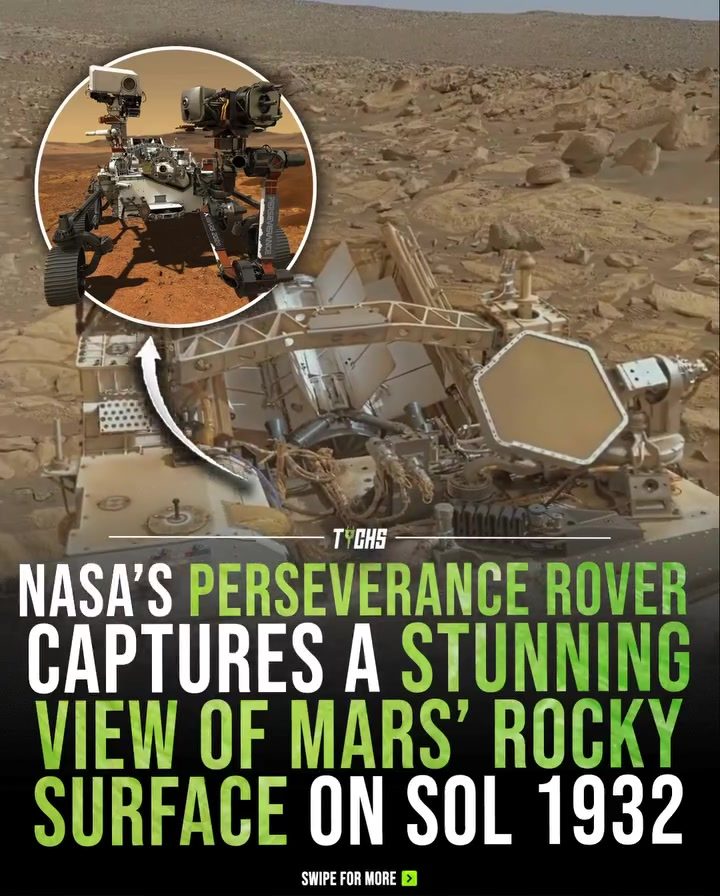
Mars Rover Image: Unveiling the Rocky Surface of Mars
NASA's Perseverance rover has provided us with a stunning view of Mars' rocky surface, captured on Sol 1932. This remarkable image, taken from around 140 million miles away, offers a unique perspective on the Red Planet's landscape. Powered by a radioisotope thermoelectric generator, the rover is designed to explore and study the planet's rocks, soil, and ancient environment, providing invaluable insights into Mars' geological history.
Context / Why this matters
The Perseverance rover's mission to Mars is a testament to human ingenuity and technological advancement. The rover, launched on July 30, 2020, landed on Mars on February 18, 2021, and has since been exploring the Jezero crater, an ancient lake bed that scientists believe could hold evidence of past microbial life. The images captured by Perseverance offer a glimpse into the planet's geological past and help scientists understand the potential for life beyond Earth. The rover's mission is crucial for advancing our knowledge of Mars and paving the way for future human exploration.
Main discussion
The image captured by the Perseverance rover on Sol 1932 showcases the rocky surface of Mars, providing a detailed view of the planet's terrain. The rover's ability to capture such high-quality images is a result of its advanced imaging system, which includes multiple cameras designed for different purposes. These cameras allow the rover to capture panoramic views, close-ups, and even 3D images of the Martian landscape.
The rover's power source
The Perseverance rover is powered by a radioisotope thermoelectric generator (RTG), a type of nuclear battery that converts heat from the decay of plutonium-238 into electricity. This power source is crucial for the rover's operation on Mars, as it allows the rover to function continuously without relying on sunlight, which is limited on Mars due to its distance from the sun and frequent dust storms. The RTG provides a steady source of power, enabling the rover to operate autonomously and complete its scientific missions.
The rover's mission
The Perseverance rover's primary mission is to search for signs of ancient life and collect samples of Martian rocks and soil for potential return to Earth. The rover is equipped with a suite of scientific instruments designed to analyze the planet's geology, atmosphere, and potential biosignatures. These instruments include cameras, spectrometers, and a ground-penetrating radar system that can detect subsurface water and ice.
The rover's cameras
The Perseverance rover is equipped with multiple cameras designed for different purposes, including navigation, scientific imaging, and engineering. The rover's Mastcam-Z camera system, for example, is capable of capturing high-resolution, 360-degree panoramic images, as well as stereoscopic 3D images. The Mastcam-Z system is also equipped with a zoom lens, allowing the rover to capture detailed images of distant objects. Other cameras on the rover, such as the SuperCam and SHERLOC cameras, are designed for scientific imaging and can capture close-up images of rocks and soil, as well as analyze their chemical composition.
Practical tips
While the Perseverance rover's mission is a testament to human ingenuity and technological advancement, there are several practical tips we can learn from its operation on Mars. Here are a few tips for those interested in exploring the potential for life beyond Earth and understanding the planet's geological history.
Research and planning
One of the key aspects of the Perseverance rover's mission is the extensive research and planning that went into its design and operation. The rover's scientific instruments and cameras were carefully selected and designed to meet specific scientific goals, and the rover's mission was carefully planned to maximize its chances of success. By conducting thorough research and planning, we can ensure that our exploration of Mars and other planets is both efficient and effective.
Collaboration and teamwork
The Perseverance rover's mission is a collaborative effort involving scientists, engineers, and technicians from around the world. The rover's success is a testament to the power of collaboration and teamwork, as experts from different disciplines work together to achieve a common goal. By fostering collaboration and teamwork in our own endeavors, we can achieve greater success and make meaningful contributions to our understanding of the universe.
Adaptability and resilience
The Perseverance rover's mission is also a testament to the importance of adaptability and resilience. The rover's design allows it to adapt to the challenges of operating on Mars, such as the harsh environment and limited sunlight. The rover's ability to adapt and overcome these challenges is crucial for its success, and it serves as a reminder of the importance of adaptability and resilience in our own endeavors.
Important takeaways
The images captured by the Perseverance rover on Sol 1932 offer a unique perspective on the rocky surface of Mars, providing valuable insights into the planet's geological history. The rover's mission is a testament to human ingenuity and technological advancement, and it serves as a reminder of the importance of research, planning, collaboration, teamwork, and adaptability in our own endeavors. By continuing to explore Mars and other planets, we can gain a deeper understanding of the universe and our place within it.
Conclusion
The image of Mars' rocky surface captured by the Perseverance rover on Sol 1932 is a remarkable achievement in space exploration. It showcases the planet's terrain in stunning detail and provides valuable insights into its geological history. The rover's mission, powered by a radioisotope thermoelectric generator, is a testament to human ingenuity and technological advancement. As we continue to explore Mars and other planets, we can learn from the rover's mission and apply these lessons to our own endeavors. The future of space exploration is bright, and the Perseverance rover's mission is a significant step forward in our quest to understand the universe and our place within it.
Watch the Reel
Questions readers ask
What makes the Perseverance rover's Sol 1932 images significant?
The Sol 1932 images are significant because they provide an unprecedented view of the Jezero crater's rocky terrain. This detailed imagery helps scientists better understand the geological history of Mars and the potential signs of past microbial life in the crater, which was an ancient lake bed.
How does the Perseverance rover capture images of Mars?
The Perseverance rover is equipped with advanced cameras designed to capture high-resolution images of the Martian surface. These cameras work in tandem with the rover's sophisticated technology, allowing it to navigate and study the unique landscape of Mars' rocky terrain.
What is the Perseverance rover's power source and why is it important?
The Perseverance rover is powered by a radioisotope thermoelectric generator (RTG), which converts heat from the natural decay of plutonium-238 into electricity. This nuclear-powered source is crucial for the rover's operations, as it provides a reliable and long-lasting energy supply, essential for sustained exploration and data collection on Mars.
Why is the Jezero crater a key location for the Perseverance rover's mission?
The Jezero crater is a key location because it is believed to have once been an ancient lake bed, making it an ideal site to search for potential signs of past microbial life on Mars. The rover's exploration of this area aims to uncover geological evidence and potentially sample Martian rocks and soil for future analysis.
What insights can the Perseverance rover's images provide about Mars' geological history?
The images captured by the Perseverance rover offer detailed views of Mars' rocky terrain, revealing the planet's geological features and processes. By studying these images, scientists can gain valuable insights into Mars' past environments, climate changes, and the potential for habitability.
How does the Perseverance rover contribute to our understanding of Mars' surface?
The Perseverance rover contributes to our understanding of Mars' surface through its advanced imaging capabilities and nuclear-powered operations. By capturing high-resolution images and studying the geological features of the Jezero crater, the rover provides a comprehensive view of the Red Planet's landscape, aiding in the research of its past environments and potential biosignatures.
Recent articles
Fresh deep dives from the latest Reels we unpacked.




Comments
Be the first to comment.