Monorail Technology
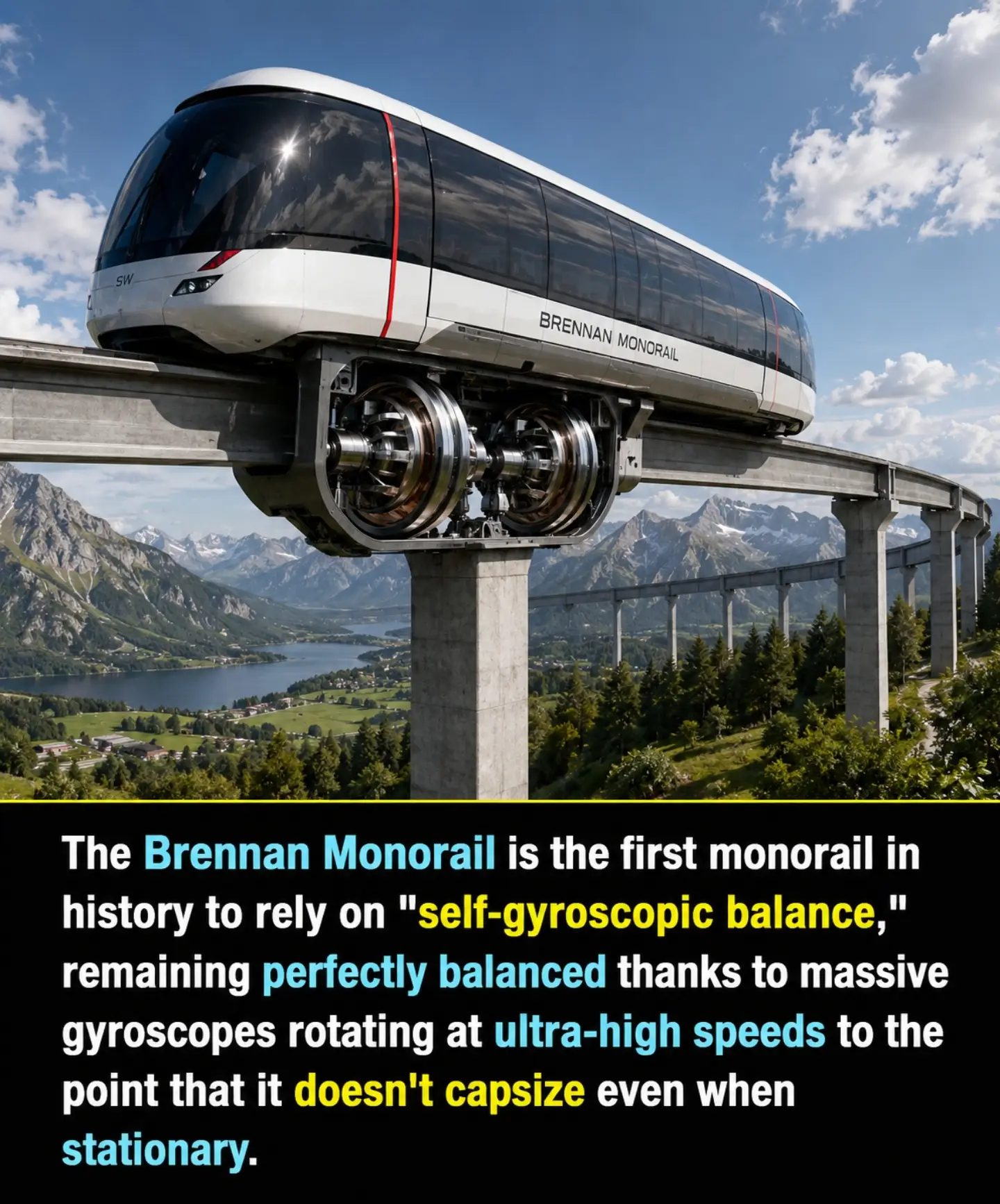
Monorail systems have long captivated imaginations with their sleek, futuristic design and efficient single-rail operation. Among the most innovative advancements in monorail technology is the self-gyroscopic balance system, a groundbreaking feature that sets certain monorails apart from traditional designs. The Brennan Monorail, in particular, exemplifies this cutting-edge technology.
Context / Why this matters
Monorails are a type of railway in which the track consists of a single rail. Traditional monorails rely on various mechanisms to maintain stability, often involving complex and heavy structures. However, the self-gyroscopic balance system represents a significant leap forward in monorail engineering. This technology uses massive gyroscopes rotating at ultra-high speeds to maintain perfect balance, even when the monorail is stationary. This innovation addresses one of the primary challenges in monorail design: stability. By eliminating the need for traditional balancing mechanisms, self-gyroscopic balance systems allow for lighter, more efficient, and potentially more cost-effective monorail designs. This makes them an attractive option for urban transportation systems, theme parks, and other applications where stability and efficiency are paramount.
Main discussion
The Science Behind Self-Gyroscopic Balance
Gyroscopes are devices that use the principles of angular momentum to maintain orientation. In the context of monorails, massive gyroscopes are integrated into the design to provide stability. These gyroscopes rotate at extremely high speeds, creating a powerful stabilizing force. The key to their effectiveness lies in their ability to counteract external forces that could otherwise cause the monorail to tip or sway.
Traditional monorails often rely on mechanical balancing systems, such as counterweights or stabilizer bars, which can add significant weight and complexity to the design. In contrast, the self-gyroscopic balance system streamlines the process, using the rotational inertia of the gyroscopes to provide a constant stabilizing force.
Advantages of Self-Gyroscopic Balance Systems
One of the most compelling advantages of self-gyroscopic balance systems is their ability to maintain stability even when the monorail is stationary. This is particularly important in urban environments where monorails may need to stop frequently at stations or intersections. The continuous rotation of the gyroscopes ensures that the monorail remains perfectly balanced, reducing the risk of accidents and enhancing passenger safety.
Additionally, the self-gyroscopic balance system allows for a more efficient use of space. Traditional monorails often require additional structures to support balancing mechanisms, which can be bulky and aesthetically unpleasing. In contrast, the self-gyroscopic balance system integrates seamlessly into the monorail's design, resulting in a sleek and modern appearance. This makes it an attractive option for urban planners and developers looking to integrate monorails into their infrastructure.
Applications and Future Prospects
The Brennan Monorail, with its self-gyroscopic balance system, is a prime example of how this technology can be applied in real-world settings. Theme parks, airports, and other large-scale facilities are particularly well-suited for monorails with self-gyroscopic balance systems. These environments often require efficient, reliable, and aesthetically pleasing transportation solutions that can handle high volumes of traffic.
As the technology continues to evolve, we can expect to see more monorails incorporating self-gyroscopic balance systems. Advances in materials science and engineering may lead to even more efficient and stable designs, further enhancing the appeal of monorails as a mode of transportation.
Practical tips
-
Consider the Terrain: When planning a monorail route, take into account the terrain and potential obstacles. Self-gyroscopic balance systems are particularly effective in maintaining stability on uneven or sloping terrain, making them a versatile option for various environments.
-
Evaluate Traffic Patterns: Monorails with self-gyroscopic balance systems are well-suited for high-traffic areas where frequent stops are required. Evaluate the traffic patterns in your area to determine if a self-gyroscopic balance monorail would be a good fit.
-
Assess Aesthetic Preferences: The sleek and modern design of monorails with self-gyroscopic balance systems makes them an attractive option for aesthetically conscious developments. Consider how the monorail's appearance will integrate with the surrounding architecture and landscape.
-
Evaluate Cost and Maintenance Requirements: While self-gyroscopic balance systems offer numerous advantages, it is important to evaluate the cost and maintenance requirements. Consult with engineers and designers to ensure that the monorail aligns with your budget and operational needs.
Important takeaways
Monorails with self-gyroscopic balance systems represent a significant advancement in transportation technology. Their ability to maintain perfect balance, even when stationary, makes them a reliable and efficient option for various applications. Theme parks, airports, and urban environments can all benefit from the stability, efficiency, and aesthetic appeal of self-gyroscopic balance monorails. As the technology continues to evolve, we can expect to see even more innovative applications and improvements, further solidifying the monorail's place in modern transportation systems.
Conclusion
Monorails with self-gyroscopic balance systems like the Brennan Monorail offer a unique blend of stability, efficiency, and aesthetic appeal. By leveraging the principles of gyroscopic stabilization, these monorails provide a reliable and efficient transportation solution for a wide range of applications. As the technology continues to advance, monorails with self-gyroscopic balance systems are poised to play an increasingly important role in urban transportation, theme park design, and other specialized settings. Whether you are a transportation planner, an engineer, or simply a technology enthusiast, the self-gyroscopic balance system represents a fascinating and practical innovation in the world of monorails.
Watch the Reel
Questions readers ask
How does the Brennan Monorail's self-gyroscopic balance system work?
The Brennan Monorail uses ultra-high-speed rotating gyroscopes to maintain stability. These gyroscopes create a stabilizing force that counteracts any tilting or swaying, ensuring the monorail remains perfectly balanced without the need for traditional balancing mechanisms. This results in a smoother, more efficient ride.
What advantages does the self-gyroscopic balance system offer over traditional monorail stability systems?
The self-gyroscopic balance system in the Brennan Monorail provides several advantages. It reduces the need for heavy and complex balancing structures, making the monorail lighter and more streamlined. This leads to improved efficiency, lower operational costs, and a more cost-effective transportation solution for urban environments.
Why is gyroscopic stability important for monorail technology?
Gyroscopic stability is crucial for monorails because it addresses the primary challenge of maintaining balance on a single rail. Traditional monorails often struggle with stability issues, leading to discomfort for passengers and potential safety concerns. The gyroscopic balance system ensures a smooth and stable ride, enhancing overall performance and reliability.
Can the Brennan Monorail's gyroscopic balance system be applied to other types of transportation?
While the Brennan Monorail's gyroscopic balance system is specifically designed for monorail technology, the principles behind it could potentially be adapted for other types of transportation. Any system that requires precise balance and stability, such as certain types of trains or even some automotive technologies, could potentially benefit from similar gyroscopic technologies.
How does the Brennan Monorail's design contribute to efficient urban transportation?
The Brennan Monorail's revolutionary design, featuring its self-gyroscopic balance system, contributes to efficient urban transportation by offering a more streamlined and cost-effective solution. The reduced weight and complexity of the system lead to lower operational costs and better performance, making it an ideal choice for urban settings where space and resources are often limited.
What are the key benefits of using high-speed gyroscopes in the Brennan Monorail's balance system?
The use of high-speed gyroscopes in the Brennan Monorail's balance system provides several key benefits. These gyroscopes generate a powerful stabilizing force that maintains the monorail's balance without the need for additional mechanical components. This results in a lighter, more efficient, and cost-effective monorail system, suitable for modern urban transportation needs.
How does the self-gyroscopic balance system enhance the passenger experience on the Brennan Monorail?
The self-gyroscopic balance system enhances the passenger experience by providing a smooth and stable ride. Passengers can enjoy a more comfortable journey without the discomfort and safety concerns often associated with traditional monorail stability systems. This improved passenger experience makes the Brennan Monorail an attractive option for urban commuters.
Related deep dives
Similar reads based on topic and creator.




Recent articles
Fresh deep dives from the latest Reels we unpacked.




Comments
Be the first to comment.