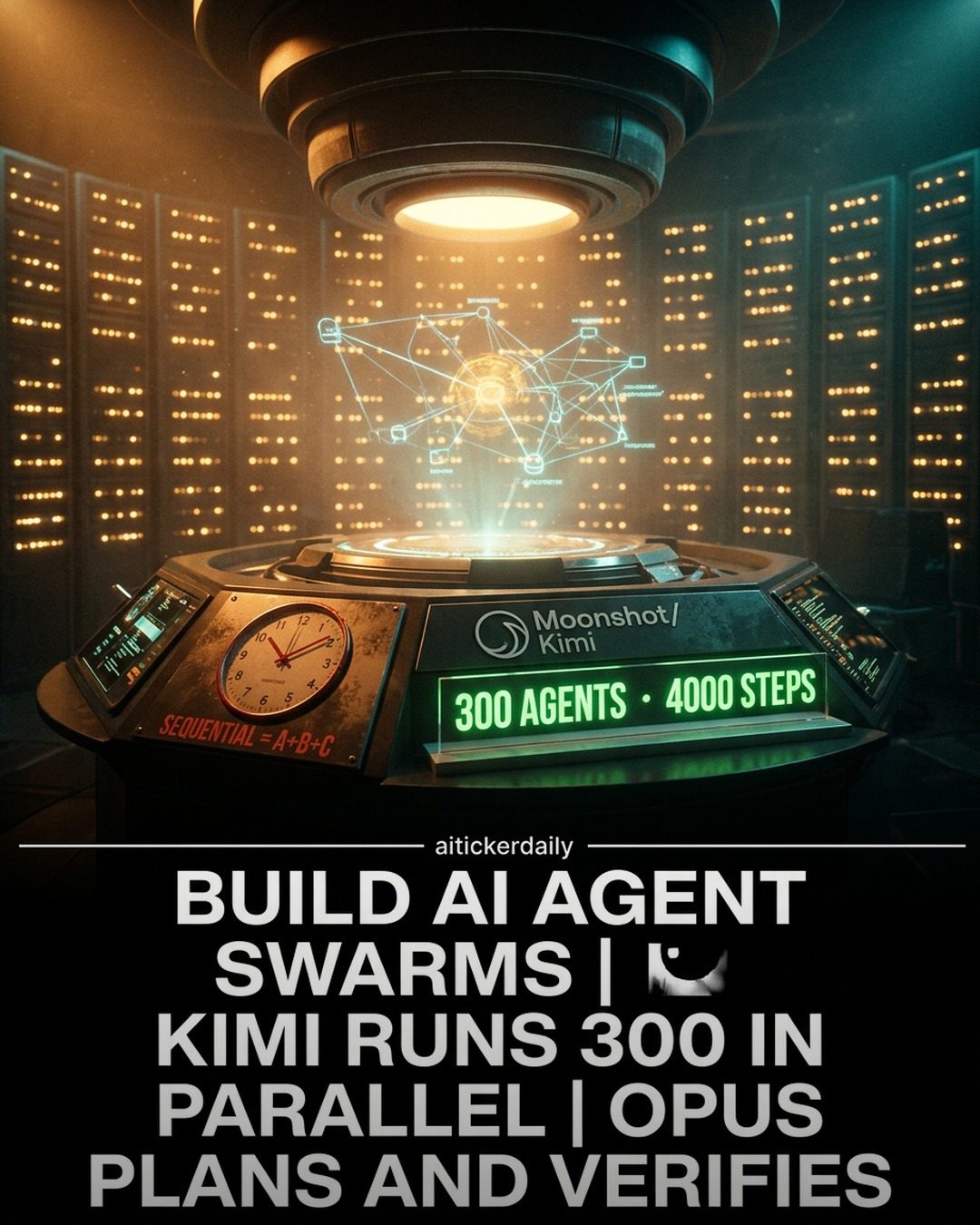
AI Agent Swarms: Orchestrating Parallel Subagents
AI agent swarms are a cutting-edge approach in the realm of technology, leveraging the power of orchestration and parallel processing to handle complex tasks efficiently. This method involves multiple subagents working together, managed by an orchestrator. Let's delve into the key components and functionalities of AI agent swarms, particularly focusing on Kimi, Opus, and the underlying infrastructure.
Why This Matters
AI agent swarms represent a significant leap forward in how we approach large-scale, intricate tasks. By coordinating multiple subagents, these systems can handle vast amounts of data and execute complex processes more efficiently than traditional single-agent systems. This capability has far-reaching implications for industries such as data analysis, automation, and artificial intelligence research.
The Components of AI Agent Swarms
Kimi 2.6
Kimi 2.6 is a powerful AI model designed for execution within AI agent swarms. It utilizes a Mixture of Experts (MoE) architecture, boasting a whopping 1.04 trillion parameters and 32 billion active tokens. This configuration allows Kimi 2.6 to handle an impressive 300 subagents in parallel, each capable of executing up to 4,000 steps. The model is trained using Parallel Orchestrator Reinforcement Learning (PARL), ensuring high levels of parallelism and efficiency.
Kimi 2.6 is built on a modified MIT license, which is crucial for its deployment and integration. The model runs on NVIDIA H100 GPUs and supports OpenAI-compatible APIs via vLLM and SGLang. This makes it highly versatile and compatible with existing AI frameworks, facilitating seamless integration into various applications.
Opus for Planning and Verification
Claude Opus 4.8 plays a critical role in the planning and verification processes within AI agent swarms. Opus focuses on reducing errors by adopting a plan/verify approach, ensuring that the orchestration and execution phases are meticulously planned and verified. This dual-functionality enhances the overall reliability and accuracy of the swarm's operations.
Mooncake Infrastructure
The Mooncake infrastructure provides the foundational support for AI agent swarms. It encompasses various patterns and guardrails that govern the behavior and interactions of the subagents. These patterns and guardrails are essential for maintaining the stability and performance of the system, ensuring that the swarm operates efficiently and effectively.
Execution and Parallelism
AI agent swarms excel in handling large-scale tasks through parallel execution. The orchestration process involves managing multiple subagents, each executing a specific task. This parallelism allows the system to handle complex workloads more efficiently than traditional sequential processing. The sequential process, on the other hand, involves executing tasks one after the other, which is less efficient for large-scale operations.
Practical Tips for Implementing AI Agent Swarms
Implementing AI agent swarms requires a strategic approach to ensure optimal performance and reliability. Here are some practical tips to get you started:
Prototyping
Before deploying a full-scale AI agent swarm, it's advisable to prototype a smaller pipeline. For instance, start with a three-agent pipeline to test the swarm's capabilities and identify potential bottlenecks. This step is crucial for refining the system before scaling up to a full swarm.
Choosing the Right Tools
Selecting the right tools and frameworks is essential for building an effective AI agent swarm. Kimi 2.6, with its MoE architecture and PARL training, is a robust choice for execution. Meanwhile, Opus 4.8 provides the necessary planning and verification capabilities. Ensuring compatibility with existing infrastructure and frameworks, such as those supported by Kimi 2.6, will streamline the integration process.
Designing Patterns and Guardrails
Patterns and guardrails are integral to the functioning of AI agent swarms. Designing effective patterns ensures that subagents interact harmoniously, while guardrails prevent errors and maintain system stability. These components should be carefully tailored to the specific requirements of your application to maximize efficiency and reliability.
Important Takeaways
AI agent swarms, with their orchestration and parallel processing capabilities, are revolutionizing how we approach complex tasks. Here are the key takeaways:
- Orchestration and Parallelism: AI agent swarms leverage orchestration and parallelism to handle large-scale, intricate tasks more efficiently than traditional single-agent systems.
- Kimi 2.6 and Opus 4.8: Kimi 2.6 is designed for execution, while Opus 4.8 handles planning and verification, ensuring a robust and reliable system.
- Mooncake Infrastructure: The Mooncake infrastructure provides the necessary patterns and guardrails to maintain system stability and performance.
- Prototyping and Testing: Prototyping a smaller pipeline before full deployment is crucial for identifying and addressing potential issues early on.
Conclusion
AI agent swarms offer a powerful and efficient way to manage complex tasks through orchestration and parallel processing. By leveraging models like Kimi 2.6 and Opus 4.8, along with the Mooncake infrastructure, these systems can handle vast amounts of data and execute intricate processes seamlessly. Whether you're in data analysis, automation, or AI research, understanding and implementing AI agent swarms can significantly enhance your capabilities and efficiency.
Watch the Reel
Questions readers ask
What are AI swarms and how do they work?
AI swarms are groups of multiple AI subagents that work together in parallel. They are orchestrated by a central component to complete complex tasks. Kimi and Opus are examples of such subagents that can be orchestrated for tasks. The parallel execution of these subagents allows for increased efficiency and faster processing of large-scale tasks.
What is the role of an orchestrator in AI swarms?
The orchestrator in AI swarms is a crucial component that manages and coordinates the activities of multiple subagents. It ensures that each subagent is assigned appropriate tasks, communicates effectively with others, and maintains a cohesive workflow. This coordination allows the swarm to operate efficiently and effectively, achieving results that would be difficult for a single AI to accomplish.
How do Kimi and Opus contribute to AI swarms?
Kimi and Opus are specific AI subagents designed to work within an AI swarm. They contribute by executing parallel tasks, sharing data, and communicating with the orchestrator to ensure smooth operation. Their role in the swarm involves various aspects of AI task orchestration, such as data analysis and automation, thereby enhancing the overall efficiency of the system.
What are the benefits of using AI swarms for data analysis?
AI swarms offer several benefits for data analysis, including the ability to handle large datasets more efficiently. By using multiple subagents, AI swarms can process data in parallel, leading to faster and more accurate results. Additionally, the orchestration capabilities of AI swarms ensure that data is analyzed comprehensively and systematically, reducing the time and resources required.
What is the significance of parallel execution in AI swarms?
Parallel execution is a key feature of AI swarms that enables multiple subagents to perform tasks simultaneously. This approach significantly reduces the time required to complete complex tasks by distributing the workload across many subagents. Parallel execution also enhances the robustness of the system, as tasks can continue to be processed even if some subagents face issues.
What are the potential applications of AI swarms in AI research?
AI swarms have a wide range of applications in AI research, including the development of advanced AI algorithms and models. Researchers can utilize AI swarms to test and validate new approaches to AI task orchestration, swarm intelligence, and parallel AI processing. This allows for the exploration of new AI capabilities and the refinement of existing techniques, pushing the boundaries of what AI can achieve.
How do AI swarms enhance automation processes?
AI swarms enhance automation processes by enabling multiple subagents to work together on complex tasks. This collaborative approach allows for more efficient and effective automation, as tasks can be broken down and executed in parallel. The orchestration of AI subagents ensures that automation processes are streamlined, reducing errors and improving overall performance.
Related deep dives
Similar reads based on topic and creator.




Recent articles
Fresh deep dives from the latest Reels we unpacked.




Comments
Be the first to comment.