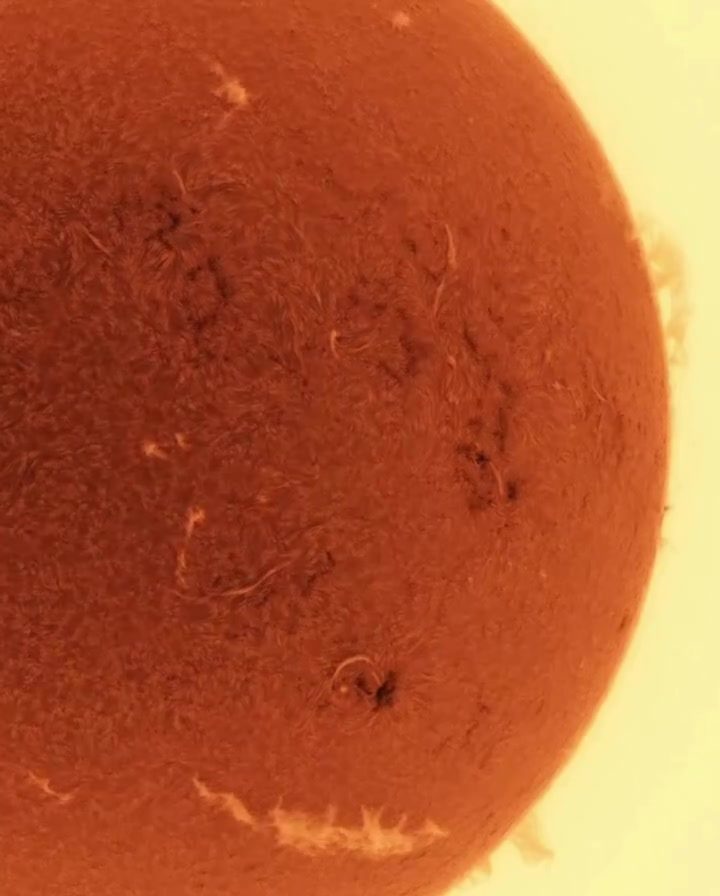
Solar Flares and Sunspots: Unveiling the Sun's Dynamic Atmosphere
The sun, our closest star, is a dynamic and turbulent celestial body that never ceases to amaze with its intricate details. Solar flares and sunspots are two of the most captivating features that reveal the sun's complex and ever-changing atmosphere. These phenomena offer valuable insights into the sun's magnetic fields, energy release, and overall behavior, which can impact space weather and, consequently, our planet. Understanding these features helps us appreciate the sun's role in our solar system and its influence on Earth's environment.
Why This Matters
The study of solar flares and sunspots is crucial for several reasons. Firstly, these phenomena can have significant effects on Earth's climate and technology. Solar flares, for instance, are intense bursts of radiation that can disrupt satellite communications, GPS signals, and power grids. Understanding their behavior helps in predicting and mitigating these disruptions. Secondly, sunspots provide a window into the sun's magnetic activity, aiding in the study of solar cycles and long-term climate changes. Lastly, observing these features helps us better comprehend the mechanisms behind stellar activity, which is essential for understanding the broader universe.
Solar Flares: Intense Bursts of Energy
What Are Solar Flares?
Solar flares are sudden, intense bursts of energy that occur on the sun's surface. They are typically associated with sunspots and are the result of the sudden release of magnetic energy stored in the sun's atmosphere. Flares can release a tremendous amount of energy, equivalent to millions of hydrogen bombs, and can last from minutes to hours.
Types of Solar Flares
Solar flares are classified based on their peak soft X-ray flux near Earth. The most common classification system uses the letters A, B, C, M, and X, with each letter representing a tenfold increase in energy output. For example, an M-class flare is ten times more powerful than a C-class flare, and an X-class flare is ten times more powerful than an M-class flare. Each of these classes is further divided into subcategories from 1 to 9, with X-class flares sometimes exceeding 9 and being labeled as X10, X20, and so on.
Impact on Earth
When solar flares occur, they can emit a variety of energetic particles, including protons and electrons, which can travel through space and interact with Earth's magnetic field. This interaction can lead to geomagnetic storms, which can disrupt satellite operations, communication systems, and power grids. Additionally, solar flares can cause auroras, the beautiful and colorful light displays visible in the sky near the Earth's poles.
Sunspots: Cooler Regions on the Sun's Surface
What Are Sunspots?
Sunspots are temporary phenomena on the sun's photosphere that appear as darker spots compared to the surrounding regions. They are cooler regions caused by intense magnetic activity that inhibits convection, the process by which heat is transferred from the sun's core to its surface. Sunspots can vary in size and shape, ranging from small pores to large sunspot groups that cover vast areas of the sun's surface. Sunspots are typically associated with strong magnetic fields and are often the sites of solar flares.
Structure of Sunspots
Sunspots have a distinct structure composed of two main parts: the umbra and the penumbra. The umbra is the darker, central region of a sunspot, where the magnetic field is strongest, and the temperature is significantly lower than the surrounding photosphere. The penumbra is the lighter, outer region that surrounds the umbra and has a more complex magnetic structure. The penumbra is also cooler than the surrounding photosphere but not as cool as the umbra.
Sunspot Cycles
Sunspots exhibit a cyclical behavior known as the solar cycle, which typically lasts about 11 years. During the solar maximum, the number of sunspots is at its peak, and the sun's activity is at its most intense. Conversely, during the solar minimum, the number of sunspots is at its lowest, and the sun's activity is relatively quiet. This cyclical behavior has been observed for centuries and is closely monitored by astronomers to study the sun's long-term behavior and its impact on Earth's climate.
Granulation Patterns: The Sun's Surface Texture
What Are Granulation Patterns?
Granulation patterns are the small, cellular-like structures visible on the sun's surface. These patterns are the result of convective cells, where hot plasma rises to the surface, cools, and then sinks back down. The granular structure provides a visual representation of the sun's dynamic and turbulent nature. Each granule is typically about 1,000 kilometers across and lasts for about 8 to 20 minutes before dissipating.
Importance of Granulation Patterns
Studying granulation patterns helps scientists understand the dynamics of the sun's atmosphere and the mechanisms behind energy transfer from the sun's core to its surface. These patterns also provide insights into the sun's magnetic fields and their role in shaping the solar atmosphere. By analyzing granulation patterns, scientists can better predict solar activity and its potential impact on Earth's environment.
Practical Tips for Observing Solar Flares and Sunspots
Observing solar flares and sunspots is a fascinating hobby that can be enjoyed by both amateur and professional astronomers. Here are some practical tips to get you started:
Safety First
Never look directly at the sun with the naked eye or through an unfiltered telescope. The sun's intense light can cause permanent eye damage. Always use proper solar filters designed for safe solar observation, such as solar eclipse glasses or specialized solar telescopes.
Choosing the Right Equipment
For observing solar flares and sunspots, a telescope or binoculars with a solar filter is essential. Look for equipment specifically designed for solar observation, as regular filters may not provide sufficient protection. High-quality solar telescopes, such as those equipped with hydrogen-alpha filters, offer detailed views of the sun's surface and can reveal intricate details of solar flares and granulation patterns.
Timing Your Observations
The best time to observe the sun is during periods of high solar activity, such as during the solar maximum. During this phase, there are more sunspots and solar flares, providing a richer viewing experience. However, even during the solar minimum, there are still plenty of interesting features to observe, including granulation patterns and occasional sunspots.
Recording Your Observations
Keeping a record of your observations can help you track changes in solar activity over time. Use a sketchbook or photography equipment to document what you see. Note down the date, time, and any notable features you observe. Comparing your observations with those of other astronomers can provide valuable insights into solar behavior and activity.
Important Takeaways
Observing solar flares, sunspots, and granulation patterns offers a unique opportunity to appreciate the sun's complex and dynamic nature. These phenomena not only reveal the intricate details of the sun's surface but also have significant implications for Earth's environment and technology. By understanding these features, we can better predict and prepare for potential disruptions caused by solar activity. Whether you are a seasoned astronomer or a curious beginner, exploring the sun's dynamic atmosphere is a rewarding and enlightening experience.
Conclusion
The study of solar flares, sunspots, and granulation patterns provides valuable insights into the sun's behavior and its impact on our planet. These features offer a glimpse into the sun's dynamic atmosphere and highlight the importance of monitoring solar activity. By understanding these phenomena, we can better appreciate the sun's role in our solar system and its influence on Earth's environment. Whether you are an amateur astronomer or a professional scientist, exploring the sun's intricate details is a journey of discovery and wonder.
Watch the Reel
Questions readers ask
What exactly are solar flares and how do they form?
Solar flares are intense bursts of radiation that occur when magnetic energy built up in the solar atmosphere is suddenly released. They are typically associated with sunspots and form when magnetic field lines cross and reconnect, triggering a sudden release of energy. This process can accelerate particles to high energies and emit radiation across the electromagnetic spectrum, including visible light, UV, and X-rays.
How do sunspots relate to solar flares?
Sunspots are darker, cooler regions on the Sun's surface that are caused by intense magnetic activity. They often appear in pairs or groups, and their magnetic fields can become twisted and tangled, leading to the sudden release of energy that results in solar flares. In essence, sunspots serve as markers for regions where solar flares are more likely to occur.
What is the significance of studying solar magnetic fields?
Studying solar magnetic fields is essential for understanding the underlying mechanisms that drive solar activity, including solar flares and sunspots. These fields shape the behavior of the Sun's atmosphere, influencing everything from the formation of sunspots to the eruption of solar flares. By examining these magnetic fields, scientists can gain insights into the dynamics of the solar atmosphere and predict space weather events.
How do solar flares impact space weather and Earth?
Solar flares can significantly impact space weather by emitting intense radiation and energetic particles that can disrupt satellite operations, interfere with GPS signals, and even cause power grid failures on Earth. These events can also enhance the auroras and increase radiation exposure for astronauts in space, making it crucial to monitor and predict solar flares for safety and operational purposes.
What are solar granulation patterns, and why are they important?
Solar granulation patterns refer to the cellular-like structures visible on the Sun's surface, which are caused by the convection of plasma. Studying these patterns provides insights into the Sun's internal structure and energy transport mechanisms. Additionally, understanding granulation can help scientists comprehend the broader dynamics of the Sun's atmosphere, including the formation of sunspots and solar flares.
How do scientists capture detailed images of the Sun's surface features?
Scientists use specialized telescopes and imaging equipment, often equipped with filters to observe specific wavelengths of light, to capture detailed images of the Sun's surface features. Satellites like the Solar and Heliospheric Observatory (SOHO) and the Solar Dynamics Observatory (SDO) provide continuous high-resolution images and data, allowing researchers to study solar flares, sunspots, and other dynamic features in great detail.
What role do sunspots play in understanding stellar activity beyond our solar system?
Sunspots serve as important indicators of stellar activity and magnetic fields in other stars. By studying sunspots, scientists can infer the presence and behavior of magnetic fields in distant stars, which helps in understanding the broader context of stellar activity. This knowledge is valuable for predicting and interpreting the behavior of stars throughout the universe, even those far beyond our solar system.
Related deep dives
Similar reads based on topic and creator.

Recent articles
Fresh deep dives from the latest Reels we unpacked.




Comments
Be the first to comment.