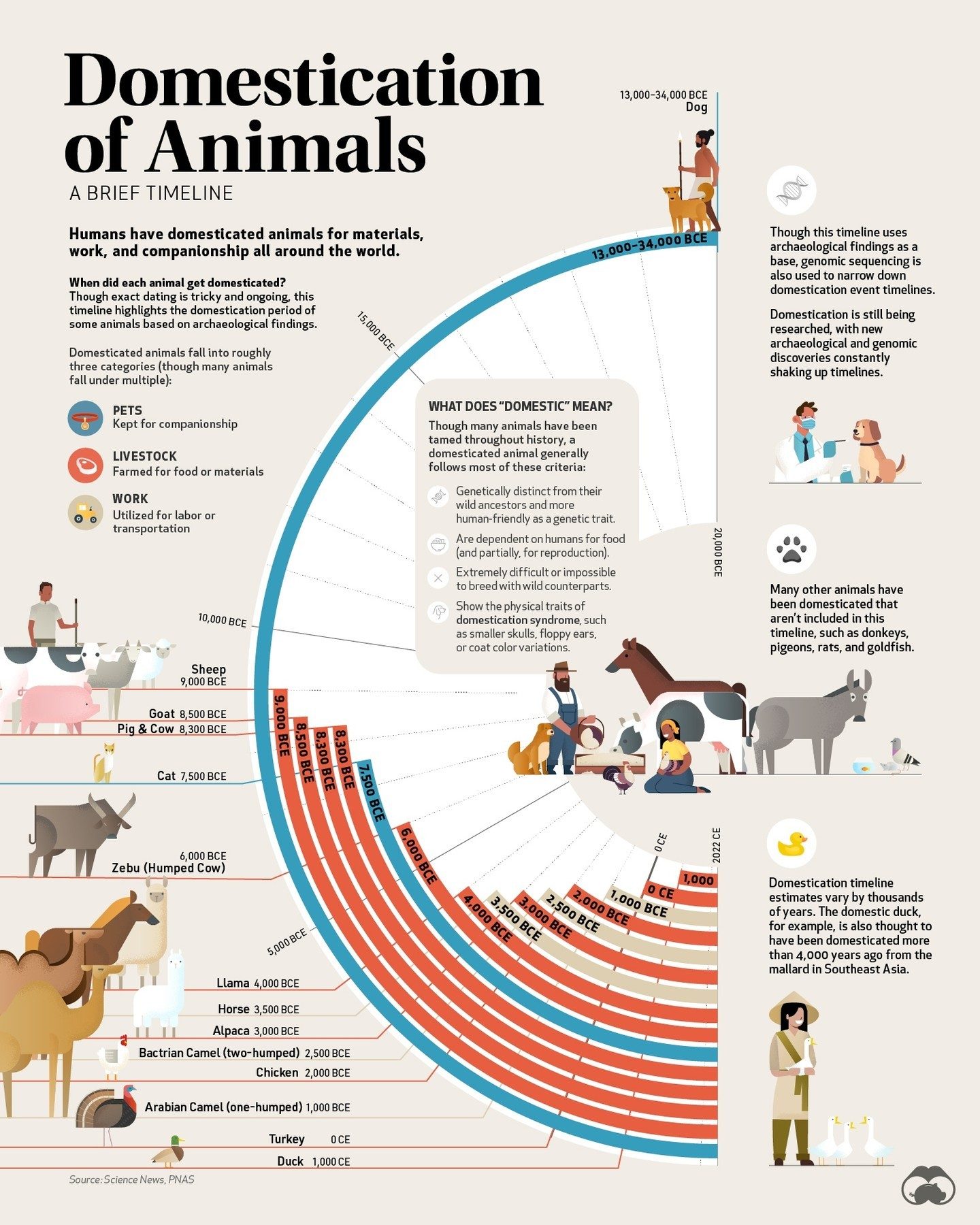
Domestication of Animals Timeline
Domestication is the process by which humans tame and breed wild animals over generations, leading to significant genetic and behavioral changes. This process began thousands of years ago and has shaped the relationship between humans and animals in profound ways.
Why This Matters
Understanding the timeline and process of animal domestication offers insights into human history, agriculture, and the evolution of various species. It also sheds light on how our ancestors adapted to their environments and developed complex societies. By tracing the domestication of different animals, we can appreciate the diverse roles these creatures have played in human cultures and economies.
The Timeline of Animal Domestication
Early Domestication
The process of animal domestication began tens of thousands of years ago. Genetic evidence suggests that dogs were among the first animals to be domesticated, splitting from their wild wolf ancestors around 33,000 years ago. This early domestication likely occurred as a result of mutual benefit: wolves may have scavenged human campsites, eventually becoming more tolerant of human presence and evolving into the domesticated dogs we know today.
Key Milestones
13,000-34,000 BCE: The earliest domestication events are believed to have occurred during this period. Although exact timelines can vary, archaeological findings and genomic sequencing provide valuable insights into when and how specific animals were domesticated.
15,000 BCE: This period marks the beginning of more deliberate domestication efforts. Humans started to selectively breed animals for specific traits, leading to the development of distinct breeds and varieties.
9,000 BCE: Sheep were domesticated around this time. These early domesticated sheep were likely used for their wool, milk, and meat.
8,500 BCE: Goats and cows were domesticated. Goats were valued for their milk, meat, and hides, while cows provided milk, meat, and labor.
8,000 BCE: Pigs and another lineage of cows were domesticated. Pigs were a significant source of meat, while cows continued to provide milk, meat, and labor.
Middle Period
7,500 BCE: The domestication of cats began. Cats were likely valued for their hunting skills, which helped control rodent populations and protect grain stores.
6,500 BCE: Zebu, a type of humped cow, was domesticated. Zebu are known for their hardiness and ability to thrive in hot climates, making them valuable for agricultural societies in regions like South Asia.
6,000 BCE: Llamas were domesticated in the Andes region. Llamas were used for their meat, wool, and as beasts of burden.
Late Period
4,500 BCE: Bactrian camels, known for their two humps, were domesticated. Camels were vital for transportation and labor, especially in desert regions.
3,500 BCE: Horses were domesticated. Horses revolutionized transportation and warfare, allowing for the rapid movement of people and goods over long distances.
3,000 BCE: Alpine sheep, a breed adapted to high-altitude environments, were domesticated. These sheep provided wool, meat, and milk in mountainous regions.
2,500 BCE: Chickens were domesticated. Chickens provided a reliable source of meat and eggs, becoming a staple in many diets.
2,000 BCE: Turkeys were domesticated, primarily in Mesoamerica. Turkeys were valued for their meat and feathers.
1,500 BCE: Donkeys were domesticated. Donkeys were used for transportation and labor, particularly in regions where camels or horses were not available.
1,000 BCE: Rabbits, pigeons, rats, and goldfish were domesticated. Rabbits provided meat and fur, while pigeons were used for meat and sometimes for communication. Rats and goldfish were kept as pets and for scientific purposes.
Categories of Domestic Animals
Pets
Animals kept for companionship have a long history in human societies. Dogs, cats, and more recently, rabbits, pigeons, rats, and goldfish, have all been domesticated for their companionship qualities. These animals often exhibit traits that make them more friendly and sociable towards humans, such as increased docility and decreased aggression.
Work
Animals farmed for food or materials and utilized for labor or transportation have been crucial to human societies from the earliest days of agriculture. Sheep, goats, cows, pigs, and chickens have provided meat, milk, eggs, and wool. Horses, donkeys, llamas, and camels have been essential for transportation and labor, enabling the movement of people and goods over long distances.
Practical Tips for Understanding Domestication
Research and Study
For those interested in domestication, research is key. Archaeological findings, genetic studies, and historical records provide valuable insights into how and when various animals were domesticated. Understanding the timeline and process of domestication can offer a deeper appreciation for the complex relationship between humans and animals.
Visit Museums and Historical Sites
Museums and historical sites often house artifacts and exhibits that showcase the domestication of animals. Visiting these places can provide a hands-on learning experience and a deeper understanding of how domestication has shaped human history.
Engage with Experts
Consulting with experts in archaeology, genetics, and animal behavior can provide valuable insights into the domestication process. Attending lectures, seminars, and workshops can offer opportunities to learn from these experts and ask questions.
Important Takeaways
Genetic and Behavioral Changes
Domestication involves significant genetic and behavioral changes. Animals that have been domesticated are genetically distinct from their wild ancestors and have adapted to rely more on humans for food and reproduction. They often exhibit traits that make them more sociable and less aggressive, making them more suitable for living in close proximity to humans.
Ongoing Process
Domestication is an ongoing process. Many animals that are domesticated today continue to evolve, adapting to new environments and human needs. Research into domestication is also ongoing, with new findings and insights continually emerging.
Cultural and Economic Impact
The domestication of animals has had a profound impact on human cultures and economies. Animals have provided food, labor, and companionship, shaping the way humans live and work. Understanding the timeline and process of domestication can offer valuable insights into the history and development of human societies.
Conclusion
The domestication of animals is a complex and fascinating process that has shaped human history in profound ways. From the earliest domestication of dogs to the more recent domestication of rabbits and goldfish, animals have played crucial roles in human societies. Understanding the timeline and process of domestication can offer valuable insights into the evolution of various species and the development of human cultures and economies. Whether for companionship, labor, or food, the domestication of animals continues to be an important aspect of human life, and ongoing research and study will undoubtedly reveal even more about this intriguing process.
Watch the Reel
Questions readers ask
When did the domestication of animals first begin?
The domestication of animals began thousands of years ago, with the earliest evidence dating back to around 15,000 to 40,000 years ago. This process started when humans began to tame and breed wild animals, initiating a long history of human-animal interaction.
What were the first animals to be domesticated?
The first animals to be domesticated were dogs, which are believed to have been tamed around 15,000 to 40,000 years ago. Shortly after, sheep and goats were domesticated around 9,000 years ago in the Middle East. These early domestications marked the beginning of significant changes in human societies and agriculture.
How has domestication altered the genetics and behavior of animals?
Domestication has led to significant genetic and behavioral changes in animals. Over generations, selective breeding has resulted in animals with traits that are beneficial to humans, such as increased docility, specific physical characteristics, and enhanced productivity. These changes have shaped the relationship between humans and animals, making them integral to various cultures and economies.
What roles have domesticated animals played in human societies?
Domesticated animals have played diverse roles in human societies, including providing food, labor, and companionship. They have been crucial in the development of agriculture, enabling the growth of settlements and complex societies. Additionally, they have contributed to the economy, transportation, and cultural practices, making them indispensable to human history.
What is the significance of understanding the timeline of animal domestication?
Understanding the timeline of animal domestication provides valuable insights into human history and the evolution of species. It offers a window into how our ancestors adapted to their environments, developed agriculture, and built societies. Moreover, it highlights the profound impact that animals have had on human cultures and economies throughout history.
What are some key events in the history of animal domestication?
Key events in the history of animal domestication include the initial taming of dogs, which occurred around 15,000 to 40,000 years ago, and the domestication of sheep and goats around 9,000 years ago. The development of agriculture, the evolution of human societies, and the selective breeding of animals for specific traits are also significant milestones in this timeline.
Related deep dives
Similar reads based on topic and creator.


Recent articles
Fresh deep dives from the latest Reels we unpacked.




Comments
Be the first to comment.