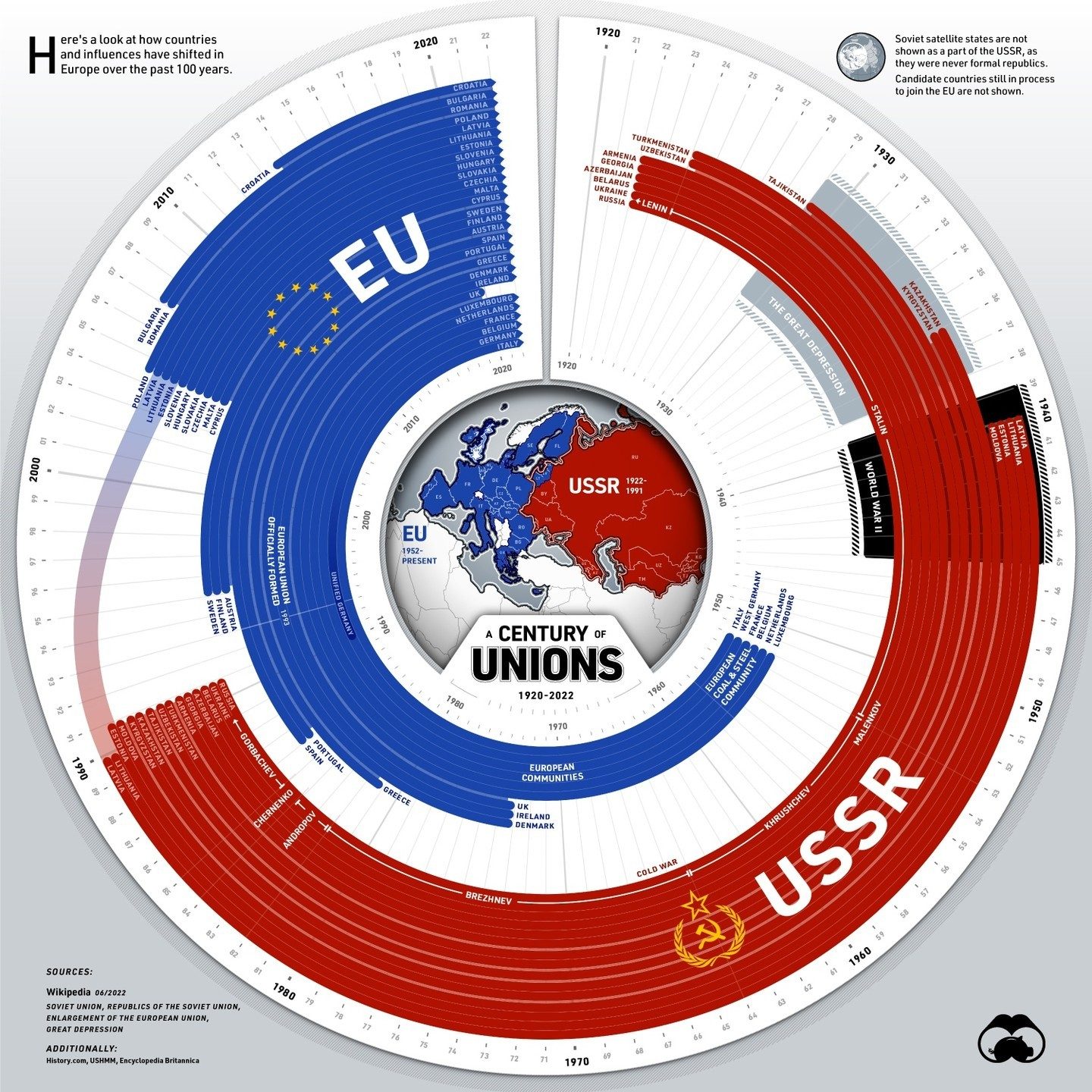
Historical Map of Europe
Europe has undergone significant political shifts over the past century. The complex interplay of territorial claims, geopolitical alignments, and historical events has shaped the continent as we know it today. The map, which has been reworked over time, showcases a visual timeline that helps us understand the evolution of countries and their affiliations.
Context
Why this matters
The political landscape of Europe has been in flux for over a century. The Soviet Union's expansion and subsequent collapse, the expansion of the European Union, and major historical events like the Great Depression and World War II have all played pivotal roles. Understanding these shifts is crucial for grasping the current geopolitical dynamics and the underlying tensions, such as Russia's belief that Ukraine—and much of the Soviet Union’s former republics and satellite states—is still their territory to claim.
Main Discussion
The Formation and Expansion of the European Union
The European Union (EU) has grown significantly since its inception. The European Economic Community (EEC) was initially established in 1958, and it evolved into the EU in 1993. Over the decades, many countries have joined the EU, seeking economic and political cooperation. The most recent additions, such as Bulgaria and Romania, joined in 2007, reflecting a longstanding process of integration.
The Influence of the USSR and Its Satellite States
The Soviet Union, which formed in 1922, had a profound influence on Europe. At its height, the USSR included several republics such as Ukraine, Belarus, and the Baltic states. However, the satellite states, which were not part of the Soviet Union but fell under its influence, are not typically shown as member republics. The collapse of the Soviet Union in 1991 marked a significant turning point, leading to the independence of many former republics and satellite states and their subsequent alignment with other political blocs, such as the EU.
Key Historical Events
Several key historical events have shaped the political landscape of Europe. The Great Depression in the 1930s and World War II in the 1940s had profound effects on the continent. The Great Depression led to economic turmoil, while World War II resulted in massive territorial changes and the rise of the Soviet Union as a superpower. The Cold War that followed further divided Europe into Eastern and Western blocs, with the USSR and the United States as the primary antagonists.
The Role of Key Figures
Key figures like Lenin and Stalin played significant roles in shaping the Soviet Union. After Lenin's death in 1924, Stalin took control and ruled the USSR until his own death in 1953. Stalin's policies, including the collectivization of agriculture and rapid industrialization, had lasting effects on the Soviet Union and its satellite states. His regime was marked by repression and centralization, which had far-reaching consequences for the political and economic landscape of Europe.
The Evolution of Former Soviet Republics
The dissolution of the Soviet Union in 1991 led to the emergence of independent states such as Ukraine, Belarus, Kazakhstan, Uzbekistan, and Kyrgyzstan. Many of these former Soviet republics have since sought to join the EU, aligning themselves with Western values and economic systems. For example, Ukraine, Moldova, and Bosnia have all sought, to varying degrees, to join the EU. This shift reflects a broader trend of former Soviet states moving away from Russian influence and towards Western political and economic models.
Candidate Countries and Future Alignments
Several countries are currently in the process of joining the EU. These candidate countries, while not yet fully integrated, represent the next phase of European expansion. The process involves meeting specific economic, political, and legal criteria set by the EU. The timeline of their accession is subject to negotiations and ongoing assessments.
Practical Tips
Understanding the historical context of Europe's political landscape can be complex, but there are several practical ways to delve deeper into this topic.
Consulting Reliable Sources
For those interested in further exploring the historical and political shifts in Europe, reliable sources such as Wikipedia, History.com, and Encyclopedia Britannica provide comprehensive overviews and detailed information. These sources are well-researched and offer a wealth of data on key events, figures, and trends.
Exploring Interactive Maps
Interactive maps and timelines are excellent tools for visualizing the political changes in Europe. These resources can help you trace the evolution of countries, their affiliations, and the impact of major historical events on the continent. They provide a dynamic way to understand the complexities of European politics and history.
Learning About Key Figures and Events
Understanding the roles of key figures like Lenin and Stalin, as well as pivotal events like the Great Depression and World War II, is essential for grasping the broader political landscape. These figures and events have had profound and lasting effects on Europe's political and economic development.
Important Takeaways
The political landscape of Europe has undergone significant transformations over the past century. The expansion of the European Union, the influence of the USSR, and key historical events have all played crucial roles in shaping the continent. Understanding these shifts can provide valuable insights into the current geopolitical dynamics and the underlying tensions.
Conclusion
The historical map of Europe reveals a complex and dynamic political landscape shaped by various factors. From the expansion of the European Union to the influence of the USSR and key historical events, Europe's evolution over the past century is a story of change, conflict, and alliance. By examining these shifts, we gain a deeper understanding of the continent's geopolitical dynamics and the ongoing tensions that continue to shape its future.
Watch the Reel
Questions readers ask
What were the major territorial changes in Europe over the past century?
Europe experienced significant territorial changes, including the expansion and subsequent collapse of the Soviet Union, the dissolution of Yugoslavia, and the unification of Germany. These shifts have profoundly impacted the political landscape and borders of the continent.
How did World War II affect the political map of Europe?
World War II led to extensive changes in Europe's political map. It resulted in the division of Germany and the rise of the Soviet Union's influence in Eastern Europe, leading to the Cold War. Post-war borders were redrawn, and new countries emerged, such as Poland and the Baltic States.
What role did the European Union play in shaping Europe's political landscape?
The European Union (EU) has been instrumental in reshaping Europe's political landscape since its formation. The EU's expansion has integrated numerous countries, fostering economic and political cooperation. It has also facilitated the reunification of former Soviet republics and Eastern European states into a cohesive political entity.
How did the collapse of the Soviet Union impact Europe's political map?
The collapse of the Soviet Union in 1991 led to the independence of 15 former Soviet republics, significantly altering the political map. This shift marked the end of the Cold War and paved the way for the expansion of the European Union and NATO, while also introducing new geopolitical dynamics and tensions.
What is the significance of the Great Depression in Europe's political history?
The Great Depression had a profound impact on Europe's political landscape. It led to economic instability, social unrest, and the rise of extremist political movements, including fascism and communism, ultimately contributing to the outbreak of World War II and shaping the continent's political dynamics for decades.
Which countries have joined the European Union since its inception?
Since its inception, the European Union has expanded to include 27 member states. Notable additions include Austria, Finland, and Sweden in 1995, followed by Cyprus, the Czech Republic, Estonia, Hungary, Latvia, Lithuania, Malta, Poland, Slovakia, and Slovenia in 2004.
How has the Cold War influenced the political divisions in Europe?
The Cold War (1947-1991) divided Europe into two distinct blocs: the Western Bloc, aligned with the United States and NATO, and the Eastern Bloc, under the influence of the Soviet Union and the Warsaw Pact. This division shaped political ideologies and alliances, influencing everything from economic policies to international relations.
Related deep dives
Similar reads based on topic and creator.

Recent articles
Fresh deep dives from the latest Reels we unpacked.




Comments
Be the first to comment.