Unmatched Diversity
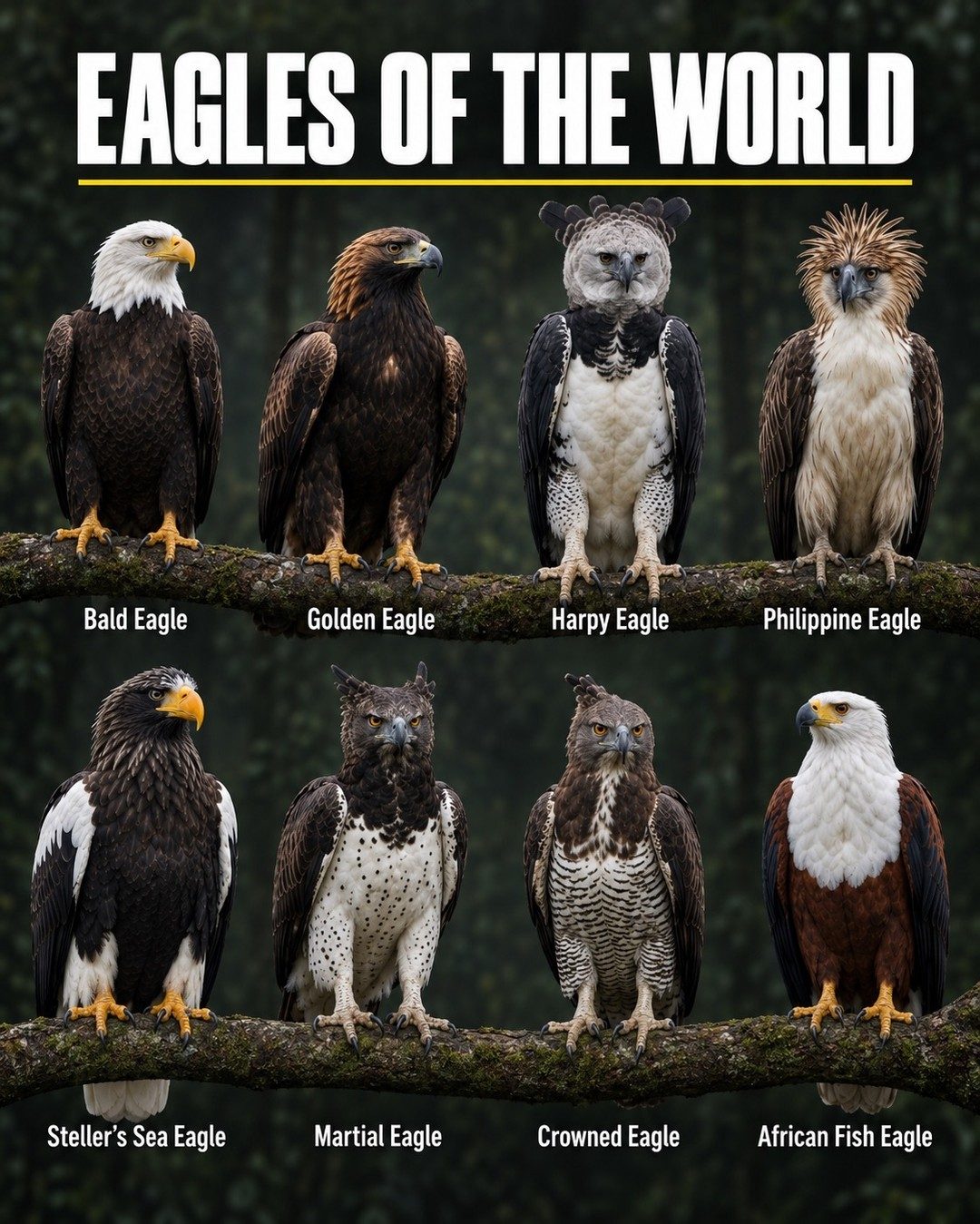
Eagles are not merely a singular species, but a vast family of birds of prey inhabiting an astonishing range of habitats. Each species has evolved unique adaptations to thrive in varied ecosystems, from dense forests to expansive open areas, and from freshwater coasts to the sea. Among the various species showcased is the Bald Eagle, a symbol of the wilderness found along waterways in North America. It has a large, powerful beak that can crush seafood, large legs, and high-speed takeoffs. The Bald Eagle is a testament to its unique marine environment and hunting strategies. Meanwhile, the African Fish Eagle is another species adept at hunting aquatic prey. Its large, white head and tail feathers contrast with its dark body, making it a striking sight along African rivers and shores. The African Fish Eagle's powerful, curved beaks and sharp talons are essential for catching and holding onto slippery fish. The Philippine Eagle’s four-inch-long talons are more like a deadly natural extension of Martin of their anatomy. The Steller’s Sea Eagle also stands out with its larger than average size and stark appearance, ideally suited to its coastal lifestyle. Another notable species is the Martial Eagle, one of the world's most powerful raptors. Its immense size and powerful talons make it a formidable hunter in its open landscapes and forests. The Martial Eagle uses its immense build to adapt to open landscapes and forests and can be found in much of the African continent. Similarly, the Crowned Eagle's strong, hooked beak and powerful talons equip it well for life in Africa's dense forests. The Harpy Eagle also has a strong grip. The Harpy Eagle's build enables it to fly over forests in Central and South America. Its unique hunting strategies and adaptations allow it to thrive in these densely forested regions.
Evolutionary Marvels
Eagles are not only diverse in their environments but also in their physical attributes. Their adaptations are a marvel of evolutionary ingenuity. For instance, the Golden Eagle's broad wings and keen eyesight allow it to soar over vast open landscapes and forests. Golden Eagles use their highly adaptability to take advantage of prey like hares, rabbits, and other small mammals. This species is known for its speed and agility. The Steller's Sea Eagle, distinct among its kin, is characterized by a robust frame and a long beak. Coastal living is made possible by their large feet and powerful claws, which catch food at the shores and cliffs. Similarly, the African Fish Eagle's large, white head and tail feathers are adapted for life along African rivers and lakes, where it swoops down to catch fish with remarkable precision. The Philippine Eagle, native to the Philippines, has a wingspan of two meters and is known to mate for life. Its strong talons and robust body are also crucial for hunting in dense tropical forests. The Philippine Eagle is one of the most powerful and largest birds in the world. They use their strong grip for transporting prey. The Harpy Eagle, native to South America, is also a formidable hunter. They can hunt armored animals weighing 16 pounds.
Adaptability In the Wild
Eagles are not only masters of their specific environments but also exemplify adaptability. These birds have developed unique hunting strategies and physical traits to accommodate their habitats. Hunting strategies vary greatly among eagle species. For instance, the Bald Eagle's prowess in aquatic habitats involves swooping down to snatch fish from the water's surface, while the African Fish Eagle exhibits similar tactics. The Philippine Eagle, on the other hand, hunts in dense forests, often perched motionlessly until an opportunity arises, showcasing patience and precision. The Martial Eagle's hunting behavior can be seen in the vast, open landscapes of Africa.
Conservation and Awareness
While eagles are revered for their majesty and power, many species face threats due to habitat destruction and climate change. Conservation efforts, including habitat protection and education, are crucial for preserving these remarkable birds. Raising awareness about the diversity and uniqueness of each eagle species can inspire greater appreciation and support. Conservation districts play a vital role in protecting these birds. Each species has a unique habitat, and erratic climate changes can significantly impact their territories. Climate change and habitat destruction are significant threats to these species. In 2018, the Philippine Eagle was recognized by the Philippine Congress as a national symbol. The diverse adaptations and hunting styles of eagles underscore the complexity of their ecological roles. Bald eagles are better at handling terrestrial animals, while Steller’s sea eagles can handle heavy prey. How the Harpy Eagle escapes the tropical forest with its dense foliage is a reflection of their adaptation.
Watch the Reel
Related deep dives
Similar reads based on topic and creator.




Recent articles
Fresh deep dives from the latest Reels we unpacked.




Comments
Be the first to comment.