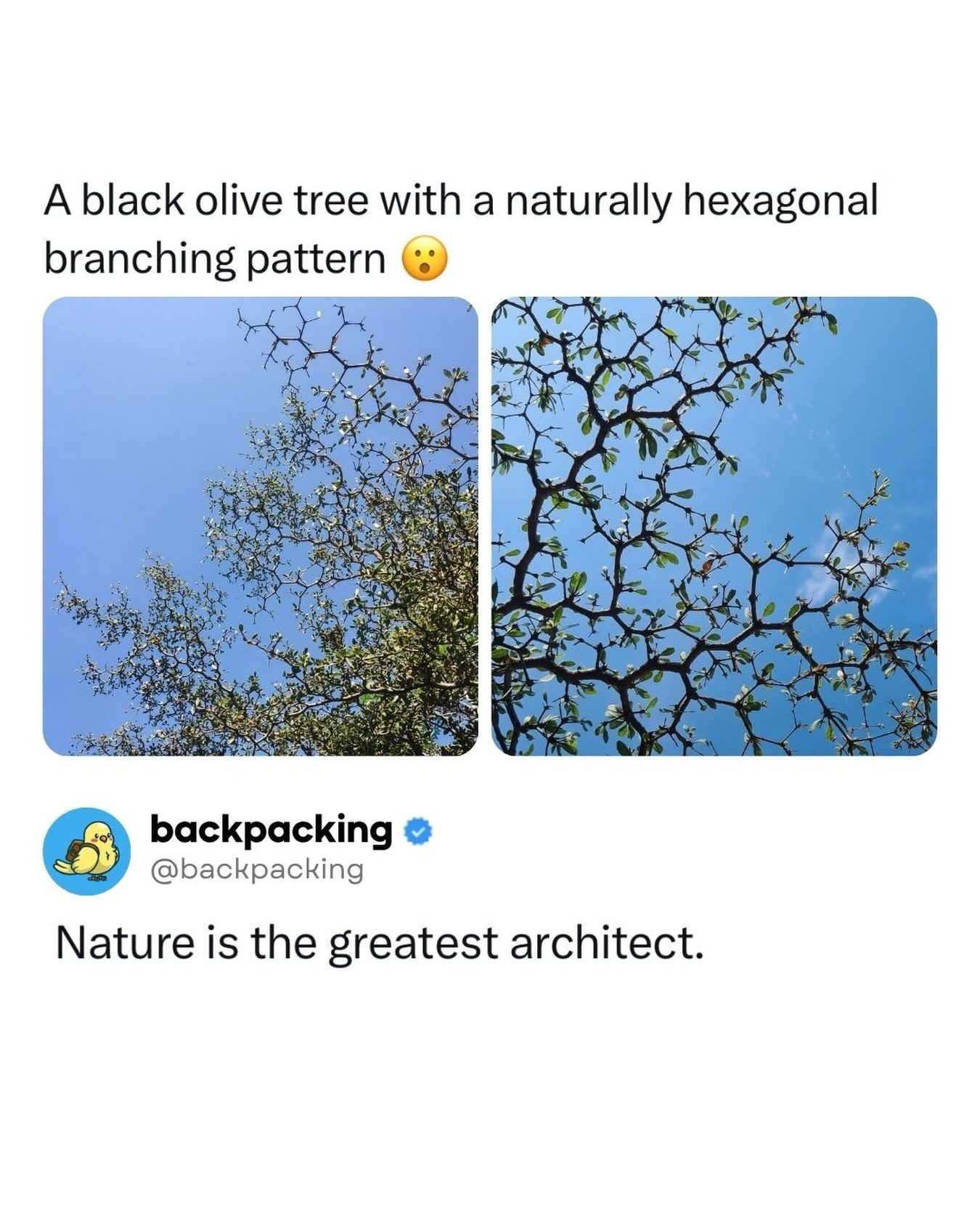
Hexagonal Olive Tree
The Dwarf Black Olive (Bucida spinosa), often referred to as the "Geometry Tree," showcases a remarkable natural phenomenon: an intricate, hexagonal branching pattern. This tree, native to parts of the Caribbean and Central America, grows through a process called dichotomous branching. Unlike the European Olive tree, the Dwarf Black Olive is not part of the same family.
Context / Why this matters
The unique branching pattern of the Dwarf Black Olive is more than just a visual marvel; it also serves a critical biological function. The geometric structure of its branches and leaves maximizes sunlight exposure and reduces overcrowding, making photosynthesis more efficient. This combination of form and function is not just a fascinating example of nature’s design, but a testament to the efficiency of natural processes.
Main discussion
The geometry of growth
The Dwarf Black Olive’s distinctive appearance is the result of a process called dichotomous branching. As the tree grows, its branches repeatedly split into two nearly symmetrical branches, forming a mesmerizing geometric pattern. When viewed directly below, these Y-shaped divisions create a hexagonal pattern. This branching pattern is a natural adaptation that helps the tree manage its resources efficiently.
The role of phyllotaxis
Phyllotaxis, or the arrangement of leaves on a plant, plays a crucial role in the Dwarf Black Olive’s efficiency. The tree's leaves are arranged in a way that maximizes sunlight exposure, ensuring that each leaf gets enough light for photosynthesis. This arrangement also reduces overcrowding, preventing the tree from becoming too dense and allowing for better air circulation and nutrient distribution.
Function over form
The intricate geometry of the Dwarf Black Olive isn’t just an aesthetic feature; it serves a practical purpose. The hexagonal branching pattern and phyllotaxis arrangement optimize the tree's ability to capture sunlight and perform photosynthesis. This efficiency is a result of millions of years of evolution, where the tree has adapted to its surroundings to ensure its survival. The tree’s structure allows it to thrive in its native environment, where survival is directly linked to its ability to optimize resources like sunlight and water.
Practical tips
If you’re interested in observing or studying the Dwarf Black Olive, here are some practical tips:
-
Location: The Dwarf Black Olive is native to the Caribbean and Central America. If you’re planning a trip to these regions, keep an eye out for this unique tree. In the USA, you might spot it in Florida, Texas, and Louisiana.
-
Timing: The best time to observe the tree’s geometry is during the growing season, typically in the spring and summer, when new branches and leaves are actively developing.
-
Resources: There are many resources available for those interested in learning more about the Dwarf Black Olive. Libraries, universities, and online databases are a good starting point. Often, botanical gardens and arboretums will also have this tree and may provide guides and workshops.
Important takeaways
Nature has a way of turning survival into art. The Dwarf Black Olive exemplifies this principle with its unique branching pattern and efficient use of resources. The tree’s beauty and functionality make it a fascinating subject for study and admiration. Viewing this tree through a scientific lens can provide insights into natural processes and the efficiency of natural systems.
Conclusion
The Dwarf Black Olive, with its hexagonal branching pattern and efficient use of resources, is a testament to the beauty of nature. Whether you’re a nature enthusiast, a botanist, or simply someone who appreciates the beauty of natural patterns, this tree offers a glimpse into the intricate and efficient world of plant life. Take a moment to appreciate the Dwarf Black Olive’s unique features and the way it showcases nature’s ingenuity.
Watch the Reel
Questions readers ask
What is dichotomous branching and how does it relate to the Dwarf Black Olive?
Dichotomous branching is a growth pattern where a single branch splits into two equal branches, which then split again, and so on. In the case of the Dwarf Black Olive, this process results in a symmetrical, hexagonal branching pattern that is not only visually striking but also functionally efficient.
How does the hexagonal branching pattern benefit the Dwarf Black Olive?
The hexagonal branching pattern of the Dwarf Black Olive allows for optimal sunlight capture and efficient nutrient distribution. This structure minimizes leaf overlap, reducing competition for light and ensuring that each leaf has adequate access to sunlight for photosynthesis.
Why is the Dwarf Black Olive known as the 'Geometry Tree'?
The Dwarf Black Olive is nicknamed the 'Geometry Tree' due to its precise and intricate hexagonal branching pattern. This unique growth pattern makes it a standout example of nature's architectural designs, showcasing a precise, almost mathematical, form.
What makes the Dwarf Black Olive different from the European Olive tree?
The Dwarf Black Olive (Bucida spinosa) and the European Olive tree (Olea europaea) belong to different plant families and have distinct features. The most notable difference is the Dwarf Black Olive's unique hexagonal branching pattern, which is not found in the European Olive tree.
Can the Dwarf Black Olive's structure be useful for backpackers?
While the Dwarf Black Olive's hexagonal branching pattern does not directly provide resources for backpackers, its dense, symmetrical structure can offer shade and shelter in certain environments. Additionally, the tree’s distinctive silhouette can serve as a notable landmark for navigation in areas where it grows.
How does the Dwarf Black Olive's branching pattern enhance its efficiency?
The Dwarf Black Olive's hexagonal branching pattern enhances its efficiency by maximising sunlight exposure and reducing overcrowding. This structure allows for better distribution of nutrients, ensuring that the tree can thrive in its natural habitat.
What are the key features of the Dwarf Black Olive?
The key features of the Dwarf Black Olive include its unique hexagonal branching pattern, its native growth in parts of the Caribbean and Central America, and its efficient sunlight capture and nutrient distribution system. These features make it a fascinating subject for those interested in nature's architectural patterns.
Related deep dives
Similar reads based on topic and creator.




Recent articles
Fresh deep dives from the latest Reels we unpacked.




Comments
Be the first to comment.