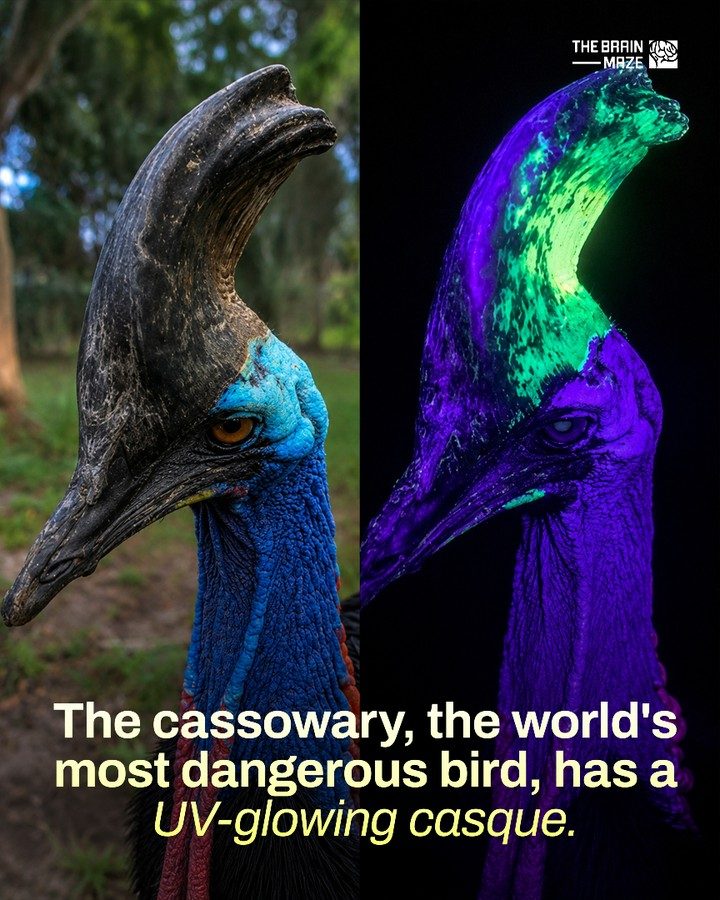
Cassowary UV Glow: The Hidden Light of the Southern Cassowary
The southern cassowary, often called the world's most dangerous bird, possesses a unique feature that has recently captivated researchers. This large, flightless bird has a distinctive bony helmet-like crest known as a casque. Recent findings have revealed that this casque has an extraordinary property: it fluoresces a bright blue-green under ultraviolet (UV) light. This fascinating discovery sheds new light on the behavior and communication of these elusive birds.
Context / Why this matters
Understanding the UV fluorescence of the cassowary's casque is significant for several reasons. First, it provides insights into the sensory capabilities of these birds, which are crucial for their survival. Secondly, it highlights the intricate ways in which animals communicate in their natural habitats. Lastly, it underscores the importance of conservation efforts, as these birds are often threatened by habitat loss and human activity.
Main discussion
The Cassowary and Its Casque
The southern cassowary (Casuarius casuarius) is one of the largest and most formidable birds in the world. The casque on its head is a distinctive feature that sets it apart from other species. This bony structure is not just an ornament; it plays a vital role in the bird's behavior and communication.
The casque is believed to have multiple functions, including defense, courtship, and social interactions. It can be used as a weapon, a tool for foraging, and a visual display during mating rituals. However, the recent discovery of its UV fluorescence adds a new dimension to our understanding of this fascinating feature.
The Discovery of UV Fluorescence
Researchers from THE BRAIN MAZE discovered that the casque of the southern cassowary glows under UV light. This fluorescence was not visible to the human eye in natural light but became evident under UV illumination. The casque emits a vibrant blue-green light, creating a striking visual signal.
This discovery was made possible by advances in technology that allow scientists to observe natural phenomena in ways that were previously impossible. Using UV lights and specialized cameras, researchers were able to capture the fluorescence of the casque in a way that had never been done before.
The Role of UV Fluorescence in Cassowary Behavior
The UV fluorescence of the cassowary's casque is thought to play a crucial role in the bird's behavior, particularly in dense tropical rainforests where visibility is limited.
Cassowaries are known for their solitary nature and prefer to live in dense, tropical rainforests. These environments are characterized by low light levels and a lack of visual cues, making it difficult for birds to recognize one another. The UV fluorescence of the casque provides a hidden visual signal that helps cassowaries recognize each other in the dim light.
This hidden signal is particularly important for mating and territorial disputes. During courtship, the fluorescence of the casque may serve as a visual display to attract potential mates. Additionally, it may play a role in territorial disputes, as it can signal dominance and aggression.
Practical tips
Observing and understanding the UV fluorescence of the cassowary's casque requires specialized equipment and knowledge. Here are some tips for those interested in studying this phenomenon:
-
Equipment: Use specialized UV lights and cameras that can capture fluorescence. These tools are essential for observing the casque's UV fluorescence.
-
Environment: Study cassowaries in their natural habitat, dense tropical rainforests. This environment provides the best conditions for observing the fluorescence in action.
-
Behavior: Observe the birds during mating and territorial interactions. These are the times when the UV fluorescence is most likely to be visible and significant.
-
Conservation: Support conservation efforts for cassowaries and their habitats. Preserving these birds and their environments is crucial for understanding and protecting this unique phenomenon.
Important takeaways
The discovery of the southern cassowary's UV fluorescence is a testament to the wonders of the natural world. It highlights the importance of studying and preserving these unique species and their habitats. As researchers continue to uncover the mysteries of the cassowary, we gain a deeper appreciation for the complexity and beauty of nature. Here are some key takeaways:
-
Unique Feature: The casque of the southern cassowary fluoresces a bright blue-green under UV light, creating a hidden visual signal.
-
Behavioral Insights: This fluorescence may help cassowaries recognize one another in the dim light of dense tropical rainforests, playing a crucial role in mating and territorial interactions.
-
Conservation Importance: Understanding and preserving these birds and their habitats are essential for protecting this unique phenomenon and the broader ecosystem.
Conclusion
The southern cassowary's UV fluorescence is a fascinating discovery that offers new insights into the behavior and communication of these remarkable birds. By understanding this hidden visual signal, we can gain a deeper appreciation for the complexity and beauty of the natural world.
Watch the Reel
Questions readers ask
What is the cassowary casque and why is it significant?
The cassowary casque is a distinctive, bony helmet-like crest found on the head of southern cassowaries. Its significance lies in its recently discovered ability to fluoresce a vibrant blue-green under ultraviolet light, which provides new insights into the birds' communication and sensory abilities.
Why do cassowaries glow under UV light?
The exact reason why cassowaries glow under UV light is still under investigation. However, it is believed that this unique feature may play a role in their communication, helping them to signal to other cassowaries in their environment, especially in low light conditions.
Are there other birds that glow under UV light?
While the cassowary's UV fluorescence is particularly notable due to its vibrant color and the bird's elusive nature, there are other bird species that exhibit some form of UV reflectance or fluorescence. Examples include certain species of parrots and birds of paradise, but the cassowary's casque is unique in its structure and glowing properties.
How does the UV glow of the cassowary's casque help in research?
The UV glow of the cassowary's casque offers researchers a new avenue for studying these elusive birds. By understanding how and why the casque glows, scientists can gain insights into the birds' behavior, communication methods, and sensory capabilities, which are crucial for their survival and conservation.
Is the cassowary truly the world's most dangerous bird?
The southern cassowary is often dubbed the world's most dangerous bird due to its powerful kick, which can cause serious injury. However, this label is more about its defensive capabilities rather than aggressive behavior. Cassowaries typically avoid humans but can be dangerous when threatened or protecting their young.
Can humans see the UV glow on a cassowary's casque?
No, humans cannot see the UV glow on a cassowary's casque with the naked eye. The glow is only visible under ultraviolet light, which is outside the visible spectrum for humans. Special equipment, such as UV filters or lights, is required to observe this phenomenon.
What are the implications of the cassowary's UV glow for conservation efforts?
Understanding the UV glow of the cassowary's casque can enhance conservation efforts by providing new ways to monitor and track these birds. This knowledge can also inform strategies to protect their habitats and ensure their survival. Additionally, it raises awareness about the unique characteristics of these birds, fostering greater interest and support for their conservation.
Related deep dives
Similar reads based on topic and creator.


Recent articles
Fresh deep dives from the latest Reels we unpacked.




Comments
Be the first to comment.