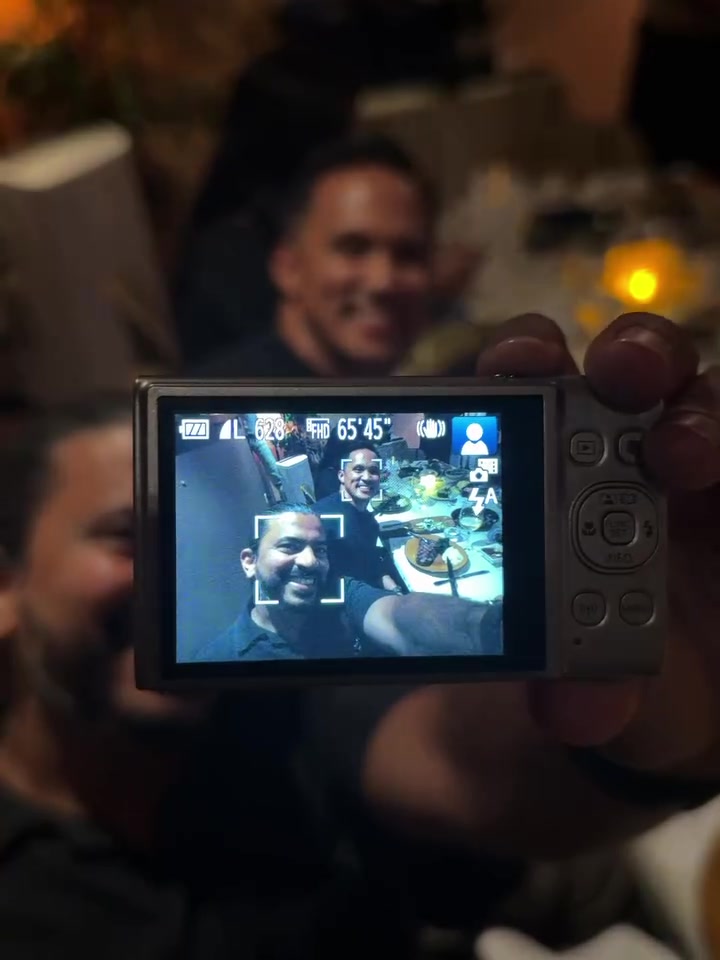
A digital camera captures more than just moments — it freezes time, and living landscapes into a digital frame, and reveals, in the process, how photographers see the world. The entire playbook of light, distance, and detail is laid out in a single live screen. But cameras have become wildly varied objects, and the tools and settings could be a headache to learn. This isn't your grandparent's camera anymore, but a tech marvel.
Flashcard then Launchpad
Digital cameras capture light and turn it into an image. They use a lens to focus light onto a sensor, which then converts the light into a digital signal. By adjusting the ISO and aperture, photographers can control how much light reaches the camera's sensor and how large the lens opening is. The camera effectively hones in on the subject, leaving the rest of the world soft and blurred. The ISO can brighten or dim the whole image — ISO 100 makes the whole image light and ISO 1600 is what photographers use to make the image look night-like. ISO and aperture are the keys to the gate of light. Where manual cameras were only for professionals, digital cameras have changed that. Autofocus and automatic controls bring ease to the layman. The digital age, moreover, gives users infinite digital storage from the cloud. Prices of older-model digital cameras vary but fall between USD 200 and USD 1,000.
The World Framed
Digital cameras, especially as society shifts to a more digital world, cater to a particular lifestyle. People carry their phones everywhere, and so a camera isn't required for every person, but who doesn't want to capture moments in real life that are more or less perfect?
How Photographers Live Through the Camera
The Power of the Winch
To be able to focus the image and optimize the exposure, the lens has to be able to move, zoom and focus; the lens needs a body that can stretch and flex. Photographers then add external flash, and in an imperfectly lit world, a camera needs a person to take it to the best areas of a place or a scene. The camera, however, does not provide a lens. The photographer needs to come up with the lens. The camera takes the object or scene through the lens and lets out light, which the photographer wants to capture on a digital sensor. The photographer can then project the light onto a digital image. The camera is, now, aligned with the lens. The shutter is locked with the lens. The camera is going to make the best impression on the scene.
Mastering the Camera Like a Table-Top
The camera must be held close to the heart and the scene. The camera must be held upright, and the camera must face the scene. The camera can't move with whatever happens with the scene. The camera has to be held still, and it has to be held in the direction of the scene. The scene must be the focus of the camera. The camera must not move around, and it must be held still. The camera must be pointed at the scene. The camera allows the photographer to see the world differently. The photographer thinks that the world is beautiful, but it is beautiful in a way that the photographer makes the world beautiful.
The Lives of Photographers Chained to a Backpack
Photographers see their cameras as an extension of themselves. They always have them by their side, ready to capture the perfect moment. Because cameras are sensitive to dust particles, they avoid certain situations because they cannot clean their camera. Their camera could damage the sensor, which is made of sensitive electronics. They take mandatory precautions when they have lighter colors on their clothes, and they need to wear a camera backpack. However, not all cameras were created for all seasons. Ultras are specialized for underwater sceneries, while futures are good for wildlife and sports. There are even some sports cameras which are heavier, and ones which are smaller. They are used for different kinds of photography and events.
Why It Has To Be Pointed at the Scene
Photographers can't just point a camera at a scene and expect a good image. Each lens is a tool suited to whatever they need to take. They know what kinds of cameras are needed for video, or for photos. They know what kinds of lenses are needed for birds, for wildlife, and for close-up photos. Photographers use very large sensors to capture the best image. They use the lens to capture the image for the best result. The lens gives the camera an image and it subjects the camera to a picture. They use a camera to capture the picture by the camera, or to take the picture. A camera is a tool to capture the image in a certain way.
Watch the Reel
Questions readers ask
What is the difference between ISO 100 and ISO 1600 on a digital camera?
ISO 100 makes the whole image bright, which is ideal for well-lit environments. In contrast, ISO 1600 is used in low-light conditions to make the image appear darker and more dramatic, mimicking a night-like scene. It's important to note that higher ISO values can introduce more image noise, so it's a trade-off between brightness and image quality.
How does the aperture setting affect the image captured by a digital camera?
The aperture setting controls the size of the lens opening, which in turn affects the amount of light that reaches the camera's sensor. A larger aperture (smaller f-number) lets in more light and creates a shallow depth of field, blurring the background and focusing on the subject. A smaller aperture (larger f-number) lets in less light and keeps more of the scene in focus.
Can I use a digital camera without any prior photography experience?
Digital cameras have made photography more accessible to beginners with features like autofocus and automatic controls. However, learning the basics of settings like ISO, aperture, and shutter speed can significantly improve your photos. Start with the automatic modes and gradually explore manual settings as you get more comfortable.
What are some of the key differences between digital cameras and traditional film cameras?
Digital cameras use a sensor to capture light and convert it into a digital signal, while film cameras use photographic film. Digital cameras offer instant feedback through the live view screen, and have a range of shooting modes. They also have the advantage of instant digital storage and editing capabilities, whereas film cameras require processing and developing.
How do external flashes help in photography with a digital camera?
External flashes provide additional light, which can be crucial in low-light conditions or when you need to illuminate a subject from a different angle. They offer more control over lighting, allowing photographers to create more dynamic and well-lit images. Many digital cameras have a hot-shoe mount for external flashes, making it easy to attach and use them.
Is it possible to capture high-quality images in low-light conditions with a digital camera?
Yes, but you may need to adjust your settings accordingly. Increasing the ISO can help brighten the image, but it may also introduce noise. Using a wider aperture can let in more light, but it will also create a shallower depth of field. Additionally, using a tripod or stabilizing the camera can help prevent blurry images caused by camera shake in low-light conditions.
How do photographers use the live view feature on a digital camera?
The live view feature allows photographers to see exactly what the camera is capturing in real-time. This is particularly useful for composing shots, especially in challenging lighting conditions or when using a tripod. It also helps in adjusting settings like focus and exposure before taking the shot, ensuring that the final image matches the photographer's vision.
Related deep dives
Similar reads based on topic and creator.
Recent articles
Fresh deep dives from the latest Reels we unpacked.

Comments
Be the first to comment.