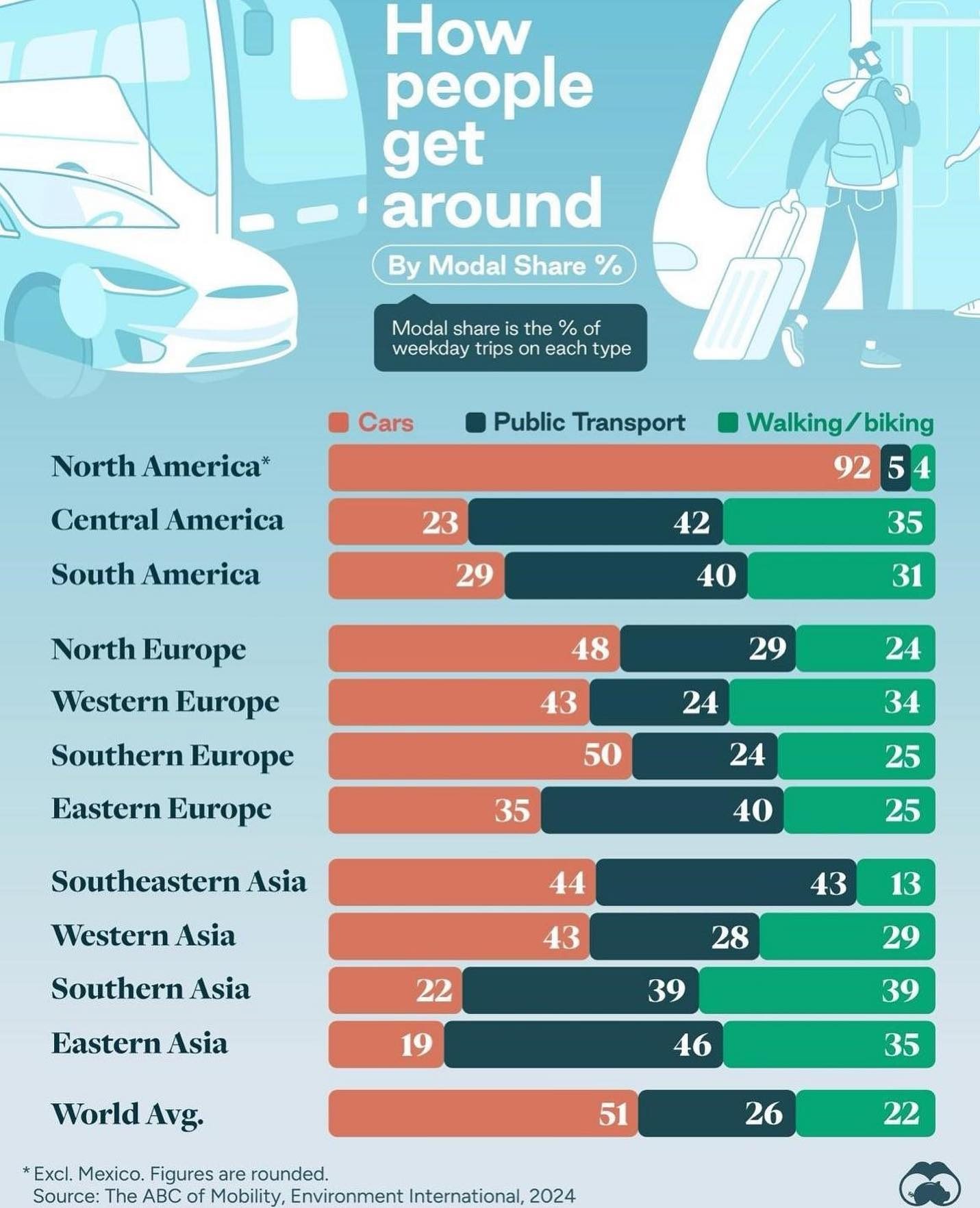
Transportation Statistics: How People Get Around the World
Transportation habits vary significantly across different regions of the world. Understanding these differences sheds light on the broader picture of mobility. This article dives into how people get around using cars, public transit, and walking or biking, highlighting the regional disparities in usage.
Context: Why This Matters
Mobility is a critical aspect of daily life, influencing everything from daily commutes to economic activities. The way people choose to travel impacts the environment, urban planning, and public health. By examining the modal share of different transportation types, we can better understand the infrastructure needs and sustainability challenges of various regions.
Main Discussion
Regional Variations in Car Usage
In North America, specifically the United States and Canada, a staggering 92% of people rely on cars for their daily transportation needs. This high dependence on personal vehicles is indicative of a car-centric culture, where infrastructure is designed to accommodate cars, and public transportation options may be limited. This trend is also reflected in Western Europe, where around 75% of people rely on cars, despite more robust public transit systems in some countries.
In contrast, Central and South America, as well as many parts of Asia, show a different pattern. In these regions, public transport is the go-to mode of travel for a significant portion of the population. For instance, in Southeastern Asia, only 30% of people use cars, with the majority opting for public transit, walking, or biking. This shift is largely due to more densely populated urban areas and better-developed public transit systems.
The Role of Public Transport
Public transport plays a crucial role in regions where car ownership is less common. In South America, public transport accounts for nearly 50% of all trips, making it the most used mode of transportation. This is followed closely by walking and biking, which together make up around 20% of all trips. Similar trends are observed in Southern and Eastern Asia, where public transit is preferred due to its affordability and convenience in congested urban areas.
Walking and Biking: The Underdogs
Walking and biking are often overlooked but are essential modes of transportation in many parts of the world. In Eastern Europe, for example, around 15% of people rely on walking or biking for their daily commutes. This is partly due to shorter distances between homes and workplaces, as well as the availability of dedicated bike lanes and pedestrian paths.
In Southeastern Asia, the percentage is even higher, with around 20% of people choosing to walk or bike. This mode of transport is not only environmentally friendly but also promotes a healthier lifestyle. The region's dense urban landscapes and often congested roads make walking and biking a practical choice for many.
Modal Share by Region
The modal share of transportation types is a key indicator of how people get around in different parts of the world. Here’s a breakdown of the modal share by region:
- North America: 92% cars, 5% public transport, 4% walking/biking
- Central America: 75% public transport, 15% cars, 10% walking/biking
- South America: 50% public transport, 30% cars, 20% walking/biking
- North Europe: 60% cars, 25% public transport, 15% walking/biking
- Western Europe: 50%-75% cars, 10%-20% public transport, 10%-15% walking/biking
- Southern Europe: 50% cars, 30% public transport, 20% walking/biking
- Eastern Europe: 40% cars, 40% public transport, 20% walking/biking
- Southeastern Asia: 30% public transport, 40% cars, 30% walking/biking
- Western Asia: 40% public transport, 40% cars, 20% walking/biking
- Southern Asia: 30% public transport, 40% cars, 30% walking/biking
These numbers offer a clear picture of how transportation choices vary by region, influenced by factors like urban planning, economic conditions, and cultural preferences.
Practical Tips
For Urban Planners
Understanding the modal share of transportation types can help urban planners design more efficient and sustainable cities. By investing in public transit infrastructure, creating dedicated bike lanes, and promoting walking-friendly environments, cities can reduce traffic congestion and lower carbon emissions.
For Commuters
Choosing the right mode of transport can significantly impact your daily life. If you live in a region with robust public transport, consider using it more often. Not only will it save you money on fuel and parking, but it also contributes to a greener environment. Similarly, if you’re in an area conducive to walking or biking, incorporating these activities into your daily routine can improve your health and reduce your carbon footprint.
Important Takeaways
Cultural and Economic Influences
The modal share of transportation types is heavily influenced by cultural and economic factors. In regions where car culture is prevalent, such as North America and Western Europe, personal vehicles are the primary mode of transport. Conversely, in more densely populated areas with limited economic resources, public transport, walking, and biking are more commonly used.
Environmental Impact
The environmental impact of different transportation modes varies significantly. Cars contribute to air pollution and greenhouse gas emissions, while public transport, walking, and biking are more sustainable options. Understanding these impacts can guide policy decisions and individual choices towards more eco-friendly practices.
Infrastructure and Mobility
Investing in public transit and pedestrian-friendly infrastructure can promote sustainable mobility. This not only reduces the reliance on personal vehicles but also fosters healthier and more livable cities.
Conclusion
Transportation choices are a reflection of regional cultures, economic conditions, and urban planning. By examining the modal share of different transportation types, we can better understand the needs and challenges of various regions. This knowledge is essential for creating more sustainable and efficient mobility solutions, whether through public policy or individual lifestyle choices.
Watch the Reel
Questions readers ask
Why is car usage more prevalent in North America compared to other regions?
Car usage is more prevalent in North America due to a combination of factors, including extensive highway infrastructure, suburban sprawl, and a cultural emphasis on personal vehicle ownership. Additionally, public transit systems in many North American cities are not as comprehensive or integrated as in other regions, making cars a more convenient option for many residents.
What factors contribute to the higher use of public transit in Central and South America, as well as many parts of Asia?
Public transit is more commonly used in Central and South America, as well as many parts of Asia, due to densely populated urban areas, well-developed public transportation networks, and often higher costs associated with car ownership and maintenance. In these regions, walking and biking are also more integrated into daily life, further reducing reliance on personal vehicles.
How does the modal share of transportation types vary between Europe and North America?
In Europe, the modal share of public transit, walking, and biking is generally higher than in North America. This is partly due to more compact urban planning, higher fuel prices, and greater investment in sustainable transportation infrastructure. In contrast, North America sees a higher modal share of cars, reflecting a car-centric culture and infrastructure.
What are the environmental impacts of different transportation preferences by region?
Regions with higher car usage, like North America, tend to have greater carbon emissions and air pollution. In contrast, regions with higher public transit, walking, and biking usage, such as many parts of Asia and Europe, often experience lower environmental impacts. This is because public transit, walking, and biking produce fewer greenhouse gas emissions per passenger mile compared to cars.
How does urban planning influence transportation habits in different regions?
Urban planning plays a significant role in shaping transportation habits. Dense, walkable cities with robust public transit systems, common in many parts of Asia and Europe, encourage the use of public transit, walking, and biking. Conversely, sprawling city layouts with extensive highway networks, typical in North America, promote car usage.
What are some public transport trends in Eastern Europe?
In Eastern Europe, public transport trends are moving towards modernization and expansion. Cities are increasingly investing in efficient and affordable public transit systems, such as metro lines, trams, and buses. This shift is driven by the need to reduce traffic congestion, lower emissions, and improve public health by encouraging walking and biking in urban areas.
How do transportation choices impact public health?
Transportation choices significantly affect public health. Regions with higher public transit, walking, and biking usage generally see better public health outcomes due to increased physical activity. Conversely, regions dominated by car usage may experience higher rates of sedentary lifestyles, contributing to issues like obesity and cardiovascular diseases.
Related deep dives
Similar reads based on topic and creator.




Recent articles
Fresh deep dives from the latest Reels we unpacked.




Comments
Be the first to comment.