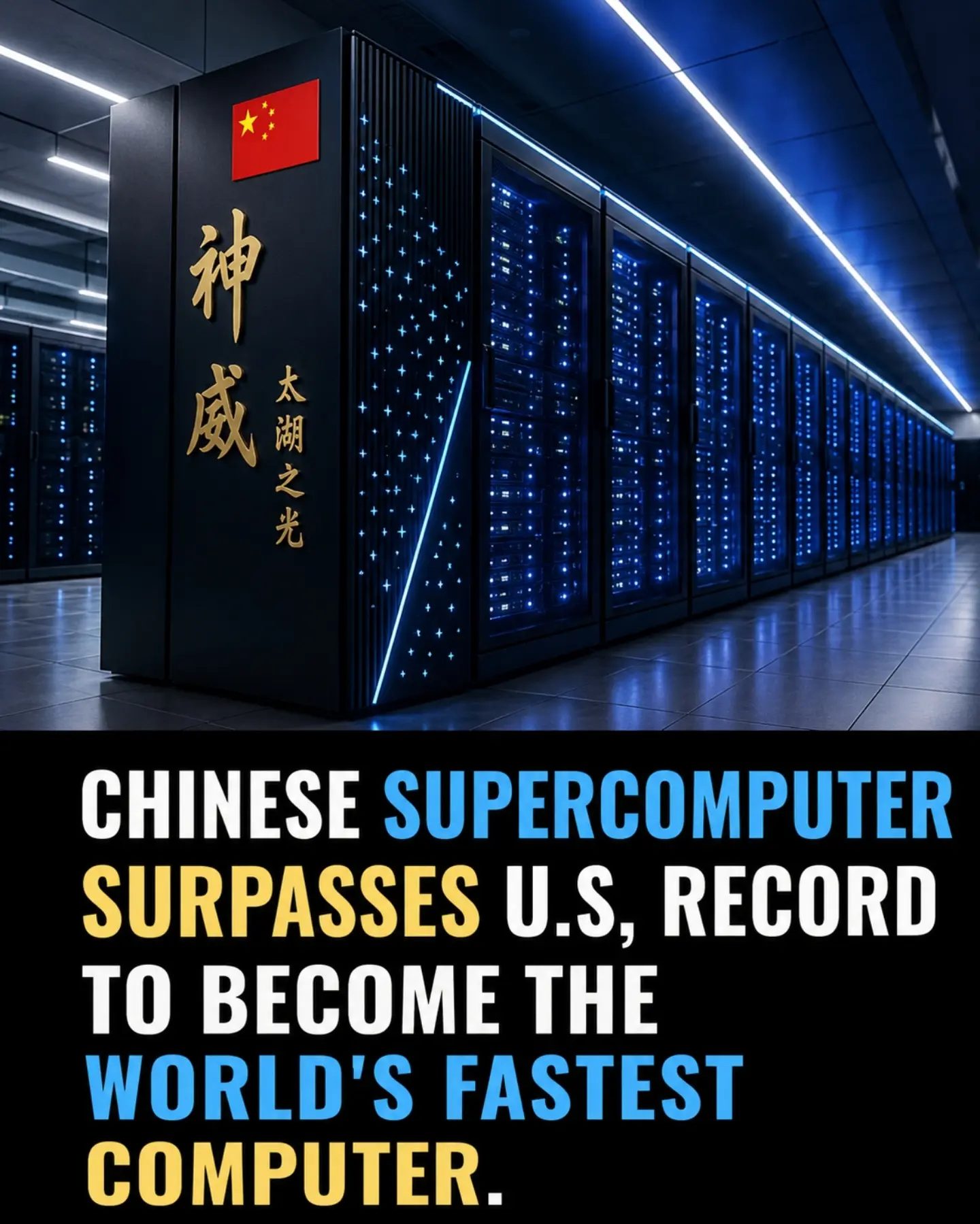
Supercomputer Achievement: Breaking the World Record
The supercomputer is a remarkable feat of engineering, and a recent development in China has set a new benchmark in computational power. A Chinese supercomputer has surpassed the previous U.S. record to become the world's fastest computer. This achievement is a testament to the advancements in technology and the growing capabilities of supercomputing infrastructure.
Context / Why This Matters
Supercomputers are essential tools for scientific research, engineering simulations, and data analysis. They enable researchers to tackle complex problems that would be impossible to solve with standard computers. The race to build the world's fastest supercomputer is not just about bragging rights; it has significant implications for various industries, including healthcare, climate modeling, and artificial intelligence.
Main Discussion
The Global Competition
The competition to build the fastest supercomputer is intense, with countries around the world investing heavily in this technology. The United States has long been a leader in this field, but recent advancements by China have shifted the balance. The Chinese supercomputer's achievement underscores the country's commitment to advancing its technological capabilities and its ambition to lead the global supercomputing landscape.
The Technology Behind Supercomputers
Supercomputers are designed to perform complex calculations at extremely high speeds. They consist of thousands of processors working together in parallel, allowing them to handle massive amounts of data simultaneously. The Chinese supercomputer that broke the record likely uses advanced architectures and specialized hardware to achieve its performance.
The Impact on Research and Industry
The world's fastest supercomputer has profound implications for research and industry. Scientists can use this technology to simulate complex systems, such as weather patterns, molecular structures, and even the universe. This capability allows for breakthroughs in fields like medicine, where researchers can simulate the behavior of drugs at a molecular level. In engineering, supercomputers enable the simulation of designs and materials, leading to more efficient and innovative products.
The Role of Supercomputers in Artificial Intelligence
Artificial Intelligence (AI) also benefits significantly from supercomputing power. Training advanced AI models requires vast amounts of computational resources, and supercomputers provide the necessary infrastructure. As AI continues to evolve, the demand for more powerful supercomputers will only increase, making this a critical area of technological development.
Practical Tips
Understanding Supercomputer Performance
When evaluating supercomputer performance, several metrics are important. The most commonly cited metric is the LINPACK benchmark, which measures a system's ability to solve a dense system of linear equations. This benchmark is often used to rank supercomputers in the TOP500 list, which is a widely recognized benchmark for the world's fastest supercomputers.
Investing in Supercomputing Infrastructure
For organizations looking to invest in supercomputing infrastructure, there are several key considerations. First, it's important to assess the specific computational needs of the research or project. Different applications require different types of computational power, so it's essential to choose the right hardware and software configuration. Additionally, ongoing maintenance and updates are crucial to ensure that the supercomputer remains efficient and effective.
Collaborating with Supercomputing Centers
Many institutions and companies collaborate with supercomputing centers to access the resources they need. These centers often provide expertise, support, and access to cutting-edge technology. Collaborating with a supercomputing center can be a cost-effective way to leverage the power of supercomputers without the need for a significant upfront investment.
Important Takeaways
Using the world’s fastest supercomputer is a pivotal moment in the global race for computational supremacy. It highlights the increasing importance of supercomputing in various fields and the need for continued investment and innovation. As technology advances, supercomputers will play an even more critical role in solving complex problems and driving innovation.
Supercomputers are essential for advancing scientific research, engineering, and AI. The recent achievement by a Chinese supercomputer underscores the global competition in this field and the significant implications for various industries. Organizations and researchers looking to leverage supercomputing power should consider investing in the right infrastructure and collaborating with supercomputing centers to achieve their goals.
Conclusion
The world's fastest supercomputer represents a significant milestone in technological advancement. This achievement by a Chinese supercomputer underscores the global competition and the critical role of supercomputing in various fields. As technology continues to evolve, the demand for more powerful supercomputers will only increase, making this a vital area of development.
Watch the Reel
Questions readers ask
What makes the Chinese supercomputer the fastest in the world?
The Chinese supercomputer has achieved the fastest speed by surpassing the previous record set by a U.S. supercomputer. This is measured by its ability to perform a higher number of calculations per second, making it the most powerful in the world.
How does supercomputing benefit scientific research?
Supercomputers allow scientists to run complex simulations and analyze large datasets, enabling breakthroughs in various fields. They can process vast amounts of information quickly, accelerating the pace of discovery and innovation.
What role do supercomputers play in engineering simulations?
In engineering, supercomputers are used to simulate and model complex systems, such as climate patterns, fluid dynamics, and structural integrity. These simulations help engineers optimize designs and predict performance, leading to more efficient and reliable products.
Why is there a global competition for the world's fastest supercomputer?
The competition is driven by the need for advanced computational power in research and industry. Nations strive to build the fastest supercomputers to gain a technological edge, drive innovation, and attract top talent in the field.
How does the advancement of supercomputing impact various industries?
Supercomputing advancements benefit industries by enabling more accurate data analysis, faster problem-solving, and improved simulations. This leads to better decision-making, enhanced product development, and increased competitiveness in fields like healthcare, finance, and manufacturing.
What are some key applications of supercomputing in data analysis?
Supercomputers are used for large-scale data analysis in areas like genomics, climate modeling, and financial forecasting. They can process and analyze massive datasets, revealing insights and patterns that would be impossible to detect with standard computers.
What are the implications of China's achievement in supercomputing?
China's development of the world's fastest supercomputer signifies a shift in global technological leadership. It highlights the country's commitment to advancing technology and its potential to influence global research and industry trends.
Related deep dives
Similar reads based on topic and creator.




Recent articles
Fresh deep dives from the latest Reels we unpacked.




Comments
Be the first to comment.