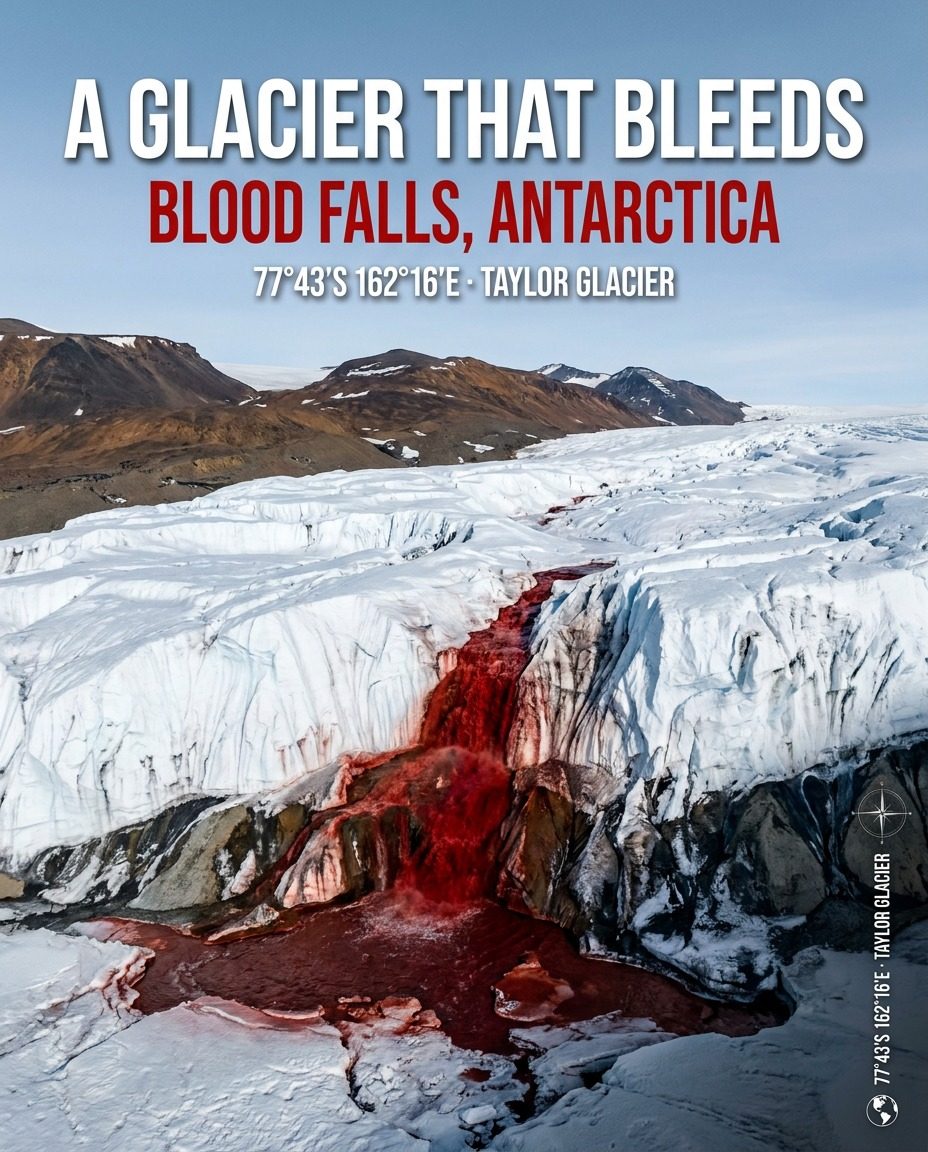
Blood Falls, Antarctic Glacier
Much of the Antarctic continent is covered with thick sheets of ice that move slowly across the land into the sea. But one glacier stands out from the crowd — Taylor Glacier, whose unique feature is a vibrant stream of rust-colored water that gives this glacier a striking nickname: Blood Falls. Despite the name, there is no blood, but iron oxide. Blood Falls is fed by iron-rich saltwater from a subglacial lake. The red stream bursts forth when the water comes into contact with air and rust starts to form. This water stream is a stark contrast to typical glaciers, which flow from the slow melting of ice above.
Hostile region of the Earth
Blood Falls lies at 77°43' South, 162.16° East, within the McMurdo Dry Valleys. The McMurdo Dry Valleys are one of the most extreme desert environments on Earth, with harsh climatic conditions. These valleys are remarkably dry, and characterized by extreme cold and low humidity. The valleys lack vegetation and are prone to intense UV radiation. These dry valleys are the most physically similar landscapes to Mars. The Taylor Glacier and its intriguing Blood Falls exist in this region. This is an environment that is as far from human activities as possible; but this means that Blood Falls paints a picture of Antarctica where humans are not at work, a glimpse into the Earth as it can be without us.
Taylor Glacier water: life on Antarctica
The Taylor Glacier that houses Blood Falls is one of the most well-studied glaciers on the planet. What makes it so interesting to scientists is that the water source that feeds Blood Falls is strikingly unusual. The water is sourced from a subglacial lake that has been isolated from the open ocean for millions of years. Scientists are fascinated about this water source, and how this water could harbor life. This water source provides an opportunity to study the possibility of life in extreme environments, and some studies indicate a lack of oxidative stress in the water — an important component of life for modern organisms. The water therefore provides a unique opportunity to study life in regions on Earth that resemble conditions in other celestial bodies, such as Mars.
Watch the Reel
Related deep dives
Similar reads based on topic and creator.
Recent articles
Fresh deep dives from the latest Reels we unpacked.
Comments
Be the first to comment.