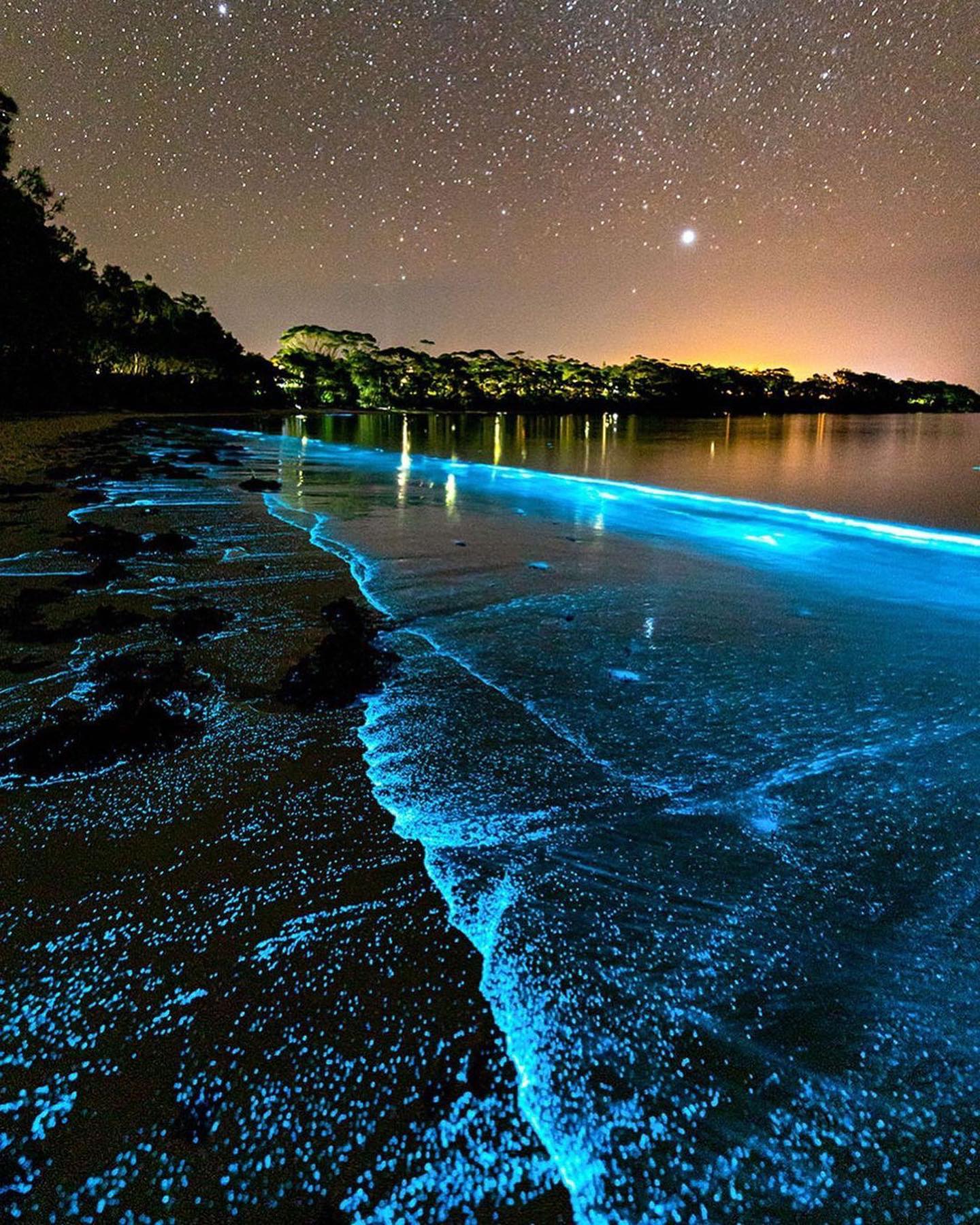
From beaches to waves turning vibrant blue as the sun sets, bioluminescent beaches are a mesmerizing natural phenomenon. The glowing effect lights up the water's edge and creates an ethereal atmosphere, especially appealing in a world where many people rarely see the night sky without light pollution.
The Thrill of Bioluminescent Waves
Bioluminescence refers to the process by which living organisms emit light. These waves are typically illuminated by dinoflagellates, a microscopic plankton. As waves roll across the shore, they churn the water, causing the tiny organisms to glow. When they are disturbed, dinoflagellates produce a blue light.
How does it happen?
Dinoflagellates are single-celled marine plankton that produce light through a chemical reaction. This type of bioluminescence is triggered by physical disturbance, like the waves crashing on shore. “Bioluminescence is the production and emission of light by a living organism as the result of a chemical reaction during which chemical energy is converted to light energy." It's the same chemicals that light fireflies and other organisms.
Finding your Illuminated Beach
To see the blue waves in action, you'll have to hit the beach at the right time. There isn't a map of bioluminescent beaches — beachgoers are often surprised when they arrive to a glowing shore. Bioluminescence occurs year-round, but it tends to be more visible during summer and fall, when warm weather boosts the algae population. Although the best viewing happens on beach during a new moon, people have reported bioluminescent beaches during a waning moon.
Blue-Glowing Waves around the World
Bioluminescence is a global phenomenon, but not all beaches glow. Although the phenomenon isn’t well-studied, it tends to occur in tropical or subtropical environments with shallow waters and minimal pollution. While the phenomenon is far from unique to Florida, they're famous for bioluminescent beaches. In the western hemisphere, further beaches are found in Puerto Rico and the Bahamas. Reports of bioluminescence beaches exist in Southeast Asia.
The science of glowing waves
Dinoflagellates are the tiny organisms that make waves glow. They are a type of plankton and are a phytoplankton that produces bioluminescence. These organisms are a form of phytoplankton. These organisms contain a chemical called luciferin. When luciferin reacts with a protein called luciferase, and water it produces light. When waves crash on shore or water movement disturbs the lucifer and luciferase, a light is produced. The light created is blue.
What's the best time to see them?
The night sky is ideal for watching bioluminescence, but the new moon is the best time to visit a bioluminescent beach. During a full moon, the moon brightens the shore. The ambient light from the moon masks the bioluminescence. In contrast, a new moon provides a dark backdrop. It maximizes the glow, which makes the waves more visible. The best time to see bioluminescence is during low tide, under a new moon. Low tide means less water movement, which can reduce the disruption of the dinoflagellates. The waves move toward the beach quickly. This movement often causes some splashback, which increases the visibility of the glowing waves. The movement of the water causes the waves to throw blue light. That seems to create the illusion of a glowing wave.
The glow is worth the risk to visit a bioluminescent beach
The beauty of the bioluminescent beaches is part of their risk. Some beaches are laid back like San Diego, but others have some risk. It’s important to be cautious when visiting a bioluminescent beach at night and to follow local safety guidelines. The blue glow creates a magical atmosphere. That makes it an appealing destination. However, if you’re thinking of visiting. The best time to enjoy a beach to see the bioluminescent beaches is to visit the beaches at night, on a new moon. You may experience the glow when you visit the beach during the day, but it will be much dimmer. Visiting a bioluminescent beach brings risks. Beaches are secluded with no safety measures, like lifeguards or street lights. There may not be a hotel nearby. Some beaches are unmarked with no trails, steps, or signs. Beaches have wildlife, dangerous surf, and trash. Always follow safety guidelines for visiting the ocean at night.
Catching the glow
Some bioluminescent beaches can be found by searching online. Others can be found in a guide. The beach may be miles away, requiring off-roading to get there. Some beaches are hard to navigate. Beaches can be hard to reach, and it’s best to go with an experienced guide. Just like any nature phenomenon, the best time to visit bioluminescent beaches is during the dinoflagellates migration. This is an annual event that occurs when warm water currents move toward the shoreline. Focusing on the tropical waters and the areas where dinoflagellates populations are found. Focus on tropical and subtropical climates, which have warm water, which is a key ingredient to seeing bioluminescent beaches.
Watch the Reel
Questions readers ask
What causes the glowing effect in bioluminescent waves?
The glowing effect is caused by tiny organisms called dinoflagellates. These are single-celled marine plankton that produce light through a chemical reaction involving luciferin and luciferase, which is triggered by physical disturbance like waves crashing on shore.
Can I see bioluminescent waves at any time of the year?
Bioluminescence can occur year-round, but it's more visible during summer and fall when the warmer weather boosts the algae population. The best time to see them is during a new moon, when the dark sky provides a perfect backdrop for the glowing waves.
Are there bioluminescent beaches near me?
Bioluminescent beaches are found in tropical and subtropical environments with shallow waters and minimal pollution. While they are more famous in Florida, you can also find them in places like Puerto Rico, the Bahamas, and Southeast Asia.
Is it true that bioluminescence only happens during a new moon?
While a new moon provides the best conditions for viewing bioluminescence due to the dark sky, people have reported seeing glowing waves during a waning moon as well. The key is minimal ambient light to maximize the visibility of the glow.
What role does the tide play in viewing bioluminescent waves?
Low tide is ideal for viewing bioluminescent waves because it means less water movement, which can reduce the disruption of the dinoflagellates. This allows for a more concentrated and visible glow. Additionally, the waves move toward the beach quickly, which can enhance the glowing effect.
What is the science behind the blue light produced by dinoflagellates?
Dinoflagellates contain a chemical called luciferin, which reacts with a protein called luciferase and water to produce light. This chemical reaction is what creates the blue glow seen in bioluminescent waves. The light is produced when the waves or other water movements disturb the luciferin and luciferase.
Are bioluminescent beaches rare?
Bioluminescent beaches are not rare, but they are not as common as regular beaches. They tend to occur in tropical or subtropical environments with shallow waters and minimal pollution. While not all beaches glow, many tropical and subtropical beaches have the potential to exhibit this phenomenon.
Related deep dives
Similar reads based on topic and creator.




Recent articles
Fresh deep dives from the latest Reels we unpacked.



Comments
Be the first to comment.