Big Mac Index: Global Price Comparison
The Big Mac Index is a famous economic tool used to compare the purchasing power of different currencies. It works by comparing the price of a Big Mac in various countries, all converted to U.S. dollars.
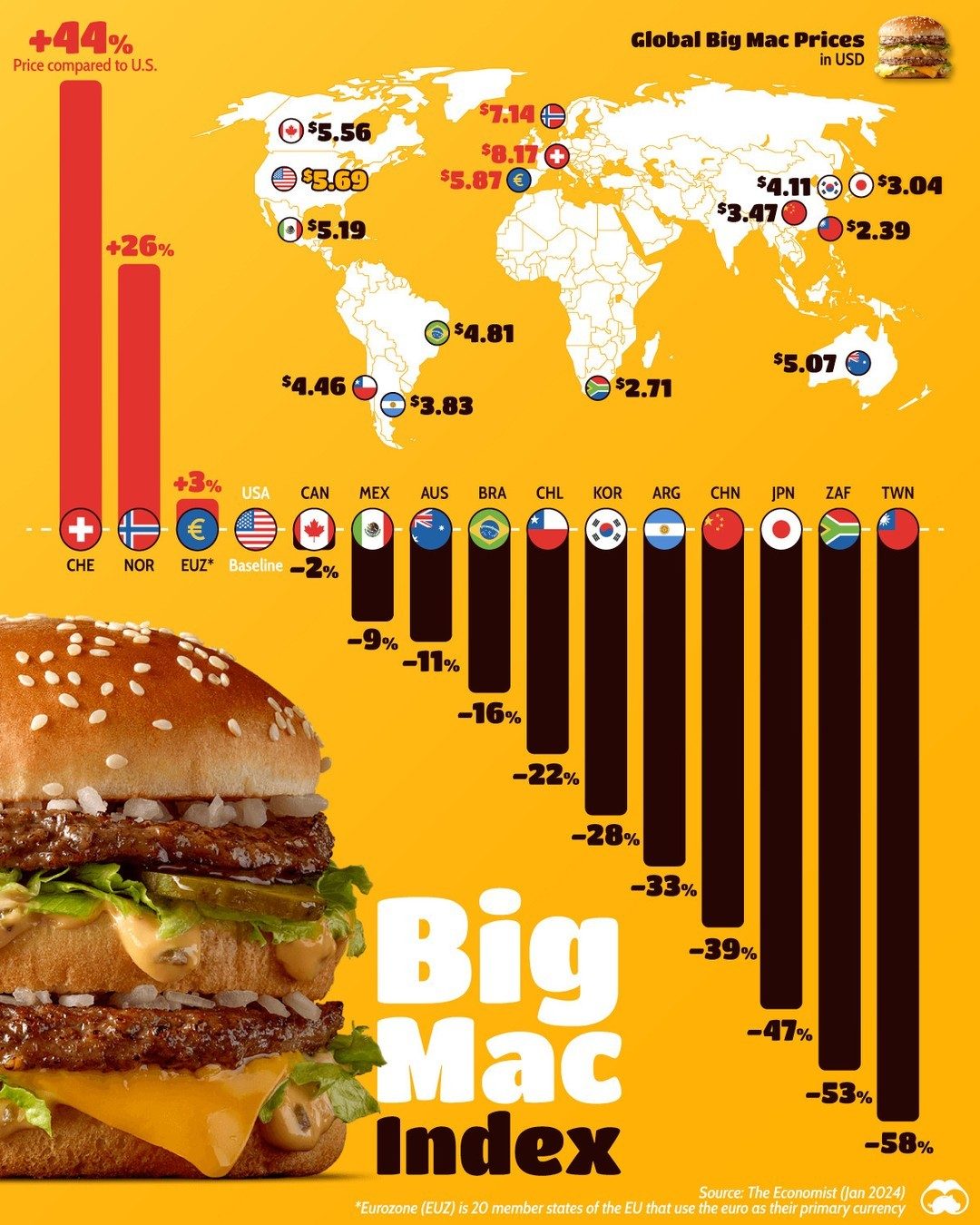
The graphic visualizes this price disparity clearly. While the graphic doesn't show the entire world, it gives a good overview of the cost of purchasing a Big Mac in different countries.
Context / Why this matters
The Big Mac Index is more than just a fun way to compare prices. It provides insights into currency valuation and purchasing power. By examining the price of a common item like a Big Mac, economists can gauge the relative strength or weakness of a country's currency.
This comparison is particularly relevant in today's interconnected world. With global trade and travel, understanding currency values is crucial. The Big Mac Index offers a simple, relatable way to grasp complex economic concepts.
Main discussion
The Most Expensive Big Mac
Surprisingly, Switzerland tops the list with the most expensive Big Mac at $8.17 USD. This price is 44% higher than the price of a Big Mac in the United States. Why is this? It's partly due to Switzerland's strong currency and high cost of living. The country's robust economy and stable political environment contribute to its strong franc, making imported goods and services more expensive.
Affordable Big Macs in East Asia
On the other hand, East Asian economies like Taiwan, Japan, China, and South Korea have currencies undervalued against the U.S. dollar. This means that a Big Mac in these countries is less expensive. For example:
- Japan: $5.69 USD
- South Korea: $4.46 USD
- China: $3.04 USD
- Taiwan: $3.47 USD
Many factors influence these lower prices, including government policies, trade agreements, and market dynamics. For instance, China's controlled currency exchange rate keeps the yuan undervalued, making exports cheaper and imports more expensive. Similarly, Japan's long-standing economic policies aim to keep the yen weak to boost exports.
Prices in Other Countries
The Big Mac Index also reveals interesting insights in other regions:
- Canada: $5.56 USD (3% higher than the U.S.)
- Australia: $5.19 USD (2% cheaper than the U.S.)
- Mexico: $3.47 USD (16% cheaper than the U.S.)
- Brazil: $4.11 USD (24% cheaper than the U.S.)
- Chile: $4.81 USD (16% cheaper than the U.S.)
These variations highlight the diverse economic landscapes across the globe. Factors like inflation, labor costs, and local market conditions all play a role in determining the price of a Big Mac in each country.
The Eurozone
The Eurozone, consisting of 20 member states of the European Union that use the euro, is another notable region. The price of a Big Mac in the Eurozone is $5.07 USD, which is 9% cheaper than in the U.S. This reflects the relative strength of the euro against the U.S. dollar and the economic policies within the Eurozone.
Practical tips
Understanding Currency Undervaluation
When a currency is undervalued, it means that the local currency can buy more foreign goods and services. This is beneficial for exporters but can make imports more expensive. Understanding this concept can help travelers and businesses make informed decisions about currency exchange and purchasing power.
Plan Ahead for Currency Exchange
If you're planning to travel, knowing the Big Mac Index can help you budget more effectively. For example, if you're heading to Switzerland, be prepared for higher costs. Conversely, if you're visiting East Asia, you might find that your U.S. dollars go further.
Global Economic Trends
The Big Mac Index offers a snapshot of global economic trends. By keeping an eye on these price comparisons, you can gain insights into inflation, currency valuation, and market dynamics. This information can be valuable for investors, economists, and anyone interested in global finance.
Important takeaways
- The Big Mac Index is a useful tool for comparing purchasing power across different currencies.
- Switzerland has the most expensive Big Mac, highlighting its strong currency and high cost of living.
- East Asian economies have undervalued currencies, making Big Macs more affordable in these regions.
- The Eurozone, with its stable currency, offers a different economic perspective.
- Understanding the Big Mac Index can help travelers and investors make informed decisions.
Conclusion
The Big Mac Index provides a fascinating and relatable way to understand global economics. By comparing the price of a Big Mac in different countries, we can gain valuable insights into currency valuation, purchasing power, and economic trends. Whether you're a traveler, investor, or simply curious about the world, the Big Mac Index offers a unique perspective on the global economy.
Watch the Reel
Questions readers ask
What is the Big Mac Index and how does it work?
The Big Mac Index is an economic measurement tool developed by The Economist. It compares the price of a Big Mac in different countries, all converted to U.S. dollars, to assess the purchasing power of various currencies and provide insights into their relative strength or weakness.
Why is the price of a Big Mac in Switzerland notably high?
The price of a Big Mac in Switzerland is high due to several factors, including the strength of the Swiss franc, higher labor costs, and stricter regulations compared to other countries. This makes the Big Mac a more expensive purchase in Switzerland than in many other nations.
Which region has the most affordable Big Mac prices?
East Asia, particularly countries such as China and Hong Kong, offers the most affordable Big Mac prices. This is primarily due to lower labor costs, different market conditions, and varying operational expenses for the fast-food chain in these regions.
How does the Big Mac Index help in understanding global economies?
The Big Mac Index helps in understanding global economies by providing a simple, relatable way to compare the purchasing power of different currencies. By examining the price of a Big Mac, which is a standardized product available worldwide, economists can gain insights into the relative strength or weakness of a country's currency and economy.
Why is the Big Mac Index graph useful for comparing global prices?
The Big Mac Index graph is useful because it visually represents the price of a Big Mac in different countries, allowing for an easy comparison of global prices. By displaying the data in a graphical format, it highlights the significant price disparities, making it simpler to understand the cost of living and currency values across various nations.
How does the Big Mac price in the USA compare to other countries?
The price of a Big Mac in the USA serves as a benchmark for comparison with other countries. Depending on the exchange rate and local economic factors, the price in the USA can be lower, higher, or comparable to other nations, providing a useful reference point for understanding global currency values and purchasing power.
What insights can be gained from the eurozone Big Mac prices?
Comparing Big Mac prices within the eurozone can reveal disparities in purchasing power and cost of living among different European countries. Despite sharing a common currency, variations in labor costs, taxes, and local market conditions can lead to significant differences in the price of a Big Mac across eurozone countries.
Related deep dives
Similar reads based on topic and creator.




Recent articles
Fresh deep dives from the latest Reels we unpacked.




Comments
Be the first to comment.