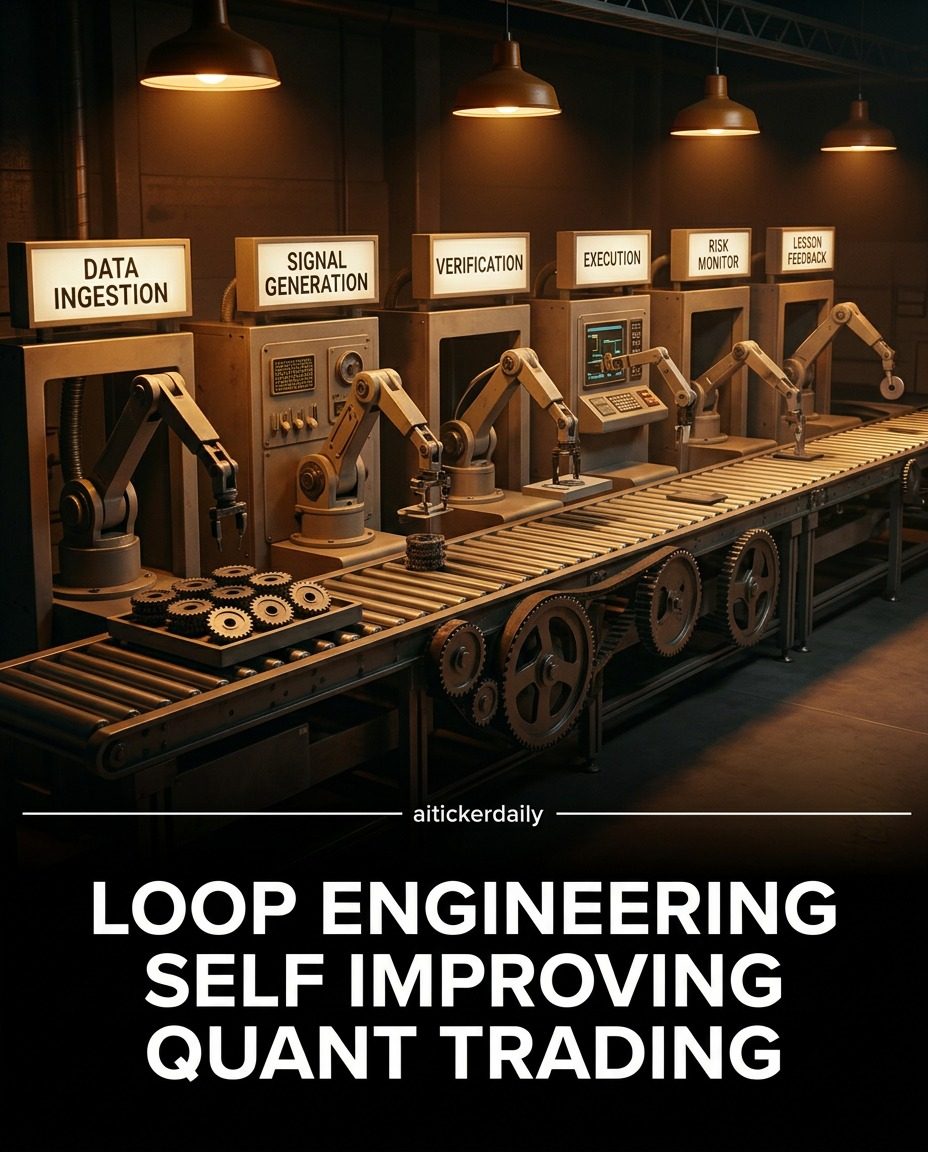
Loop Engineering in Self-Improving Quant Trading
Quant trading, or quantitative trading, involves using mathematical models and algorithms to make trading decisions. Loop engineering in quant trading transforms this process from a manual, prompt-typing chore into an autonomous system that continuously improves. This system researches alpha, verifies signals, executes trades, and monitors risk, all while learning from each trade.
Context / Why This Matters
In today's fast-paced financial markets, staying ahead of the competition is crucial. Traditional quant trading methods often rely on manual data entry and decision-making, which can be time-consuming and prone to human error. By automating these processes, loop engineering ensures that trading systems can adapt and improve without constant human intervention. This not only enhances efficiency but also increases the accuracy and reliability of trading strategies.
Main Discussion
Loop engineering in quant trading involves several key components: automation, verifiers, worktrees, and parallel processing. Let's delve into each of these components to understand how they contribute to the overall system.
Automation: The Core of the System
Automation is the backbone of a self-improving quant trading system. It utilizes cron schedules, webhooks, and commands to pull market data and iterate until a verifiable condition is met, such as achieving a Sharpe ratio greater than 1.5. This automated process ensures that the system runs consistently without manual intervention, making it reliable and efficient.
Verifiers and Worktrees: Ensuring Accuracy and Efficiency
Verifiers and worktrees play a critical role in the system. A verifier is a separate agent with different instructions that checks the work done by the main agent, following a maker-checker pattern. This dual-agent system helps prevent errors and ensures the accuracy of the trading signals. Worktrees, on the other hand, provide each agent with its own isolated working directory. This isolation prevents collisions when running multiple agents, allowing for parallel processing of tasks such as signal research, backtesting, and risk monitoring.
Parallel Processing: Optimizing Trading Strategies
Parallel processing is essential for optimizing trading strategies. By running multiple agents simultaneously, the system can handle various tasks concurrently. This includes researching alpha signals, backtesting strategies, and monitoring risk. The isolated working directories provided by worktrees ensure that these processes do not interfere with each other, leading to more efficient and effective trading.
Practical Tips
Implementing a self-improving quant trading system requires careful planning and execution. Here are some practical tips to help you get started:
-
Automate Data Collection: Use cron schedules and webhooks to pull market data at regular intervals. This ensures that your system has access to the most up-to-date information.
-
Set Verifiable Conditions: Define clear and verifiable conditions for your trading signals. This could be a specific Sharpe ratio or any other metric that aligns with your trading strategy.
-
Implement Verifiers and Worktrees: Use a maker-checker pattern with verifiers to ensure the accuracy of your trading signals. Worktrees can help isolate different processes, preventing any interference.
-
Leverage Parallel Processing: Run multiple agents simultaneously to handle tasks such as signal research, backtesting, and risk monitoring. This can significantly improve the efficiency of your trading system.
-
Monitor and Adjust: Continuously monitor the performance of your system and make adjustments as needed. This iterative process will help your system improve with each trade.
Important Takeaways
Loop engineering in quant trading offers several key benefits:
- Efficiency: By automating data collection and decision-making, the system can operate more efficiently, reducing the need for manual intervention.
- Accuracy: The use of verifiers and worktrees ensures that trading signals are accurate and reliable, minimizing the risk of errors.
- Adaptability: The system can adapt and improve with each trade, making it more effective over time.
- Parallel Processing: Running multiple agents simultaneously allows for concurrent handling of various tasks, optimizing the overall trading strategy.
Conclusion
Loop engineering in quant trading represents a significant advancement in the field of quantitative finance. By automating key processes, implementing verifiers and worktrees, and leveraging parallel processing, this system can improve efficiency, accuracy, and adaptability. With these improvements, traders can stay ahead of the competition and achieve better results in the fast-paced world of financial markets.
Watch the Reel
Questions readers ask
What is loop engineering in the context of quant trading?
Loop engineering in quant trading is a method that automates various aspects of the trading process, such as research, signal verification, trade execution, and risk monitoring. It creates a system that continuously learns and improves, reducing the need for manual intervention and enhancing overall efficiency.
How does loop engineering improve trade accuracy?
By automating the quant trading process, loop engineering minimizes human error and ensures consistent application of trading strategies. The system's ability to learn from each trade further refines its decision-making, leading to more accurate and profitable trades over time.
What are the key components of a loop engineering system in quant trading?
The key components include research for alpha, signal verification, trade execution, and risk monitoring. These components work together in an automated loop, continuously improving the system's performance and adaptability in fast-paced financial markets.
Why is continuous improvement crucial in quant trading?
Continuous improvement is vital in quant trading because financial markets are dynamic. A system that can adapt and improve based on new data and market conditions ensures that the trading strategies remain relevant, competitive, and profitable.
How does loop engineering handle risk management in quant trading?
Loop engineering integrates risk monitoring into the automated trading process, allowing for real-time assessment and management of risks. This proactive approach helps to identify potential issues early, mitigate losses, and ensure that the trading system operates within predefined risk parameters.
Can loop engineering be applied to existing quant trading strategies?
Yes, loop engineering can be applied to existing quant trading strategies. By automating the process and adding a continuous improvement loop, traders can enhance their current strategies, making them more efficient, accurate, and adaptable to changing market conditions.
What are the benefits of automating trade execution in quant trading?
Automating trade execution in quant trading increases speed and consistency, which is crucial in fast-moving financial markets. It also reduces the potential for human error, ensures precise order placement, and allows for better alignment of trade execution with the overall trading strategy.
Related deep dives
Similar reads based on topic and creator.




Recent articles
Fresh deep dives from the latest Reels we unpacked.




Comments
Be the first to comment.