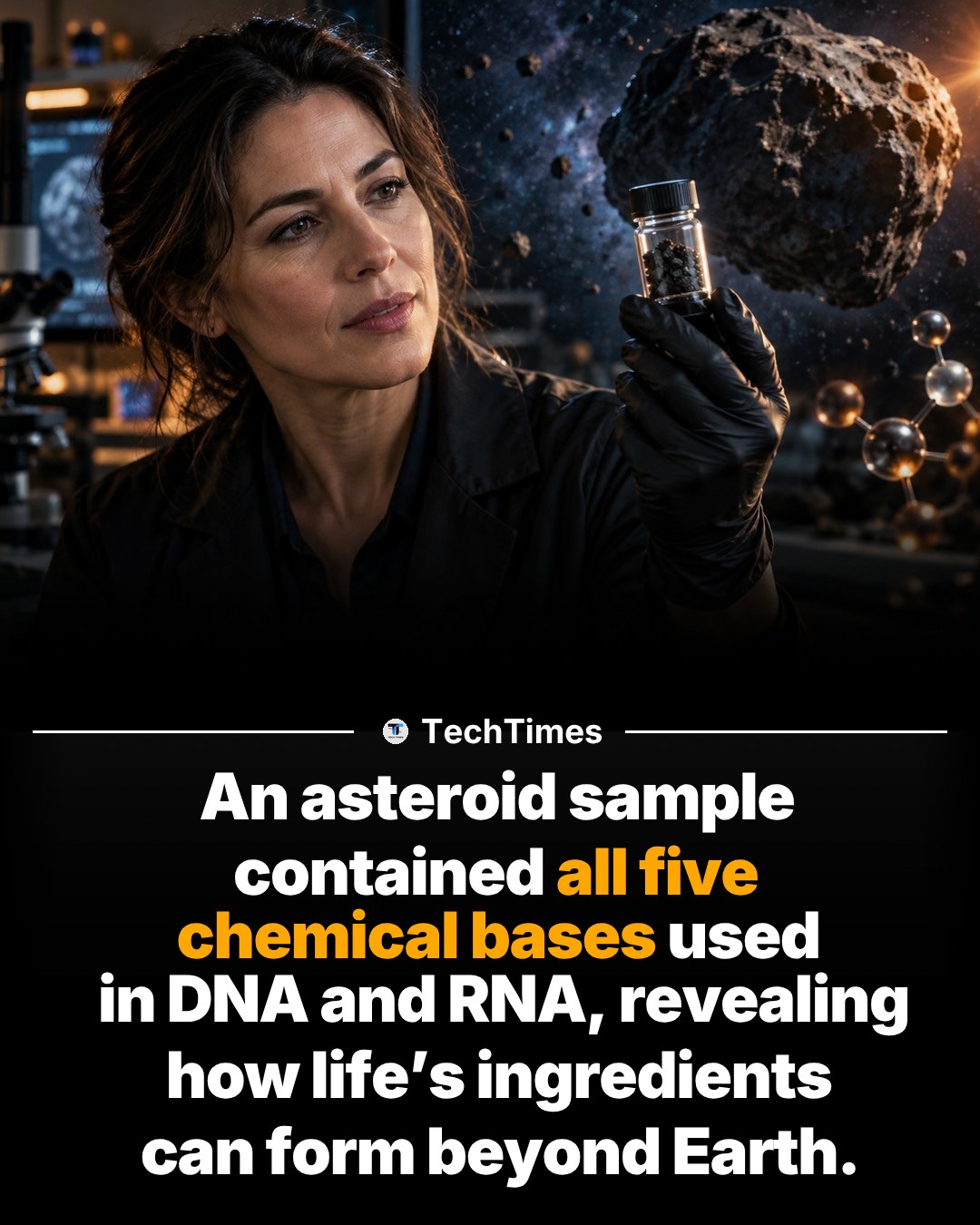
An asteroid sample has been found containing all five chemical bases necessary for DNA and RNA. What does this mean for understanding if life exists outside of Earth?
Speed-dating science in space
Asteroid sample analysis is a relatively new field of research where scientists study matter from asteroids to understand the origin of life on Earth and the potential for life beyond Earth. Asteroid samples reveal the fundamental elements required to support life. Scientists collecting samples from asteroids use laboratory equipment to analyze the samples. They typically use high-precision instruments to examine the chemical composition, mineralogy, and isotopic signatures of the samples. This helps them understand the asteroid's origins and the conditions that prevailed when it formed. These analyses are distinctive for several reasons. Firstly, asteroids are remnants from the early solar system, so their composition can provide insights into the conditions present at that time. Secondly, asteroids have not undergone the same geological processes as Earth, which means their samples can be more pristine and easier to analyze. Lastly, asteroids have been exposed to a wider range of conditions and environments.
DNA and the cosmic dance
Asteroids might have deposited the ingredients for life on Earth. Or life has formed in asteroids and has potentially the ability to survive space travel. The presence of all five chemical bases used in DNA and RNA suggests that life's ingredients can form beyond Earth. This discovery reveals potential for life to exist in a multitude of environments and may advance future research. This discovery is part of a broader scientific effort to understand the conditions that give rise to life. Astrobiologists are also studying other cosmic bodies, such as Mars and the icy moons of Jupiter and Saturn, to see if they might harbor life. One goal is to develop technology to detect life on other planets. Another aspiration is to establish a framework defining life.
The five DNA base pairs
The five chemical bases
The five chemical bases are adenine, guanine, cytosine, thymine, and uracil. Their presence in the asteroid sample is significant as these bases are the building blocks of nucleic acids, which are essential for all known forms of life. Adenine and guanine are purines, while cytosine, thymine, and uracil are pyrimidines. Both DNA and RNA contain these chemical bases. DNA uses adenine, guanine, cytosine, and thymine and forms a double helix. RNA uses adenine, guanine, cytosine, and uracil. RNA usually does not form a complex structure. These bases pair up with each other to form base pairs. Adenine always pairs with thymine in DNA and with uracil in RNA. Guanine always pairs with cytosine. This specific pairing is crucial for the stability and functionality of nucleic acids. The base pairs are held together by hydrogen bonds and allows DNA and RNA to form their respective structures.
Bases for survival
The chemical bases play different roles in the function of DNA and RNA. Adenine and guanine contribute to the stability of the nucleic acid structure while also participating in chemical reactions. Cytosine, thymine, and uracil are involved in the replication and transcription processes, where the genetic information is copied and expressed. These five chemical bases are essential for the structure and function of nucleic acids. Their presence in the asteroid sample suggests that the conditions necessary for life to form are not unique to Earth.
Scientists measure the presence of the chemical bases from asteroids
Scientists use a variety of techniques to measure the presence of these chemical bases. Techniques include:
- Mass Spectrometry: This technique identifies the mass-to-charge ratio of ions. Scientists use it to determine the chemical composition of a sample.
- Chromatography: This separates the components of a sample based on their physical and chemical properties. It can isolate and identify specific chemical bases.
- Spectroscopy: This measures the interaction between matter and electromagnetic radiation. Scientists use it to identify the chemical composition of a sample by analyzing the absorbed, emitted, or scattered electromagnetic radiation. This can reveal the presence of chemical bases. Laboratory equipment such as mass spectrometers, chromatographs, and spectrometers are essential in allowing scientists to analyze the asteroid sample.
The cosmic chasm
Asteroids and meteoroids are small, rocky objects that orbit the Sun. Asteroids are larger and can range from a few meters to hundreds of kilometers in diameter. They are typically found in the asteroid belt located between Mars and Jupiter. Meteorids often originate from asteroids or comets and range in size from tiny dust particles to large rocks. While asteroids are primarily composed of rock and metal their composition varies widely. Asteroids are typically classified based on their composition into three main types: carbonaceous, silicate, and metallic. Carbonaceous asteroids are rich in organic compounds, such as the five chemical bases. The presence of organic compounds in some asteroids suggests that they may have played a role in the origin of life on Earth. Recent discoveries have also shown that some carbonaceous asteroids contain water, which is essential for life as we know it. Scientists have collected samples from asteroids using spacecraft such as NASA's OSIRIS-REx and JAXA's Hayabusa2. They have found the five chemical bases present in samples from asteroids.
Hunting for the sparkling needle
The discovery of the five chemical bases in the asteroid sample is a significant step forward in our understanding. Researchers are also studying the possibility of life beyond Earth and want to identify other chemical compounds that could serve as building blocks for life. Some compounds they are looking for include amino acids, lipids, and carbohydrates. Astrobiologists are also studying the potential for life to exist in environments beyond Earth. They are investigating the conditions that could support life on other planets and moons in our solar system and beyond. Understanding the building blocks of life in extraterrestrial samples will help develop a framework that defines what life is. Asteroid sample analysis complements other fields of research, such as exoplanet studies and planetary science. Working together these fields help scientists better understand the conditions that give rise to life. Thus, the presence of the five chemical bases in the asteroid sample is part of a bigger cosmic chasm to explore life beyond Earth.
Watch the Reel
Questions readers ask
What are the five chemical bases found in the asteroid sample, and why are they important?
The five chemical bases are adenine, guanine, cytosine, thymine, and uracil. These are important because they are the building blocks of nucleic acids, which are essential for all known forms of life. Their presence in the asteroid sample suggests that the ingredients for life can form beyond Earth.
How do scientists analyze asteroid samples to find these chemical bases?
Scientists use high-precision laboratory instruments to examine the chemical composition, mineralogy, and isotopic signatures of asteroid samples. This analysis helps them understand the asteroid's origins and the conditions that prevailed when it formed, which can provide insights into the early solar system and the potential for life beyond Earth.
Why are asteroids useful for studying the origins of life?
Asteroids are remnants from the early solar system and have not undergone the same geological processes as Earth, making their samples more pristine and easier to analyze. This allows scientists to study the fundamental elements required to support life and understand the conditions that might have given rise to life on Earth and elsewhere.
Could life have originated from asteroids, and can it survive space travel?
Asteroids might have deposited the ingredients for life on Earth, or life could have formed in asteroids and survived space travel. The discovery of all five chemical bases used in DNA and RNA in an asteroid sample suggests that the building blocks of life can form beyond Earth and may advance future research into the potential for life in a multitude of environments.
What is the difference between DNA and RNA in terms of their structure and function?
DNA and RNA both contain the chemical bases adenine, guanine, and cytosine, but DNA uses thymine and RNA uses uracil. DNA forms a double helix, while RNA usually does not form a complex structure. The specific pairing of these bases is crucial for the stability and functionality of nucleic acids, with adenine pairing with thymine in DNA and with uracil in RNA, and guanine pairing with cytosine.
Related deep dives
Similar reads based on topic and creator.




Recent articles
Fresh deep dives from the latest Reels we unpacked.




Comments
Be the first to comment.