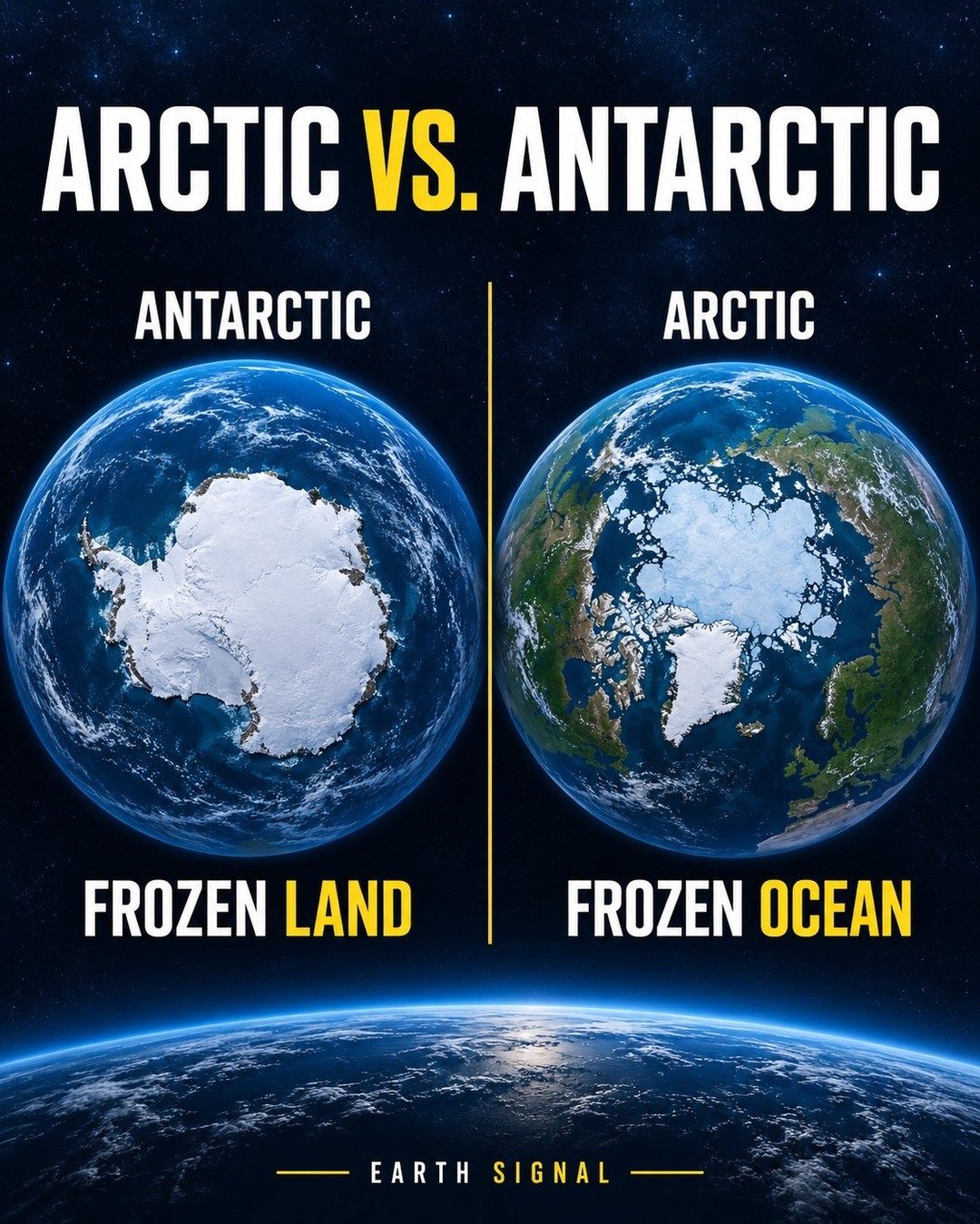
The Polar Divide: Land vs. Ocean
Science often gets shorthanded in education —and misconceptions about the poles are frequent. Polar bears on each end of the world, glaciers everywhere. Distinguish between the Arctic and Antarctic. Earth Signal cuts through the noise and reveals the essential difference: Antarctica is a continent, while the Arctic is a frozen ocean. This is more than a geographical detail. It informs much of the ice, animals, and ecosystems. Antarctica, the frozen land, is entirely surrounded by water and encased in a massive ice sheet averaging 2,000 meters (6,500 feet) thick. It’s a single, icy continent. The Arctic, on the other hand, involves multiple landmasses, including parts of Canada, Russia, and Greenland. Most of the Arctic is an ocean, covered by a layer of floating sea ice that thickens and shrinks with the seasons. The Arctic Ocean is the counterpart to Antarctica’s land ice.
Uncharted by humans.
The two polar regions exhibit striking contrasts in human presence and exploration. The Arctic has hosted Indigenous communities for centuries and remains a territorial focus for many countries. It's linked to the global economy through the Northern Sea Route and the Northwest Passage, vital for navigation and natural resources. The Arctic is the stage for Indigenous cultures’ resilience, and scientific exploration. Antarctica, notably, is a different story. The landmass is a wilderness of scientific outposts, focusing on climate research. This region remains an uncharted territory, leaving us with more mysteries to unfold. The Antarctic Treaty System, established in 1959, guarantees that Antarctica remains a demilitarized, cooperative scientific preserve for global exploration. Researchers and scientists are the primary inhabitants, unlike the Arctic's diverse mix of communities and settlers.
The ecosystems of frosty realms
The Arctic’s frozen ocean is home to the ringed seal and walrus, while the Antarctic has the emperor penguin. Distinctive animals. Two regions of Antarctica earmarked as polar deserts — precipitation is low but persistent. Life here is tenuous, but unique. The local flora relies on nutrient-rich soil, albeit sparse. The Arctic’s fauna is thornsier. The Arctic Ocean's extensive ice cover, melted seasons, and deeper waters nurture diverse species. Polar bears reign while seals and marine life teem. Life in the Arctic seeks nourishment in this wilderness, far from Antarctica’s more isolated ecosystem.
The Big Thaw: Climate Change
These two regions experience warmer temperatures at alarming rates, but climate change is altering the Arctic Ocean more profoundly. The Arctic’s sea ice is shrinking faster, with recent studies suggesting it could be ice-free during summers in the near future. The Arctic acts as a heat regulator, but its rapid transformation could lead to unpredictable weather patterns worldwide. Both regions face unprecedented challenges, yet the pace and scope of change aren’t the same.
Watch the Reel
Related deep dives
Similar reads based on topic and creator.
Recent articles
Fresh deep dives from the latest Reels we unpacked.
Comments
Be the first to comment.