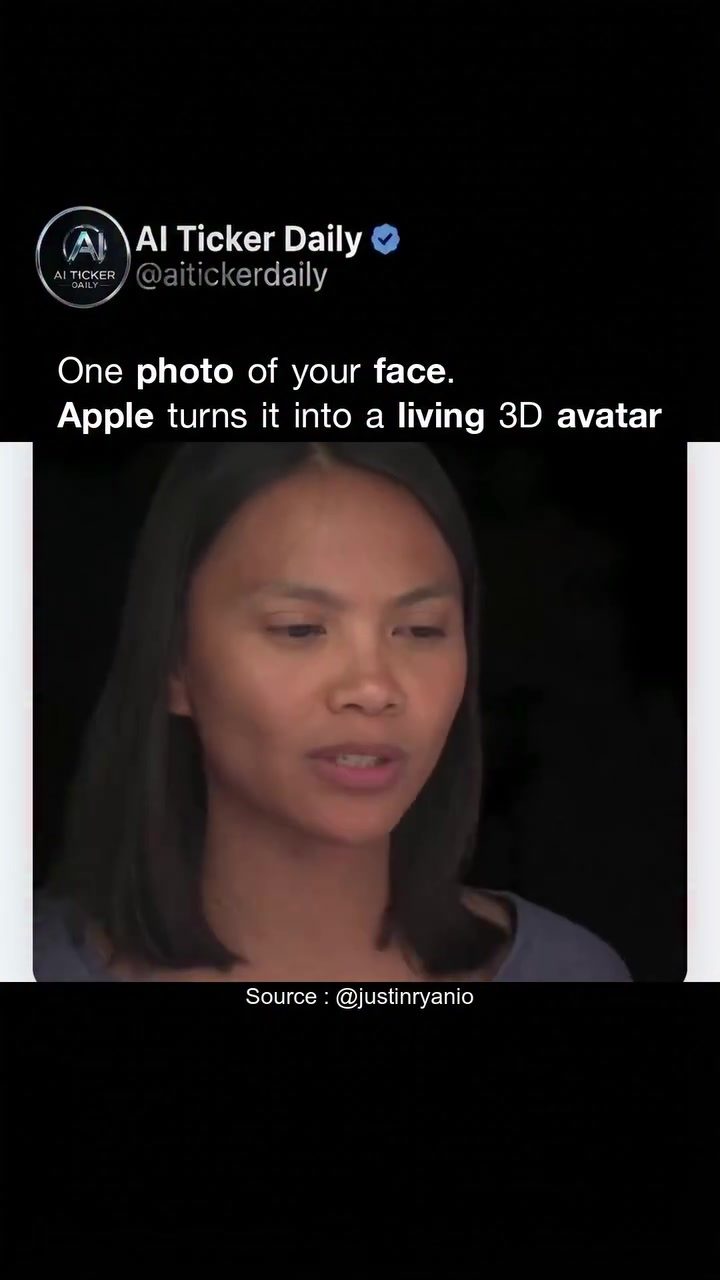
Apple's HeadsUp: Revolutionizing AI Avatar Creation with a Single Photo
The advent of Apple's HeadsUp research paper has quietly ushered in a new era of avatar creation. This innovative technology can transform a single photo of a person's face into a fully animatable, rotatable, and lightable 3D avatar. Unlike traditional cartoon filters or digitized images, HeadsUp creates a photorealistic 3D model that can be manipulated from any angle.
Why This Matters
The implications of HeadsUp extend far beyond simple avatar creation. This technology represents a significant shift in how digital identities are generated and utilized. Apple's approach eliminates the need for specialized hardware or extensive capture sessions, making the process more accessible and efficient. As spatial computing continues to evolve, having a realistic digital self could become integral to various applications, from virtual reality experiences to Augmented Reality (AR) interactions.
The HeadsUp Technology
Training and Model Accuracy
HeadsUp has been meticulously trained on over 10,000 real human faces to ensure high accuracy and realism. This extensive training allows the model to capture the nuances of individual facial features, resulting in a highly detailed and lifelike 3D avatar. The process involves sophisticated algorithms that analyze the photo and reconstruct the face in three dimensions, making it possible to animate, rotate, and light the avatar in various ways.
Photorealism vs. Traditional Approaches
Traditional avatar creation methods often rely on depth sensors, special hardware, or full capture sessions to achieve a 3D model. These methods can be time-consuming and require specialized equipment. In contrast, HeadsUp simplifies the process by using a single photo, making it more convenient and accessible. The resulting avatar is not just a static image but a dynamic, photorealistic model that can be integrated into spatial computing environments.
Integration with Apple Vision Pro Personas
HeadsUp is set to play a pivotal role in Apple's Vision Pro Personas, a technology that allows users to have a digital self within spatial computing. This integration means that users can have a realistic, digital representation of themselves that can interact within virtual environments. Whether for gaming, virtual meetings, or other AR experiences, this digital self can enhance immersion and realism.
Practical Tips for Users
Preparing the Perfect Photo
While HeadsUp can work with a single photo, the quality of the photo can significantly impact the final avatar. Here are some tips for getting the best results:
- Lighting: Ensure the photo is well-lit to capture all the details of the face.
- Resolution: A high-resolution photo will provide more data for the model to work with.
- Expression: Choose a photo where the facial expression is neutral to avoid any distortions in the 3D model.
Exploring HeadsUp Features
Once you have your 3D avatar, explore the various features that HeadsUp offers:
- Animations: Test different animations to see how your avatar can move and interact in a virtual environment.
- Lighting: Experiment with different lighting settings to see how they affect the appearance of your avatar.
- Rotation: Rotate the avatar to view it from various angles and ensure all details are captured accurately.
Potential Applications
Beyond personal use, the technology has vast potential for various applications, including:
- Virtual Reality Gaming: Creating realistic avatars for a more immersive gaming experience.
- Virtual Meetings: Enhancing virtual meetings with photorealistic avatars for better communication.
- Content Creation: Using 3D avatars in video content, animations, and other digital media.
Important Takeaways
- Innovation in Avatar Creation: HeadsUp represents a significant leap in avatar technology, using a single photo to create a photorealistic 3D model.
- Accessibility and Convenience: The technology makes avatar creation more accessible by eliminating the need for specialized hardware or extensive capture sessions.
- Integration with Spatial Computing: HeadsUp's integration with Apple Vision Pro can transform how we interact with virtual and augmented reality environments.
- Model Accuracy: The model's extensive training ensures high accuracy and realism, making it suitable for various applications.
Conclusion
Apple's HeadsUp is poised to revolutionize the way we create and use digital avatars. By leveraging a single photo, this technology makes the process more accessible and efficient, opening up new possibilities for spatial computing and virtual interactions. As we anticipate the announcements from WWDC, it's clear that HeadsUp is laying the groundwork for a future where our digital selves are as real and dynamic as our physical ones. Stay tuned for more developments in this rapidly evolving field.
Watch the Reel
Questions readers ask
What is Apple's HeadsUp technology and how does it work?
Apple's HeadsUp technology generates a photorealistic 3D avatar from a single photo. It enables the creation of a 3D model that can be animated, rotated, and adjusted for lighting, all from one image. This technology simplifies the avatar creation process, making it more accessible and efficient.
What makes HeadsUp different from other avatar creation methods?
Unlike traditional methods that require extensive capture sessions or specialized hardware, HeadsUp uses a single photo to create a 3D avatar. It focuses on photorealism and offers advanced features like animatable, rotatable, and lightable 3D models, setting it apart from simpler filters or digitized images.
What are the practical applications of HeadsUp's 3D avatars?
HeadsUp's 3D avatars have a wide range of applications. They can be used in digital identity and representation, enhancing user experiences in various fields. The technology's ability to create photorealistic 3D models from a single photo makes it valuable for gaming, virtual reality, social media, and other interactive platforms.
Do I need special equipment to create a 3D avatar using HeadsUp?
No, Apple's HeadsUp technology does not require specialized hardware or extensive capture sessions. A single photo is sufficient to generate a 3D avatar, making it an accessible option for anyone with a smartphone or digital camera.
What are the benefits of using HeadsUp for 3D avatar creation?
HeadsUp simplifies the 3D avatar creation process, making it faster and more efficient. It produces photorealistic 3D models that can be manipulated in various ways, enhancing digital identity applications. Additionally, it eliminates the need for complex setups or multiple photos, making it user-friendly and versatile.
How does HeadsUp improve upon traditional 3D avatar creation methods?
Traditional methods often involve multiple photos, specialized equipment, and time-consuming processes. HeadsUp streamlines this by using a single photo and advanced algorithms to create a high-quality, photorealistic 3D avatar. This not only saves time but also broadens the potential user base to anyone with access to a digital camera.
Can the 3D avatars created with HeadsUp be used in real-time applications?
Yes, the 3D avatars created with HeadsUp are designed to be fully animatable, rotatable, and adjustable for lighting. This makes them suitable for real-time applications, such as live video calls, virtual reality experiences, and interactive social media platforms. The technology's flexibility allows for dynamic use in various digital environments.
Related deep dives
Similar reads based on topic and creator.




Recent articles
Fresh deep dives from the latest Reels we unpacked.




Comments
Be the first to comment.