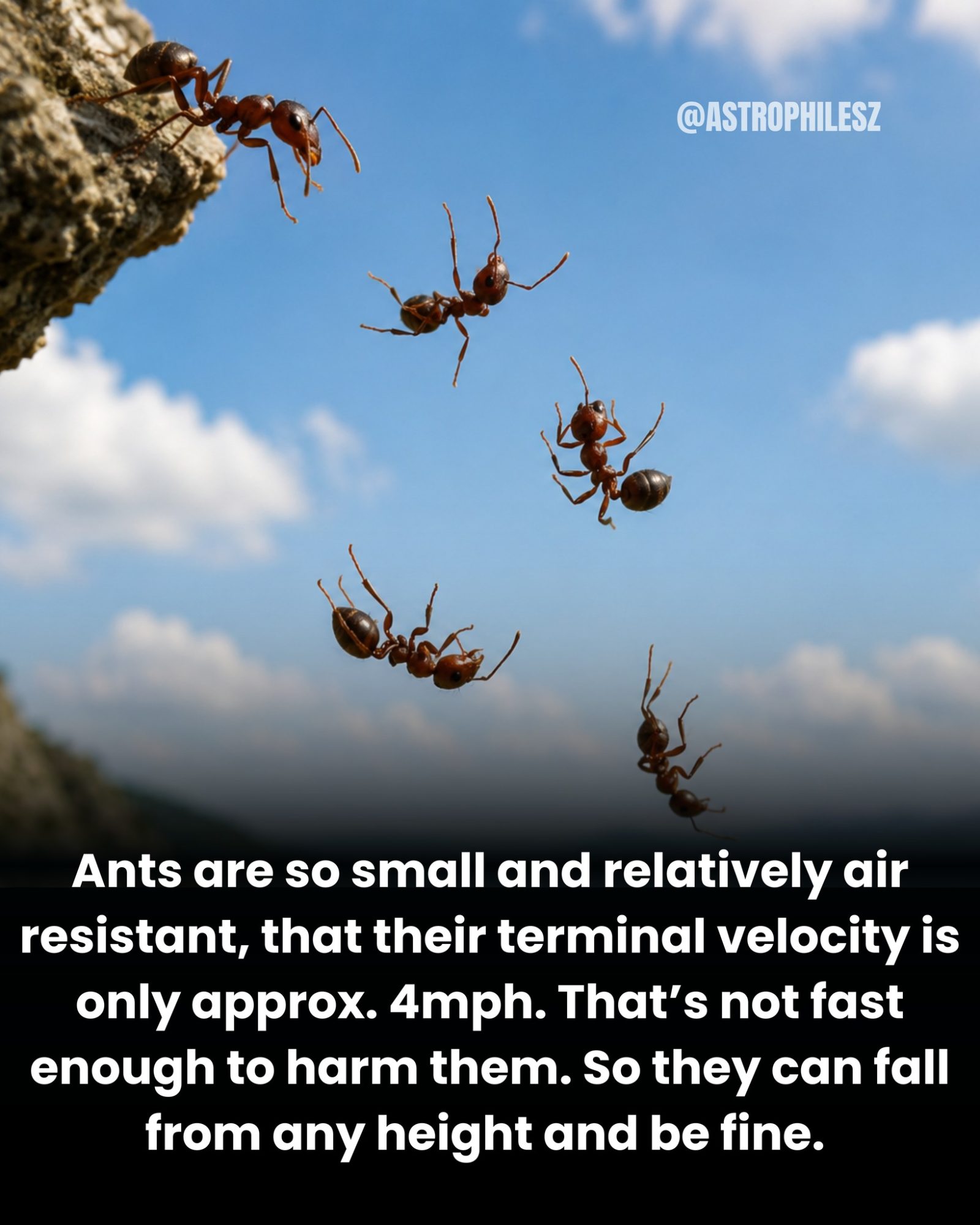
Ants' Remarkable Ability to Survive Falls from Great Heights
Ants are among the few animals capable of surviving falls from virtually any height. Their extraordinary resilience stems from a combination of their tiny size, lightweight build, and remarkable physical adaptations. Understanding why ants can withstand such falls involves delving into the physics of motion and the unique characteristics of these tiny creatures.
Why This Matters
Ants' ability to survive falls from great heights is more than just a fascinating biological trait. It highlights the incredible resilience and adaptability of these small creatures, which are among the most successful animals on Earth. Ants are found on every continent except Antarctica, and scientists estimate their global population to be in the trillions. Their resilience and durability make them a valuable subject for study, offering insights into how small organisms can thrive in diverse environments.
Main Discussion
The Role of Size and Air Resistance
Ants' small size is a crucial factor in their ability to survive falls. Because they are so lightweight, air resistance slows them down quickly, resulting in a low terminal velocity. Terminal velocity is the maximum speed that a falling object can reach. For ants, this speed is approximately 1.7–2 meters per second, or around 4 miles per hour. At this speed, the impact of a fall is usually too weak to cause any significant harm, allowing ants to walk away unscathed even after falling from extreme heights, such as skyscrapers or cliffs.
Ants as Natural Parachutes
As an ant falls, it spreads its legs and body, creating more surface area and increasing drag. This spreading action acts like a tiny parachute, further slowing the ant's descent. The ant's exoskeleton, exceptionally strong for its size, also helps absorb the impact of a fall, minimizing the risk of injury. This combination of increased drag and a sturdy exoskeleton allows ants to survive falls that would be fatal to larger animals.
The Square-Cube Law
The square-cube law explains why ants' small size makes air resistance so effective. This law states that as an organism's size decreases, its mass decreases much faster than its surface area. In other words, smaller creatures have a higher surface area-to-mass ratio, making air resistance a more significant factor in their motion. Because ants are so small and lightweight, air resistance slows them down effectively, preventing them from gaining enough momentum to experience life-threatening forces during a fall.
Practical Tips
While this is fascinating information, it is important to understand that this article is about ants. Though it is not a manual on ant safety. However, understanding the principles behind ants' ability to survive falls can offer valuable insights into the design of small, lightweight objects meant to withstand impacts. For example, engineers designing microdrones or other small, aerial devices could take inspiration from the way ants increase drag to slow their descent.
Important Takeaways
The remarkable ability of ants to survive falls from great heights is a testament to the power of natural selection and adaptation. Their small size, lightweight build, and unique physical adaptations allow them to withstand impacts that would be fatal to larger animals. Understanding these principles can offer valuable insights into the design of small, lightweight objects and the resilience of tiny organisms.
Conclusion
Ants' ability to survive falls from virtually any height is a fascinating example of nature's ingenuity. Their small size, increased drag, and sturdy exoskeleton work together to slow their descent and absorb impact, making them one of the toughest survivors in the animal kingdom. By understanding the principles behind this remarkable ability, we can gain a deeper appreciation for the resilience and adaptability of these tiny creatures, as well as valuable insights into the design of small, lightweight objects.
Watch the Reel
Questions readers ask
How do ants survive falls from extreme heights?
Ants survive falls from extreme heights due to their small size, lightweight bodies, and unique physical adaptations. These features allow them to reach lower terminal velocities, reducing the impact force upon hitting the ground.
What is terminal velocity and how does it relate to ants?
Terminal velocity is the maximum speed an object reaches when falling through the air. For ants, this speed is relatively low due to their small size and light weight, allowing them to survive falls from significant heights with minimal injury.
Can other small animals survive falls like ants?
While some small animals may survive falls from considerable heights, ants are particularly notable for their ability to withstand falls from virtually any height. This is due to their unique physical adaptations and the low terminal velocities they reach.
What role do ants' physical adaptations play in their fall survival?
Ants' lightweight bodies and small size contribute to their ability to survive falls. Additionally, their body structures act as natural parachutes, enabling them to decelerate and withstand the impact better.
What happens when an ant hits the ground after a fall?
When an ant hits the ground after a fall, the force of impact is much lower compared to larger animals or objects. This is due to their low terminal velocity, which is a result of their small size and lightweight build, minimizing the risk of injury.
Are there any other animals with similar fall survival abilities?
While ants are particularly remarkable, other small animals like spiders and certain insects also exhibit high fall survival abilities. This is often due to similar factors like small size, low terminal velocity, and specialized physical adaptations.
What does the ability of ants to survive falls tell us about their adaptability?
The ability of ants to survive falls from great heights demonstrates their exceptional resilience and adaptability. This trait contributes to their success as a species, allowing them to thrive in various environments across the globe.
Related deep dives
Similar reads based on topic and creator.




Recent articles
Fresh deep dives from the latest Reels we unpacked.




Comments
Be the first to comment.