Nature's Super Sniffers: Elephants Lead the Pack
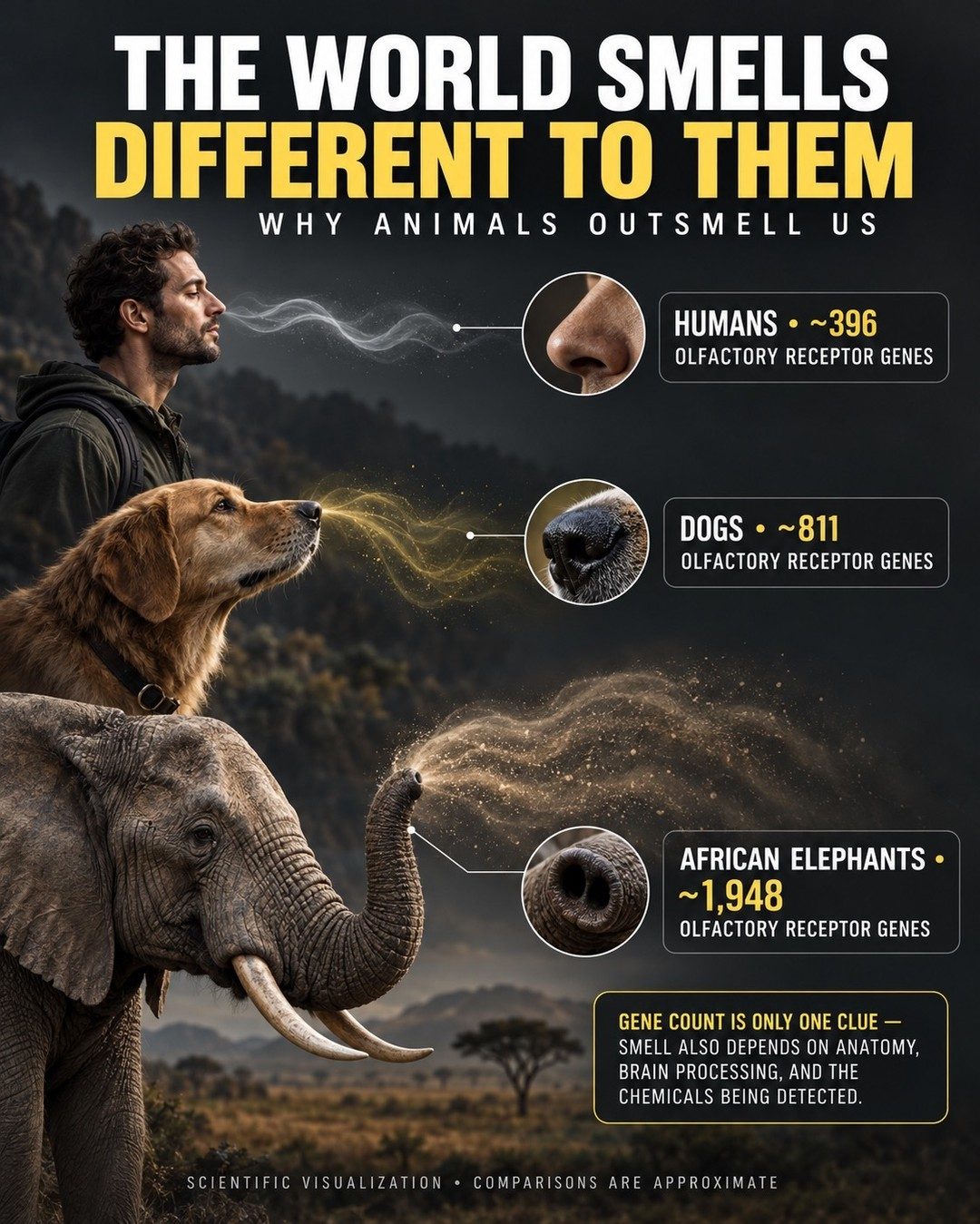
The animal kingdom is chock-full of creatures that put human olfactory abilities to shame. Elephants do not simply detect smells, they scrutinize them. Humans possess about 396 olfactory receptor genes. This genetic investment lets us differentiate between a cake and a tomato. Meanwhile, African elephants have 1,948 of these genes. This disparity exemplifies how smell can be tied to survival. Humans have 396 genes, dogs 811, and African elephants 1,948, showing an ever-increasing ability to detect, discriminate, and remember. Animal scientists have historically focused on how many olfactory receptor genes an animal has, assuming more genes equate to a better sense of smell. For many animals, however, this isn't the whole story. Certainly, having more genes results in more receptor proteins—which trains how a nose decodes molecules. But the complex mechanics of smell perception encompass more than just the number of genes. Understanding animals' olfactory power begins with understanding how their olfactory organs are structured. The structure of an animal's nose has a significant impact on its ability to smell. Dogs have a long, wide, and wrinkled inner nasal surface which maximizes the space for incoming air to contact their olfactory receptors, allowing them to scent in stereo. They can also coat their olfactory sensory areas with mucus which slows the speed of the passing air. Both of these are key to enhancing the potency of smells. And since smell is so closely tied to taste for many animals (especially carnivores), this may also affect what their food actually tastes like. But non-human mammals are not the only animals with superior olfactory sense. Insects have sensory structures that allow them to detect chemical signals — the pheromones. Scientists are still studying how these intricate pathways work, as the insect antennae are densely packed with neurons. What is clear is that an animal's perception of its environment — and its ability to thrive — is deeply tied to its ability to smell.
Human Olfactory Limits
The human olfactory system has about 40 million receptor cells, a relatively humble number compared to some animals, and our system has a high degree of redundancy. In contrast, the number of olfactory receptors is exponentially higher in dogs and elephants. Dogs have about 300 million of these receptors, while African elephants have up to 4.3 billion olfactory receptors. This allows dogs to smell, taste, and analyze the precise components of odor molecules. The number of these special receptors, however, doesn't tell the whole story. Humans outsmart these animals when it comes to certain artificial chemicals, such as those in perfumes and cosmetics. But there are 800 to 1,000 scent molecules in the air around a dog, and he can analyze each one separately, whereas humans smell them all at once. “Animals’s’ sense of smell is much better than humans”. The human nose undergoes a significant transformation by the end of the third trimester. Hormonal surges increase blood flow to the nose, swelling and narrowing the nostrils, while the mucus glands become active. The result is a heightened sense of smell. But this change is actually a "tuning" mechanism. Humans are literally sniffing out changes in our environment; but the smell is a completely new and subjective experience, one that we learn to process throughout our lives.
Elephants and Dogs: Smell's Superstars
The olfactory prowess of elephants and dogs is legendary. African elephants, in particular, have 80 times more olfactory receptor genes than humans. This genetic advantage is only part of the story. Their brain also plays a crucial role. Elephants have a large, complex olfactory bulb, the brain region responsible for processing smells. This region is relatively larger in elephants than in most other mammals. Dogs, on the other hand, have a unique way of processing smells. Their olfactory system is designed to filter out background scents, allowing them to focus on specific odors. When a dog attempts to track, the process is akin to “souring” the path. Their wet, cool snout can also collect and trap scent molecules in its olfactory mucosa. This allows dogs to maximize their smelling power. And just like humans, dogs can identify and categorize odors: flowers, decay, humans, other dogs. They can also recognize specific odors among a group of smells, and tell the difference between similar smells, which is a key ability when it comes to tracking. Both animals' olfactory abilities are tied to their survival and social structures. Elephants use their sense of smell to detect water sources from miles away, navigate complex social hierarchies, and even communicate with other elephants through chemical signals. Dogs, with their keen sense of smell, can track prey, detect threats, and interpret the social cues of their pack. Their olfactory system is so refined that they can differentiate between individual humans based on smell. Animal scientists are starting to understand the nuances of animal smell perception. Humans aren't the only species that tries to find a particular smell in a cloud of air. Many animals, especially those that are domesticated, are taught to sniff out particular odors. Though scientists still don't fully understand how the animal's whole sensory system works, it's clear that an animal's ability to sniff out a plethora of odors is a crucial aspect of its survival. Many animals have a more complex sense of smell, and understanding how their olfactory systems work can provide new insights into the animal world.
Watch the Reel
Questions readers ask
How are these numbers of olfactory receptor genes related to sense of smell abilities?
The numbers of olfactory receptor genes can be a good indicator of how well an animal can detect and differentiate smells. However, its not the sole factor. Researchers have started to add more factors, like how much of the brain is devoted to smell.
Related deep dives
Similar reads based on topic and creator.


Recent articles
Fresh deep dives from the latest Reels we unpacked.




Comments
Be the first to comment.