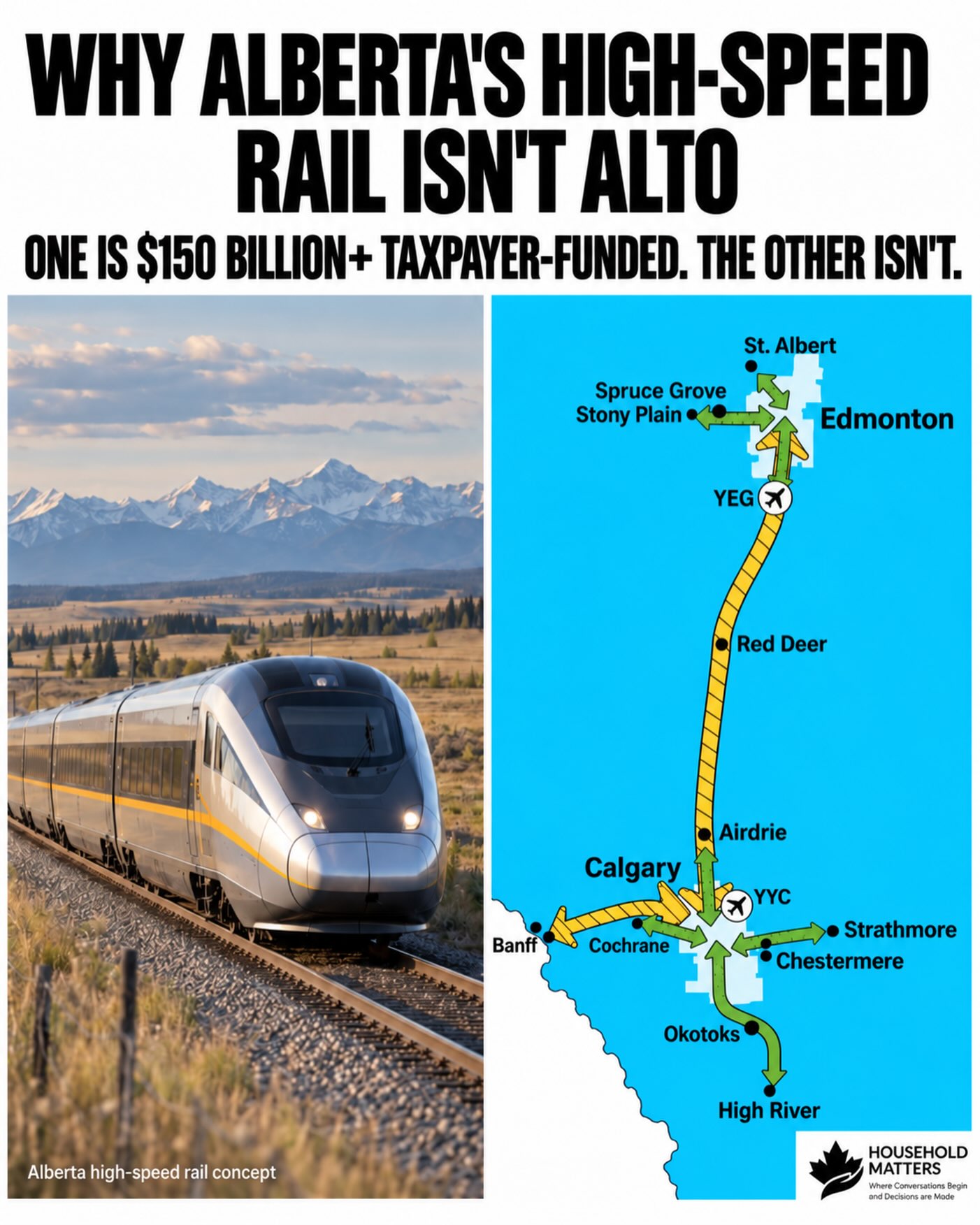
Alberta's Grand Rail Design
Alberta is planning a bold infrastructure project. The province proposes to link Calgary, Edmonton, and other cities with a high-speed rail line, stretching over 500 km and costing over $150 billion. The proposed line would connect Calgary, Edmonton, Red Deer, and other cities. The route would include major stops at St. Albert, Spruce Grove, Cochrane, Okotoks and Red Deer. The intention is to reduce the existing 4–5 hour drive between Calgary and Edmonton to a quick 90 minutes journey on the high-speed train.
A Province Split by Distance
Currently Alberta's cities aren't connected. Drivers traverse a monotonous interstate that stretches nearly 500 miles. The current drive between Calgary and Red Deer, for example, is about 1.5-hours. There's a cultural barrier, too. Newcomers to Alberta often struggle to connect with locals. But turning Alberta's vast geography into a tight-knit community means addressing basics like connectivity. The rail line would be a major step toward strengthening that connectivity — and reshaping the province's identity for future generations.
Envisioning Alberta's Rail Network
The Scope
This ambitious venture would join Calgary, Edmonton, and Red Deer via a 500 km route — cutting down driving times. Alberta's geography would be reshaped. New outposts may form, and existing destinations like Banff and Drumheller could become more accessible. Cities previously isolated by the Prairie's expanse would become interconnected nodes in a gleaming network.
Travel Time
Calgary's to Edmonton's commute could be cut down to about 90 minutes. Currently, a 4–5 hour drive is required. The major cities' travel times are not the only ones affected. The line could cut a 1.5–hour drive from Calgary to Red Deer down to less than 40 minutes. Travel would become predictable. Skip the traffic that often fills highways in rural Alberta.
Stations and Stops
The rail line connects cities with some smaller stops. It links Calgary, Edmonton, Red Deer and cities along the route — St. Albert, Spruce Grove, Strathmore, and Cochrane, among others. Calgary and Edmonton offer the most direct routes. But smaller cities would still be served with at least one stop along the route. OKotoks, St. Albert, and Red Deer each receive one stop.
The Funding Gap
This project would run taxpayers upwards of $150 billion — which raises some concerns. This cost is not a small concern for many residents. This cost nearly equals Alberta's total annual GDP. Diversifying an entire province in terms of agriculture, industry, and transportation costs a lot.
The Reality Check
The rail line’s vision is bold, but it's not without its hurdles. Founding an entire infrastructure network is not cheap, and may not translate into quick income. Infrastructure funding is already a pressure point for the province. Routes like these are seldom initiated except by countries with considerable resources. Japan, China, and Germany, to name a few. If Alberta pulls this off, it's a milestone not only for the province but for the whole of North America. The continent's largest rail network outside the USA, a European-style railway grid, would define the province.
On the Look Out
There are challenges beyond just the cost. Building an infrastructure network of this scale means environmental impact, road closures, new development, and more. Even widespread support for this project cannot ignore those impacts.
Practical Considerations
But with any new transport infrastructure comes questions. A commuting citizen might ask:
- Opportunity: How will the idea translate, given the province's funding decisions?
- Cities' Impact: How will it alter CIties' real estate and transportation needs?
- Environmental: What environmental impacts could it create or mitigate? If these questions are on the minds of concerned Alberta residents, looking for answers may be a good start. Any citizen concerned with this project can call up their local MP, reach out to the project's steering board, or even speak to their neighbours.
Watch the Reel
Questions readers ask
What are the main cities that will be connected by the Alberta high-speed rail line?
The high-speed rail line will primarily connect Calgary, Edmonton, and Red Deer. Additionally, it will have major stops in cities like St. Albert, Spruce Grove, Cochrane, and Okotoks, among others.
How much faster will the train travel between Calgary and Edmonton compared to driving?
The high-speed rail is projected to reduce the travel time between Calgary and Edmonton from the current 4–5 hour drive to just 90 minutes, making it a much more efficient and faster option.
What is the estimated cost of the Alberta high-speed rail project, and why is it so high?
The estimated cost of the project is over $150 billion. This high cost is due to the extensive infrastructure required to build a 500 km rail line and connect multiple cities, as well as the need to diversify the province's agriculture, industry, and transportation sectors.
How will the high-speed rail line impact smaller cities and towns along the route?
Smaller cities and towns like Okotoks, St. Albert, and Red Deer will benefit from having at least one stop along the route. This increased connectivity could boost local economies and make these areas more accessible, potentially leading to new developments and growth.
What are some of the challenges that Alberta might face in building this high-speed rail line?
The main challenges include the enormous cost of the project, which is close to Alberta's total annual GDP. Additionally, infrastructure funding is already a significant burden for the province, and the project may not generate quick returns on investment.
How does the travel time between Calgary and Red Deer change with the high-speed rail?
The current 1.5-hour drive from Calgary to Red Deer would be reduced to less than 40 minutes with the high-speed rail, making travel between these cities much more efficient and predictable.
Related deep dives
Similar reads based on topic and creator.



Recent articles
Fresh deep dives from the latest Reels we unpacked.



Comments
Be the first to comment.