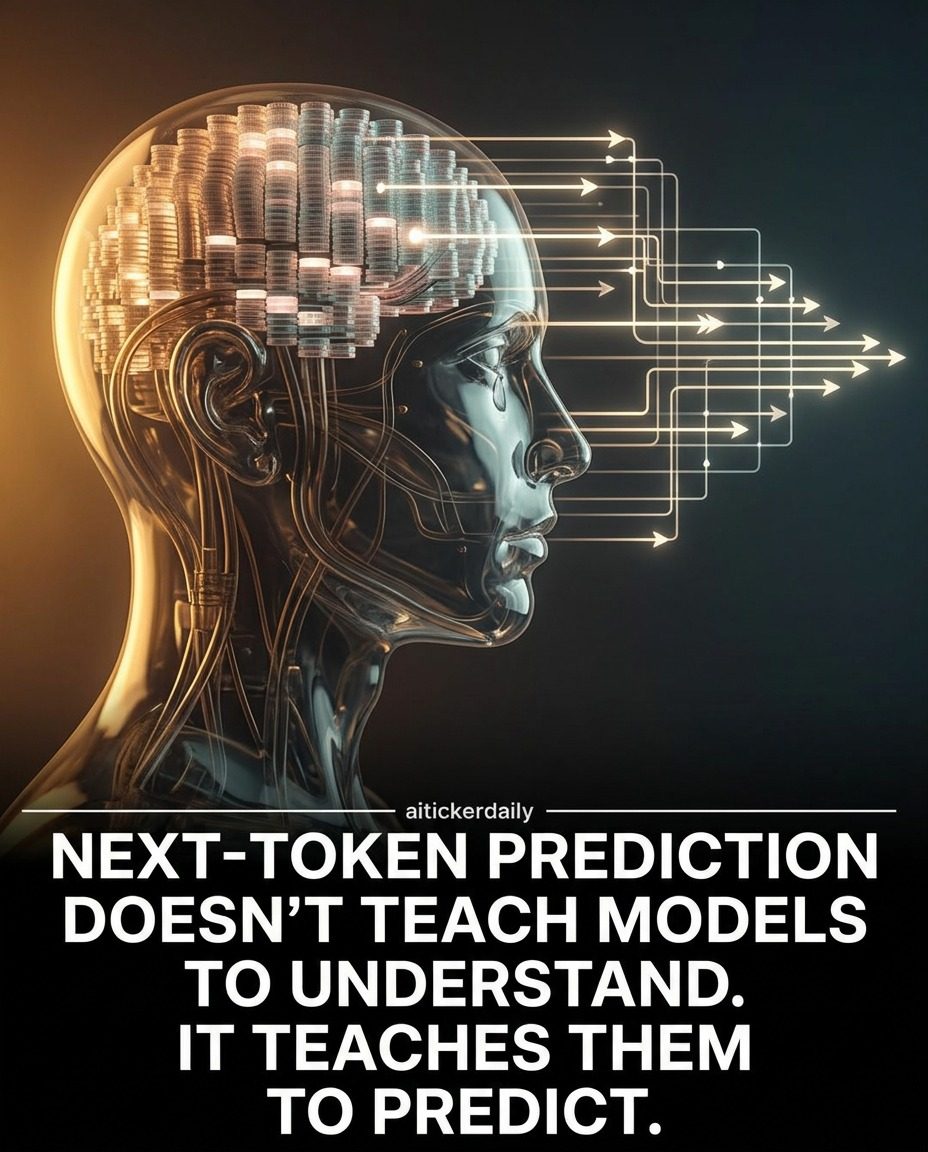
Next-Token Prediction in AI: Understanding the Limitations
Next-token prediction is a fundamental technique in natural language processing, enabling AI models to generate text by predicting the next word in a sequence. While this approach has driven significant advancements, it also presents notable limitations that are crucial to understand for anyone working with or interested in AI.
Why This Matters
Next-token prediction models are widely used because they can generate coherent and contextually appropriate text. However, their focus on prediction rather than understanding has significant implications. These models excel at pattern recognition and can produce fluent text, but they lack a deep comprehension of the content they generate. This distinction is vital for applications where true understanding, rather than mere prediction, is essential. For instance, in fields like healthcare, law, or customer service, the ability to understand context, reasoning, and causality is paramount.
The Prediction Trap
Learning Statistical Associations
Next-token prediction models primarily learn statistical associations between words. They identify patterns in vast amounts of text data, such as what word typically follows another in a given context. This statistical approach allows models to generate text that aligns with the patterns they have learned. However, this method does not equate to genuine understanding. For example, a model might correctly predict the next word in a sentence but fail to grasp the meaning or implications of that word within the broader context.
The Fluency Comprehension Gap
Fluency in language generation often comes at the cost of true comprehension. While next-token models can produce grammatically correct and contextually relevant text, they do not build mental simulations or maintain a consistent causal picture of reality. They cannot reason about the world in the way humans do. This limitation means that while these models can generate plausible text, they may also produce inaccuracies or nonsensical statements that sound convincing but are fundamentally flawed.
Benchmarks and Reality
Current benchmarks in AI often reward models based on their ability to predict the next word accurately. However, in real-world applications, the ability to understand and reason about information is more valuable. Benchmarks that focus solely on prediction do not capture the nuances of understanding, leading to a potential disconnect between model performance on benchmarks and their effectiveness in practical scenarios.
The Structural Gap
Lack of Grounded World Models
Current AI architectures lack mechanisms for grounded world models. These models have no internal simulation, no persistent state, and no causal reasoning module. They operate on the surface level of text, predicting the next word without developing an internal representation of the world or its underlying principles. This structural limitation prevents models from engaging in causal reasoning or building a cohesive understanding of the information they process.
The Role of the Learning Signal
The bottleneck in AI learning is not model size but the learning signal. Adding more layers or increasing the model's complexity does not address the fundamental issue if the training objective remains prediction. To achieve true understanding, models need better training signals that go beyond the next-word objective. This shift would require a paradigm change in how we approach AI training, focusing on Signals that encourage models to build and maintain internal models of the world.
Addressing the Limitations
Better Training Signals
To move beyond the current limitations, AI models need better training signals that encourage them to learn more than just statistical associations. This could involve incorporating more diverse and context-rich data, designing training objectives that reward understanding and reasoning, and developing architectures that support grounded world models. By focusing on these areas, researchers can help models transition from mere pattern matching to genuine comprehension.
The Path Forward
The path forward involves a multi-faceted approach. First, there is a need for more nuanced benchmarks that evaluate models on their ability to understand and reason about information, not just predict the next word. Second, research should focus on developing architectures that support grounded world models, enabling models to build and maintain an internal representation of the world. Finally, fostering collaboration between researchers, practitioners, and policymakers can help drive innovation and ensure that AI technologies are developed and deployed responsibly.
Practical Tips
For those working with or developing next-token prediction models, it's essential to be aware of these limitations and take steps to mitigate them. Here are some practical tips:
- Diversify Your Data: Use a variety of data sources to expose your model to different contexts and scenarios. This can help the model build a more comprehensive understanding of the world.
- Experiment with Training Objectives: Explore different training objectives that reward understanding and reasoning, rather than just prediction.
- Evaluate Beyond Benchmarks: Go beyond traditional benchmarks and evaluate your model's performance in real-world scenarios. This can help you identify areas where the model may be falling short in terms of understanding.
- Stay Informed: Keep up-to-date with the latest research and developments in AI. This will help you stay informed about new techniques and approaches that can help address the limitations of next-token prediction models.
Important Takeaways
- Next-token prediction models excel at pattern recognition but lack genuine understanding.
- Current AI architectures do not support grounded world models, limiting their ability to reason and comprehend.
- The bottleneck in AI learning is the learning signal, not model size.
- To achieve true understanding, models need better training signals and more nuanced benchmarks.
- Addressing these limitations requires a multi-faceted approach, including diversifying data, experimenting with training objectives, and fostering collaboration.
Conclusion
Next-token prediction models have been instrumental in advancing natural language processing, but their limitations are significant. By understanding these limitations and taking steps to address them, we can pave the way for more sophisticated and capable AI systems. The future of AI lies in developing models that can genuinely understand and reason about the world, rather than merely predicting the next word in a sequence.
Watch the Reel
Questions readers ask
What is next-token prediction in AI text generation?
Next-token prediction is a technique used in AI to generate text by predicting the next word in a sequence. This method allows AI models to produce coherent and contextually appropriate text by learning statistical patterns from large amounts of data.
Why doesn't next-token prediction equate to genuine language understanding?
Next-token prediction focuses on predicting the most likely next word based on patterns it has learned, rather than comprehending the meaning or context of the text. This means AI models can generate grammatically correct sentences without truly understanding the content or context.
What are the implications of AI's lack of deep understanding in text generation?
The lack of deep understanding in AI text generation can lead to misunderstandings, inappropriate responses, and potential errors in fields that require a nuanced grasp of language and context, such as healthcare, law, and customer service.
How does next-token prediction differ from human language comprehension?
Unlike AI models, humans comprehend the meaning, context, and nuances of language. While AI can generate text based on predicted patterns, humans can understand, interpret, and respond to language in a way that AI cannot.
Why is it important to understand the limitations of next-token prediction?
Understanding these limitations is crucial for setting realistic expectations and identifying situations where AI text generation may fall short, such as in complex decision-making or contexts requiring empathy and understanding.
Related deep dives
Similar reads based on topic and creator.




Recent articles
Fresh deep dives from the latest Reels we unpacked.




Comments
Be the first to comment.