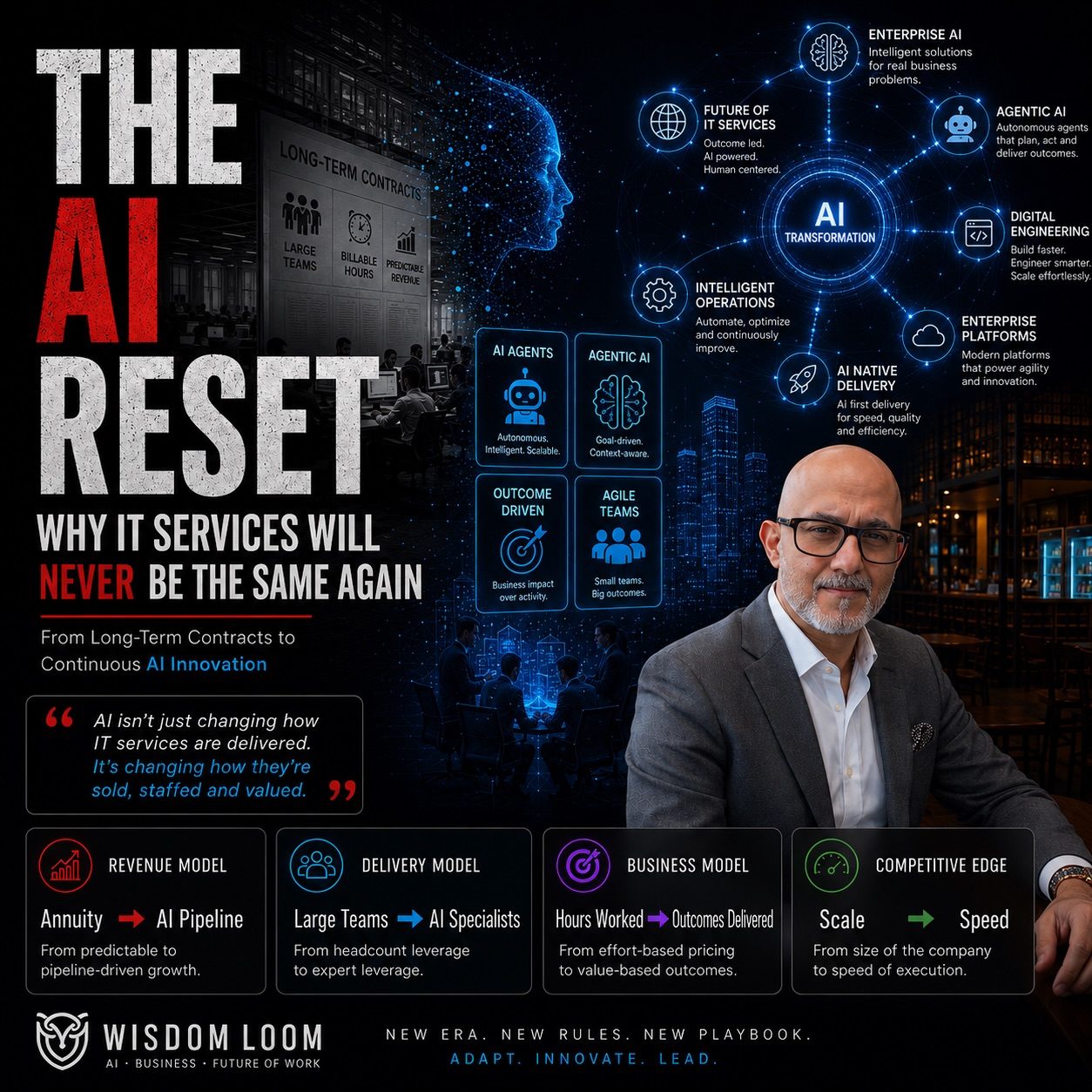
The AI Reset: Transforming IT Services
The IT services industry is undergoing a fundamental shift, driven by the integration of artificial intelligence (AI). For decades, the industry relied on a straightforward model: secure long-term outsourcing contracts, scale operations through increased headcount, and generate predictable, annuity-based revenue. This approach led to the creation of some of the world's largest technology services companies. However, this equation is being rewritten as AI becomes an integral part of IT services.
Context / Why This Matters
AI is no longer a futuristic concept; it is a tangible and growing force. Companies like Wisdom Loom are at the forefront of this transformation, leveraging AI to reshape how IT services are delivered, priced, and valued. This shift is not just about increased productivity but also about creating new business models and competitive advantages.
Main Discussion
The Shift from Annuity to Pipeline
Traditional outsourcing deals often spanned five to ten years, providing a steady stream of revenue. However, many AI engagements are completed in just one or two quarters. Once the deployment is complete, the revenue does not continue automatically. Instead, companies must continuously innovate and deliver measurable outcomes to secure the next engagement. This shift from annuity-based revenue to a pipeline-driven model has profound implications for the industry.
Focus on Outcome-Driven Approaches
The new era of IT services is characterized by agility and outcome-driven approaches. Companies are increasingly focused on identifying opportunities faster, building AI solutions rapidly, and deploying small, highly skilled teams. This approach allows for demonstrable business impact in weeks rather than years, a stark contrast to the traditional model of scaling through headcount.
The Rise of AI Agents and Autonomy
AI agents, industry-specific copilots, autonomous workflows, and digital engineering are becoming ubiquitous. These technologies automate and optimize processes, continuously improving efficiency and effectiveness. AI is not just making software development more productive; it is fundamentally changing how IT services are sold, delivered, and valued.
Revenue and Delivery Models
The integration of AI has led to a shift in revenue and delivery models. Traditional large teams are being replaced by smaller, more agile teams that can quickly adapt to changing needs. This shift is driven by the need for speed and scale, which are critical competitive advantages in the AI-driven landscape.
Practical Tips
Embrace Agile Teams
To stay competitive, companies must focus on building agile, outcome-driven teams. This involves identifying skilled professionals who can quickly adapt to new technologies and deliver measurable results. Agile teams are essential for achieving the speed and scale required in the AI-driven landscape.
Invest in AI Capabilities
Investing in AI capabilities is no longer an option but a necessity. Companies must build AI-native capabilities to stay ahead of the competition. This involves leveraging AI agents, autonomous workflows, and digital engineering to automate and optimize processes.
Focus on Continuous Innovation
In the new era of IT services, continuous innovation is key. Companies must continually innovate to secure the next engagement and deliver measurable outcomes. This involves staying ahead of the curve in terms of technology and continuously improving processes.
Deliver Measurable Outcomes
Measurable outcomes are critical for securing the next engagement. Companies must focus on delivering business impact in weeks rather than years. This involves identifying opportunities faster, building AI solutions rapidly, and deploying small, highly skilled teams.
Important Takeaways
- AI is transforming the IT services industry, reshaping how services are delivered, priced, and valued.
- The shift from annuity to pipeline-driven models is a significant change, requiring continuous innovation and measurable outcomes.
- Agile, outcome-driven teams are essential for achieving the speed and scale required in the AI-driven landscape.
- Companies must invest in AI capabilities and focus on continuous improvement to stay competitive.
- Traditional large teams are being replaced by smaller, more agile teams that can quickly adapt to changing needs.
Conclusion
The AI reset is transforming the IT services industry, creating new opportunities and challenges. Companies that embrace agile teams, invest in AI capabilities, and focus on continuous innovation will thrive in this new era. The future of IT services is driven by AI, and those who adapt will lead the way.
Watch the Reel
Questions readers ask
How is AI changing the traditional IT outsourcing model?
AI is prompting a shift from long-term IT outsourcing contracts to shorter, outcome-driven projects. This change is driven by the need for more agile and flexible IT services, allowing businesses to adapt quickly to market demands and technological advancements. Companies are moving away from predictable, annuity-based revenue models to focus on measurable results and continuous improvement.
What are the benefits of AI-driven business models in IT services?
AI-driven business models offer several benefits, including enhanced agility, improved efficiency, and better alignment with business outcomes. By leveraging AI, IT service providers can offer more customized and innovative solutions, which can lead to significant cost savings and increased competitive advantages, making them more attractive to clients.
How do outcome-driven projects differ from traditional IT service delivery?
Outcome-driven projects focus on delivering specific, measurable results rather than simply completing tasks. This approach ensures that IT services directly contribute to business goals and success metrics. Traditional IT service delivery often relies on time and materials or fixed-price contracts, which may not always align with client needs and priorities.
What role does AI play in IT service pipeline management?
AI can significantly enhance IT service pipeline management by providing predictive analytics, automating routine tasks, and optimizing resource allocation. This enables IT service providers to better forecast demand, manage workloads, and ensure that projects are delivered on time and within budget, ultimately improving client satisfaction.
How are large IT service providers adapting to AI-driven changes?
Large IT service providers are adapting to AI-driven changes by integrating AI into their service offerings, investing in AI technologies, and rethinking their business models. Many are transitioning from a headcount-driven approach to a more technology-focused strategy, emphasizing AI-driven business models and outcome-based IT services to maintain their competitive edge in the market.
What are the key challenges in transitioning to AI-driven IT services?
Transitioning to AI-driven IT services presents several challenges, including the need for significant investments in AI technologies and infrastructure, as well as the requirement for skilled personnel who can effectively implement and manage AI solutions. Additionally, there may be resistance to change from within organizations, requiring strong leadership and a well-defined transformation strategy.
How does AI impact the pricing and valuation of IT services?
AI impacts the pricing and valuation of IT services by enabling providers to offer more customized, outcome-driven solutions that deliver measurable value. This shift allows for more flexible and dynamic pricing models, such as performance-based pricing, which can lead to increased client satisfaction and better alignment with business goals.
Related deep dives
Similar reads based on topic and creator.




Recent articles
Fresh deep dives from the latest Reels we unpacked.




Comments
Be the first to comment.