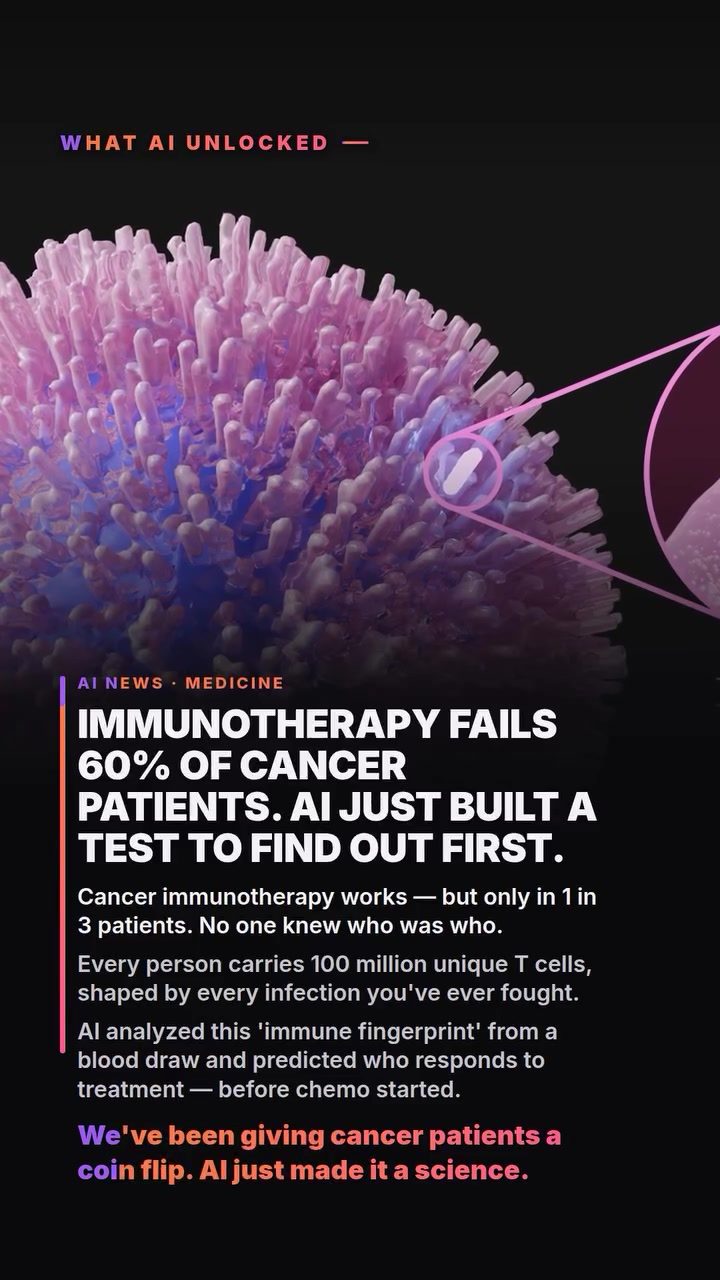
AI in Cancer Treatment
Artificial intelligence (AI) is revolutionizing cancer treatment, particularly in the realm of immunotherapy. Current immunotherapy treatments, such as immune checkpoint inhibitors like Keytruda, have significantly impacted cancer medicine. However, these treatments only work for about 20-40% of patients, depending on the type of cancer. This unpredictability has long been a challenge for oncologists, who have had no reliable way to determine which patients will respond to immunotherapy.
Context / Why This Matters
The unpredictability of immunotherapy's efficacy means that many patients undergo treatments that may not work for them. This not only delays effective treatment but also exposes patients to unnecessary side effects and emotional stress. The stakes are high: roughly 60% of cancer patients who receive immunotherapy do not benefit from it. Knowing who those patients are before treatment starts is crucial for improving outcomes and quality of life.
AI and Immunotherapy
The Science Behind Immune Fingerprints
AI is changing this landscape by analyzing what is known as the 'immune fingerprint'—the unique composition of T cells in a person's immune system. Each individual carries approximately 100 million unique T cells, shaped by every infection, vaccine, and pathogen they have encountered. This diverse repertoire of T cells is a critical factor in determining how well a person responds to immunotherapy.
Predictive Power of AI
AI tools trained on T cell receptor (TCR) sequencing data from standard blood draws can predict immunotherapy response with over 80% accuracy across multiple cancer types. This breakthrough allows oncologists to direct patients toward the most effective treatments from the outset, potentially saving months of ineffective therapy.
How AI is Changing Treatment Strategies
Personalized Medicine
The integration of AI into oncology marks a shift from a random, "coin flip" approach to a more science-based, personalized method. By analyzing a patient's immune fingerprint, AI can predict who will respond to immunotherapy before treatment even begins. This predictive capability is a significant advancement in personalized medicine, tailoring treatment plans to individual patients rather than relying on generalized protocols.
Routing Patients to Effective Treatments
With AI's ability to predict immunotherapy response, oncologists can now route patients to the right treatment from day one. This means that patients who are unlikely to respond to immunotherapy can be spared the unnecessary treatment and its associated side effects. Instead, they can be directed toward other, potentially more effective, treatment options.
Practical Tips for Oncologists and Patients
Understanding TCR Sequencing
For oncologists, understanding TCR sequencing and its implications is crucial. This involves knowing how to interpret the data from a standard blood draw and using AI tools to analyze it. This knowledge can help oncologists make more informed decisions about treatment plans.
Communicating with Patients
For patients, it is essential to have open and informed conversations with their healthcare providers about the role of AI in their treatment plans. Understanding how AI is used to predict treatment response can help patients feel more empowered and involved in their care.
Asking the Right Questions
Patients should ask their healthcare providers about the potential benefits and limitations of AI-driven predictive tools. Questions might include:
- How accurate is the prediction for my specific type of cancer?
- What are the alternative treatments if immunotherapy is not predicted to work for me?
- How will my treatment plan be adjusted based on the AI prediction?
Important Takeaways
AI's ability to predict who will respond to immunotherapy before treatment starts is a game-changer in cancer treatment. This predictive capability allows for more personalized and effective treatment plans, improving patient outcomes and quality of life.
Ethical Considerations
While the benefits of AI in cancer treatment are clear, there are also ethical considerations to keep in mind. Ensuring that AI tools are used equitably and that patients from all backgrounds have access to these advancements is crucial. Additionally, maintaining patient privacy and data security is paramount.
Future Directions
As AI continues to evolve, its applications in cancer treatment are likely to expand. Ongoing research and clinical validation studies will further refine these tools, making them even more accurate and effective. The integration of AI into oncology represents a significant step forward in the fight against cancer, offering hope for more effective and personalized treatment options.
Conclusion
AI is unlocking new possibilities in cancer treatment, particularly in the realm of immunotherapy. By analyzing immune fingerprints and predicting treatment response, AI is helping to move away from a random approach to a more science-based, personalized method. This shift has the potential to significantly improve patient outcomes and quality of life, making AI a crucial tool in the fight against cancer.
Watch the Reel
Questions readers ask
What is an 'immune fingerprint' and how does AI use it to predict immunotherapy success?
An 'immune fingerprint' refers to the unique composition of T cells in an individual's immune system. AI analyzes this information to identify patterns that correlate with successful immunotherapy outcomes, helping to predict which patients will respond to treatment with over 80% accuracy.
Why is predicting immunotherapy response important?
Predicting immunotherapy response is crucial because current treatments only work for a subset of patients. Knowing who will respond can help avoid unnecessary side effects, reduce emotional stress, and expedite the path to effective treatment.
How does AI help in reducing side effects from immunotherapy?
AI aids in reducing side effects by enabling more precise patient selection. By identifying which patients are likely to respond to immunotherapy, AI helps oncologists avoid prescribing treatments that may cause unnecessary side effects to non-responsive patients.
Can AI's predictions be used for all types of cancer?
AI's predictive capabilities are being developed and tested for various types of cancer, especially those where immunotherapy is a common treatment option. However, the accuracy and applicability can vary depending on the cancer type. Ongoing research is continuously expanding the scope of AI's predictive power across different cancer types.
What role does immune cell analysis play in cancer immunotherapy?
Immune cell analysis is a key component of AI's predictive models. By examining the composition and behavior of T cells in a patient, AI can determine whether a patient's immune system is likely to respond well to immunotherapy. This analysis allows for personalized treatment plans based on a patient's immune profile.
How soon can AI predictions be made with a simple blood test?
In some cases, AI predictions can be made quickly, often in a matter of hours, using a simple blood test. This rapid turnaround is made possible by AI's ability to analyze immune cell data efficiently, allowing for timely and informed treatment decisions.
What are the limitations of AI in predicting cancer immunotherapy success?
While AI offers significant advancements, there are limitations. For instance, the prediction accuracy can vary, and current models may not account for all the complex biological factors influencing immunotherapy response. Ongoing research and refinements are essential to enhance AI's predictive accuracy and reliability across diverse patient populations.
Related deep dives
Similar reads based on topic and creator.

Recent articles
Fresh deep dives from the latest Reels we unpacked.




Comments
Be the first to comment.