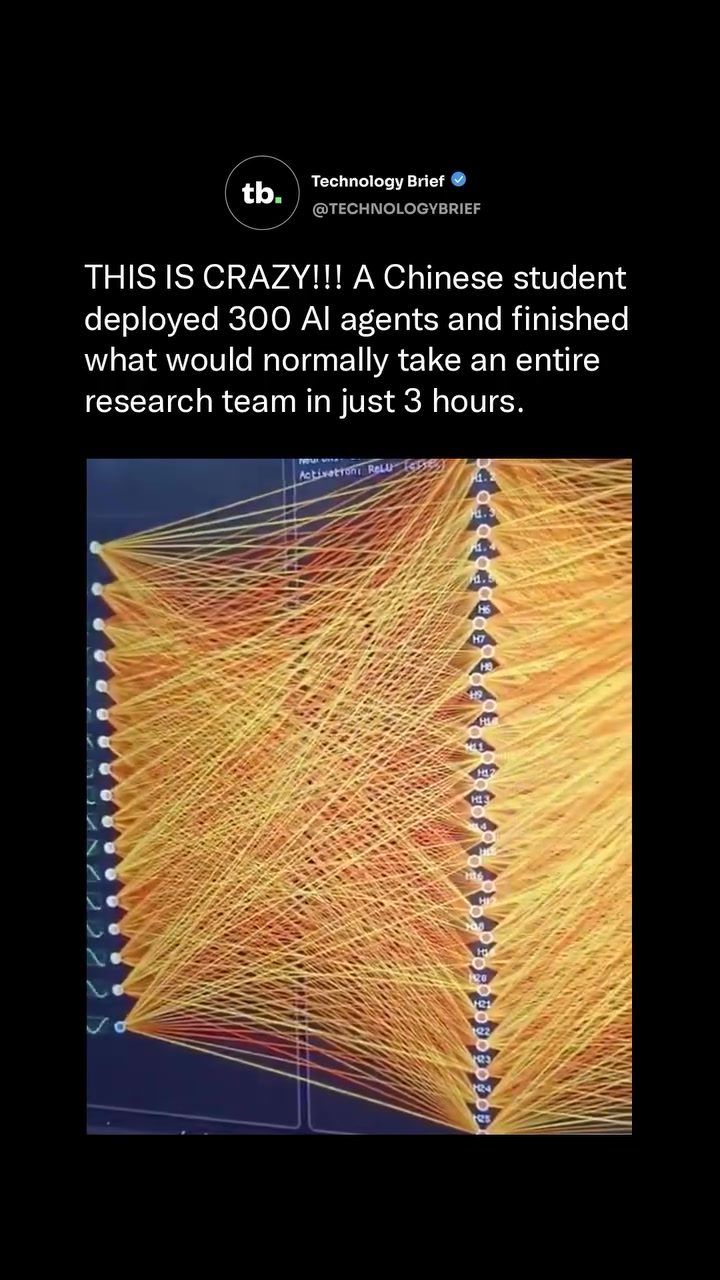
AI Agent Simulation and Neural Network Visualization
AI agent simulations and neural network editors are at the forefront of technological advancements, enabling researchers and developers to design, configure, and visualize complex AI systems in real time. This technology is particularly transformative, allowing for the deployment of hundreds of AI agents to complete tasks that would otherwise require extensive human effort. Let's dive into the details of these powerful tools and their significance in the field of AI research and development.
How AI Agent Simulations Work
At the heart of AI agent simulations lies the concept of multi-agent systems. These systems involve multiple AI agents working together to accomplish a task. Each agent operates independently, but they can communicate and coordinate their actions to achieve a common goal. This parallel processing significantly speeds up the completion of complex tasks, as demonstrated by a Chinese student who deployed 300 AI agents to finish a task that would normally require an entire research team in just 3 hours. Such efficiency highlights the potential of AI agent simulations in reducing research and development time.
In AI simulations the tasks are often executed by software designed to handle and visualize neural networks. Neural network editors, like NeuraIT v2.1, play a crucial role in this process. Built in C++ and OpenGL, these editors allow researchers to design and configure neural networks without writing raw code for every change. This capability is essential for the rapid development and testing of AI models.
Real-Time Visualization with Neural Network Editors
Neural network editors provide a visual interface for designing and configuring multi-layer neural networks. These editors display hidden layers with varying numbers of neurons, each designed to process and transmit signals through the network.
The architecture of a neural network typically includes:
- Input Layer: Receives the initial data.
- Hidden Layers: Process the data using various activation functions. In NeuraIT v2.1, the middle layers use ReLU (Rectified Linear Unit) activation, while the output layer uses Sigmoid activation.
- Output Layer: Produces the final result, handling multiple output classes.
Animated connections between neurons illustrate how signals travel through each layer, making it easier to pinpoint active network parts during training or inference. This visualization is invaluable for understanding and optimizing the performance of neural networks.
The Role of Activation Functions
Activation functions are critical components of neural networks, determining how the network processes information. Different layers within a neural network may use different activation functions to achieve specific outcomes.
- ReLU (Rectified Linear Unit): Commonly used in hidden layers, ReLU activation helps prevent issues like vanishing gradients, which can slow down the learning process.
- Sigmoid: Often used in the output layer, Sigmoid activation maps the output to a range between 0 and 1, making it suitable for binary classification tasks.
Multi-Agent AI Systems: A Fast-Growing Area of Research
Multi-agent AI systems represent a significant leap forward in AI research. These systems consist of dozens or even hundreds of individual AI models working in parallel to complete tasks. Researchers have reported dramatic reductions in the time spent on tasks that once required large groups of human researchers. This efficiency is particularly beneficial in fields like data analysis, machine learning, and automation, where complex tasks can be broken down into smaller, manageable components.
Practical Tips for Using AI Agent Simulations
To effectively utilize AI agent simulations and neural network editors, consider the following practical tips:
- Understand the Basics: Familiarize yourself with the fundamental concepts of neural networks, including layers, neurons, and activation functions.
- Choose the Right Tools: Select a neural network editor that fits your needs. Tools like NeuraIT v2.1 offer real-time visualization and customizable features, making them ideal for both beginners and experienced researchers.
- Leverage Real-Time Visualization: Use the visualization capabilities of neural network editors to monitor and optimize the performance of your AI models. This can help you identify and address issues more quickly.
- Experiment with Activation Functions: Try different activation functions to see how they affect the performance of your neural network. Understand when and why to use ReLU, Sigmoid, or other activation functions.
Important Takeaways
- Efficiency: AI agent simulations can significantly reduce the time required to complete complex tasks, as demonstrated by the Chinese student's achievement.
- Visualization: Neural network editors provide real-time visualization, making it easier to design, configure, and optimize AI models.
- Parallel Processing: Multi-agent AI systems leverage parallel processing to handle large-scale tasks more efficiently.
- Activation Functions: Understanding and choosing the right activation functions is crucial for optimizing neural network performance.
Conclusion
AI agent simulations and neural network editors are revolutionizing the way researchers and developers approach AI model design and configuration. By providing real-time visualization and parallel processing capabilities, these tools enable faster, more efficient completion of complex tasks. As the field of AI continues to evolve, the importance of these technologies will only grow, making them essential for anyone involved in AI research and development. Embrace these powerful tools to stay at the forefront of technological advancement.
Watch the Reel
Questions readers ask
How can AI agent simulations help in completing complex tasks?
AI agent simulations allow multiple AI agents to work together in a coordinated manner, breaking down complex tasks into smaller, manageable parts. This collaboration enables the completion of intricate tasks more efficiently and quickly, as demonstrated by the Chinese student who finished a task in just 3 hours.
What are the benefits of using neural network editors in AI research?
Neural network editors provide a visual interface for configuring and optimizing neural networks in real-time. This allows researchers to fine-tune AI models without extensive coding, making the process more accessible and efficient.
Can AI agents operate independently while working on a common goal?
Yes, AI agents in multi-agent systems can operate independently but are designed to work towards a common goal. Each agent can perform specific tasks autonomously, contributing to the overall objective while also being able to communicate and collaborate with other agents.
How does real-time AI configuration enhance the efficiency of AI systems?
Real-time AI configuration allows researchers to make immediate adjustments to AI systems, optimizing performance and adapting to new challenges without significant delays. This dynamic approach ensures that AI agents can respond swiftly to changes, maximizing their efficiency.
What role do AI agent simulations play in the future of AI research?
AI agent simulations are pivotal in advancing AI research by enabling the deployment of hundreds of AI agents to handle complex tasks. This capability not only accelerates research but also opens new avenues for innovation and discovery in the field, making AI systems more robust and versatile.
What are neural activation layers and how do they contribute to AI task automation?
Neural activation layers are components within neural networks that introduce non-linearity, enabling the network to learn and model complex patterns in data. By visualizing and adjusting these layers, neural network editors help in automating AI tasks more effectively, leading to improved performance and accuracy.
How do AI agent simulations and neural network editors work together in real time?
AI agent simulations and neural network editors complement each other by allowing real-time configuration and visualization of AI systems. Researchers can deploy and monitor AI agents while simultaneously adjusting neural network parameters, ensuring that both the agents and the underlying models are optimized for the task at hand.
Related deep dives
Similar reads based on topic and creator.




Recent articles
Fresh deep dives from the latest Reels we unpacked.




Comments
Be the first to comment.