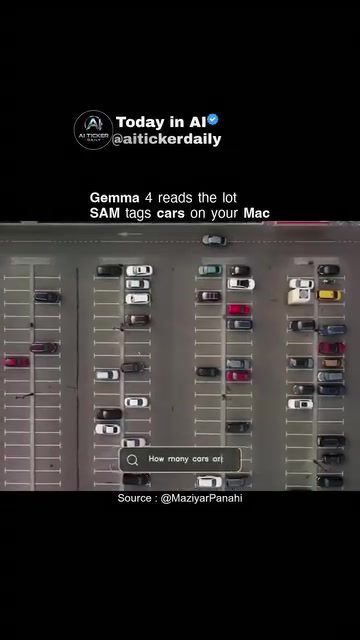
AI-Powered Car Recognition: Identifying Vehicles in a Parking Lot
Artificial Intelligence (AI) is making waves in various fields, and one of the most intriguing applications is in car recognition. Specifically, AI can be used to identify and count vehicles in a parking lot, which has significant implications for management and security. This article explores how AI software, running on a MacBook, can segment and analyze cars in a parking lot using tools like Gemma 4 and SAM.
Why This Matters
In the realm of parking lot management, security, and optimization, being able to quickly and accurately identify and count vehicles can be crucial. AI-powered car recognition offers an efficient solution to this problem. By using software that can segment and analyze vehicles, parking lot managers and security personnel can gain valuable insights into utilization, identify vehicles of interest, and improve overall efficiency.
Main Discussion
The Role of AI in Vehicle Identification
AI software leverages advanced algorithms to analyze images and videos, identifying and categorizing objects within them. In the context of car recognition, this means the software can process images of a parking lot and identify individual vehicles. This technology can be particularly useful for tasks such as managing parking spaces, monitoring traffic, and enhancing security.
How Gemma 4 and SAM Work Together
Gemma 4 and SAM are two powerful AI tools that can be used in tandem to achieve precise car recognition. Gemma 4 acts as the reasoning and orchestrating model, deciding what actions to take next based on the data it receives. On the other hand, SAM 3.1 is responsible for executing segmentation tasks, such as identifying and tagging vehicles within the parking lot.
The process typically involves Gemma 4 analyzing the parking lot scene and then calling SAM 3.1 with plain-language prompts. For instance, Gemma 4 might ask SAM to segment all vehicles in the lot. SAM then processes this request and identifies all the cars, providing a count of the total number of vehicles. This count can be further refined by additional prompts, such as identifying only white vehicles.
The Technical Setup
The AI software runs locally on a MacBook via MLX, eliminating the need for cloud computing or API keys. This local execution is advantageous because it ensures faster processing times and enhanced data privacy. The use of Apple Silicon further optimizes performance, making the setup efficient and reliable.
Practical Tips
Setting Up the System
- Install Necessary Software: Ensure you have the necessary AI software, such as Gemma 4 and SAM, installed on your MacBook. These tools can be downloaded from their respective sources or official websites.
- Configure Local Execution: Set up your MacBook to run the software locally. This involves configuring the MLX environment, which allows the software to operate without relying on cloud services.
- Optimize for Performance: Take advantage of Apple Silicon's capabilities to enhance the performance of the AI software. This can involve tweaking settings and ensuring your hardware is optimized for AI tasks.
Using Plain-Language Prompts
Utilizing plain-language prompts can simplify the interaction with the AI software. For example, instead of entering complex commands, you can use simple instructions like "segment all vehicles" or "refine to just the white ones." This makes the system more user-friendly and accessible, even for those without extensive technical knowledge.
Important Takeaways
- Efficiency and Accuracy: AI-powered car recognition offers a highly efficient and accurate way to identify and count vehicles in a parking lot.
- Local Execution: Running the software locally on a MacBook via MLX ensures faster processing and enhanced data privacy.
- User-Friendly Prompts: Using plain-language prompts simplifies the interaction with the AI software, making it accessible to a broader range of users.
Conclusion
AI-powered car recognition is a game-changer in the field of parking lot management and security. By using tools like Gemma 4 and SAM, running locally on a MacBook, you can achieve precise and efficient vehicle identification. This technology not only simplifies the management of parking spaces but also enhances security and optimizes overall efficiency. Whether you're a parking lot manager or a security professional, leveraging AI for car recognition can provide significant benefits and keep you ahead in a rapidly evolving technological landscape.
Watch the Reel
Questions readers ask
What are the benefits of using AI for parking lot management?
AI enhances parking lot management by providing real-time data on vehicle occupancy and movement. This enables better space utilization, improves traffic flow, and helps in quickly identifying available spots, thus reducing the time drivers spend searching for parking.
How does AI car recognition improve parking lot security?
AI car recognition enhances security by enabling automated monitoring of vehicles entering and exiting the parking lot. This helps in detecting unauthorized vehicles, tracking suspicious activities, and providing evidence in case of incidents. It also aids in identifying vehicles that have overstayed their permitted time.
What is the role of Gemma 4 and SAM in AI-powered car recognition?
Gemma 4 and SAM are software tools that facilitate AI-powered car recognition. They allow users to segment and analyze vehicles accurately, which is essential for counting and identifying cars in a parking lot. These tools run on a MacBook, making them accessible for users who prefer macOS.
Can AI parking analytics help in reducing operational costs?
Yes, AI parking analytics can help reduce operational costs by optimizing the use of space and resources. By providing insights into peak usage times and patterns, AI can help in dynamically adjusting staffing levels and other resources, ensuring efficient operation and minimizing waste.
How accurate is AI in vehicle detection and counting?
AI-powered vehicle detection and counting systems, like those using Gemma 4 and SAM, offer high accuracy rates, often exceeding 95%. However, accuracy can be influenced by factors such as lighting conditions, vehicle types, and parking lot layout. Regular updates and tuning of the AI models can help maintain high performance.
What are the key features to look for in vehicle counting AI software?
Key features to look for in vehicle counting AI software include real-time data processing, accuracy in vehicle detection and counting, compatibility with existing systems, ease of use, and robust analytics and reporting capabilities. The ability to integrate with other management systems is also beneficial for seamless operations.
How can AI help in optimizing parking lot usage during peak hours?
AI can optimize parking lot usage during peak hours by providing real-time data on available spaces and predicting demand based on historical data. This allows parking managers to implement dynamic pricing strategies, direct drivers to alternative parking options, and manage the flow of vehicles more effectively, thus reducing congestion and enhancing user experience.
Related deep dives
Similar reads based on topic and creator.




Recent articles
Fresh deep dives from the latest Reels we unpacked.




Comments
Be the first to comment.