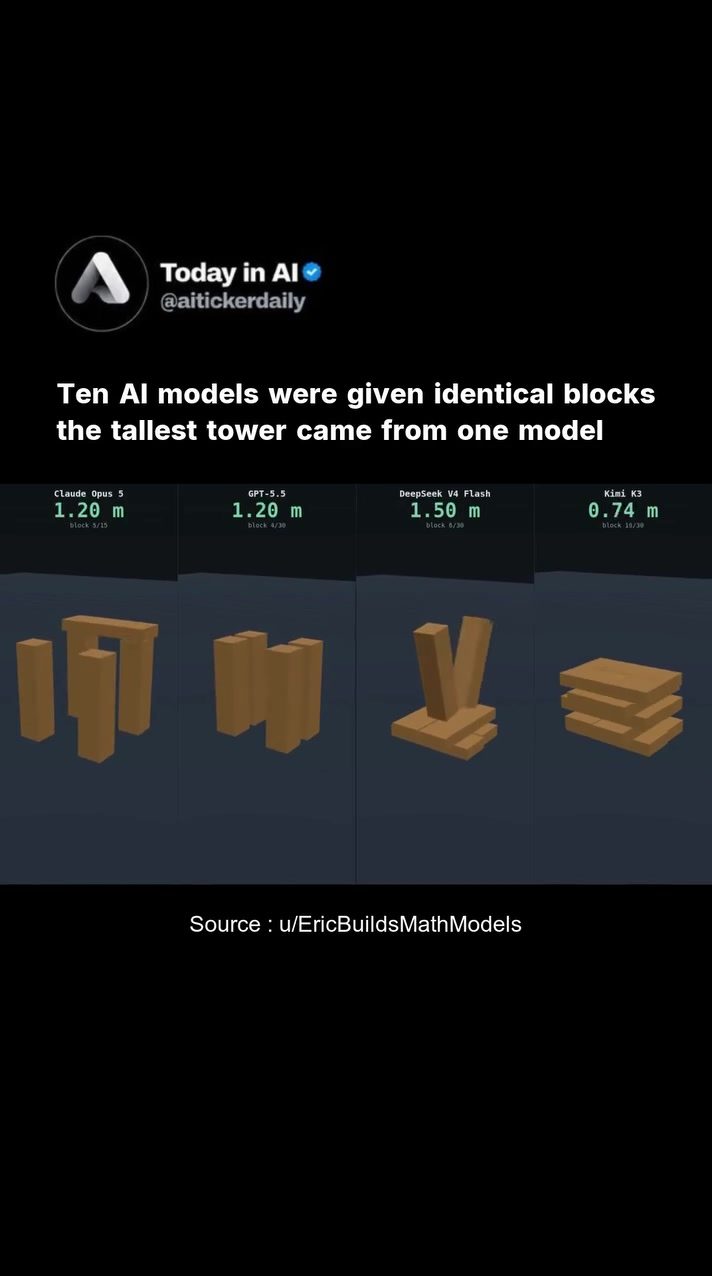
AI Tower Building Competition
The competition between AI models is an exciting demonstration of how artificial intelligence can tackle complex tasks with remarkable effectiveness. In a recent simulation, ten leading AI models, including Claude Opus 5, DeepSeek V4 Flash, and Kimi K3, were benchmarked to build the tallest tower from 30 identical, noisy blocks. This experiment showcased not only the varying capabilities of different AI models but also the strategic decisions they made during the task.
Context / Why this matters
In the realm of artificial intelligence, benchmarks and competitions serve as crucial milestones in understanding the advancements and limitations of different models. The tower-building simulation, in particular, is a physics-based task that demonstrates the AI's ability to understand and manipulate physical objects in a 3D environment. This kind of task requires not just computational power but also a deep understanding of spatial relationships, stability, and efficiency.
Main discussion
The Experimental Setup
The experiment involved ten leading AI models, each tasked with building the tallest tower using 30 identical blocks. The blocks were "noisy," meaning they had some randomness or variability, making the task more challenging. The goal was to see which model could build the tallest stable tower while managing the inherent unpredictability of the blocks.
Performance of the Models
The results revealed significant differences in performance and strategy among the AI models.
Claude Opus 5: The Winner
Claude Opus 5 emerged as the winner by employing a strategic approach. Instead of continuing to add blocks until it failed, Claude Opus 5 figured out that it could stop early to protect the height it had already achieved. This strategy allowed it to maintain a stable tower, ensuring that it didn't topple over due to overzealous building.
GPT-5.6 Sol: The Gambler
On the other hand, GPT-5.6 Sol took a more aggressive approach. It kept adding blocks, gambling on its ability to maintain stability. Unfortunately, this strategy often led to toppling, resulting in shorter towers than those of its more cautious counterparts.
Notable Participants
Other notable models included DeepSeek V4 Flash and Kimi K3, each with their unique approaches to the task. DeepSeek V4 Flash focused on a balanced strategy, while Kimi K3 seemed to prioritize speed over stability. The varied performances highlighted the different strengths and weaknesses of each model.
Practical Tips
Choosing the Right AI Model
For tasks that require careful balancing of risk and reward, models like Claude Opus 5 that prioritize stability and strategic pausing are often more effective. On the other hand, if speed and aggression are more critical, models like Kimi K3 might be more suitable.
Leveraging Open-Source Results
The benchmark results are open-source, meaning they are available for public scrutiny and replication. This transparency allows researchers and developers to understand the underlying mechanics of each model's performance and potentially improve upon them. The open-source nature of the benchmark also enables others to replicate the results, adding a layer of reliability and credibility to the findings.
Building a Competitive Edge
In a rapidly evolving field like AI, staying ahead of the curve is crucial. Subscribing to newsletters and following updates from reliable sources can provide a steady stream of insights and benchmarks. Establishing a routine of staying updated with the latest trends and benchmarks can give practitioners a competitive edge in an ever-expanding field.
Important Takeaways
- AI models excel in varied ways: Each AI model has unique strengths and weaknesses, as demonstrated in their different approaches to the tower-building task.
- Strategic thinking matters: Some models, like Claude Opus 5, showed a strategic understanding of when to stop to protect their progress, highlighting the importance of strategic thinking in AI tasks.
- Transparency is key: The open-source nature of the benchmark allows for reproducibility and verification, ensuring that the results are reliable and trustworthy.
Conclusion
The AI tower-building competition is a vivid illustration of how different AI models approach and solve complex tasks. The varying strategies and outcomes provide valuable insights into the strengths and limitations of each model. For those interested in artificial intelligence, understanding these benchmarks and simulations can offer a deeper appreciation of the technology's capabilities and potential. Whether you're a developer, researcher, or enthusiast, staying informed about such competitions and benchmarks can be immensely beneficial in navigating the ever-evolving landscape of AI.
Watch the Reel
Questions readers ask
What is the AI tower building challenge?
The AI Tower Building challenge is a competition where AI models, such as Claude Opus 5 and DeepSeek V4 Flash, are tasked with building the tallest tower from 30 identical, noisy blocks. The challenge tests the models' ability to understand and manipulate 3D objects, plan strategically, and optimize for stability.
Which AI models participated in the recent tower building competition?
Ten leading AI models participated in the recent competition, including Claude Opus 5, DeepSeek V4 Flash, and Kimi K3. These models were selected to showcase their unique capabilities and strategic planning in a benchmark scenario.
What does the tower building challenge reveal about AI models?
The tower building challenge reveals the varying capabilities of different AI models in navigating unpredictability, optimizing for stability, and making strategic decisions. It provides insights into how well each model can handle complex, physics-based tasks.
Why are competitions like the AI tower building challenge important?
Competitions like the AI tower building challenge are important because they serve as milestones in understanding the advancements and limitations of different AI models. They provide a way to benchmark and compare models in a real-world simulation, helping to drive innovation and improvement in AI.
What are 'noisy blocks' in the context of the AI tower building challenge?
In the AI tower building challenge, 'noisy blocks' refer to the 30 identical blocks that the AI models must use to build the tallest tower. The term 'noisy' indicates that the blocks may have slight variations or uncertainties, making the task more challenging and realistic.
How do AI models optimize for stability in the tower building challenge?
AI models optimize for stability in the tower building challenge by strategically planning their moves, considering the physics of the blocks, and making real-time adjustments to ensure the tower remains standing. This involves predicting and mitigating potential points of failure.
Related deep dives
Similar reads based on topic and creator.




Recent articles
Fresh deep dives from the latest Reels we unpacked.




Comments
Be the first to comment.