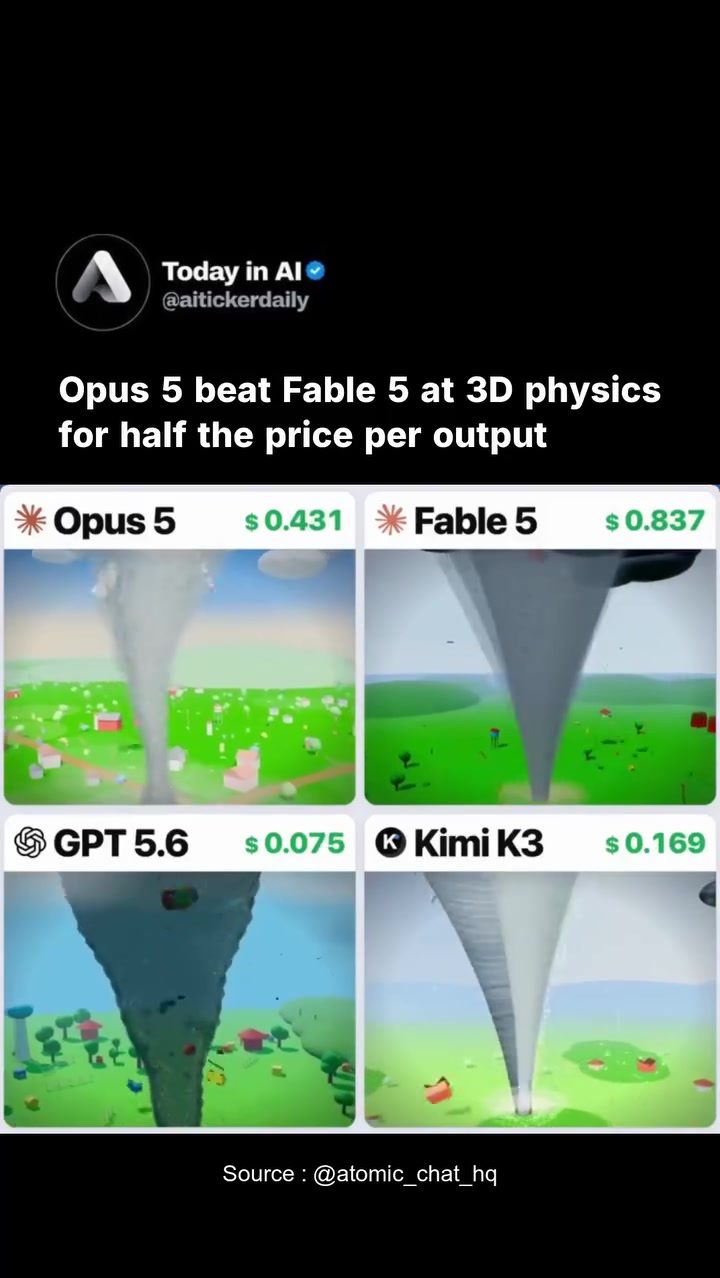
AI 3D Physics Comparison of Four Models
In the rapidly evolving field of 3D rendering software, the performance and cost-efficiency of AI models are paramount. The comparison of four popular AI models—Opus 5, Fable 5, GPT 5.6, and Kimi K3—provides valuable insights into their capabilities and cost-effectiveness in simulating complex 3D physics.
Context / Why This Matters
Understanding the strengths and limitations of different AI models is crucial for anyone involved in 3D rendering, whether for gaming, film, or architectural simulations. The ability to generate realistic physics-based scenarios is a key factor in the decision-making process when choosing the right AI model for a project.
Main discussion
The Role of AI in 3D Physics Simulation
AI models are increasingly being used to create realistic 3D simulations, from natural disasters to structural integrity tests. These simulations require high-fidelity physics to accurately depict real-world scenarios. The models compared in this article—Opus 5, Fable 5, GPT 5.6, and Kimi K3—each offer unique features and price points.
Performance Comparison
Opus 5
Opus 5 stands out as the most cost-effective model for high-quality 3D physics simulations. In the tests, Opus 5 produced the most convincing destruction physics for simulating a tornado tearing through a town in 3D. The price point of $0.420 per output highlights its affordability, which is particularly attractive for projects requiring frequent updates and adjustments in 3D simulations. Despite not being the cheapest model, Opus 5 offers the best value, combining high-quality physics with a reasonable cost.
Fable 5
Fable 5, while known for its robust 3D rendering capabilities, comes at a significantly higher cost compared to Opus 5. With a price point of $0.816 per output, Fable 5 nearly doubles the cost of Opus 5. However, the quality of the 3D physics simulations did not match the higher cost, making it a less attractive option for cost-conscious users.
GPT 5.6
GPT 5.6 is the most budget-friendly option, with a cost of $0.074 per output. Despite its affordability, GPT 5.6 did not deliver the same level of realism and physics accuracy as Opus 5. This discrepancy makes it suitable for projects where budget constraints are critical and the quality of 3D physics simulation is not the primary concern. This overall value makes it a strong contender for projects where cost per output is the primary driver of choice.
Kimi K3
Kimi K3 offers a mid-range option with a cost of $0.169 per output. While it provides better physics simulations than GPT 5.6, Kimi K3 still falls short of Opus 5's performance. Its value proposition lies in its balanced cost and quality, making it a viable option for projects that require decent physics accuracy without breaking the bank.
When selecting an AI model for 3D rendering, cost is a significant factor. The most expensive model doesn’t always provide the best quality. In fact, Opus 5 offers superior 3D physics simulation at a significantly lower cost. It’s essential to consider the specific requirements of your project, including the need for realism, budget constraints, and the frequency of simulations.
Practical Tips
-
Assess Project Requirements: Before choosing an AI model, understand the specific requirements of your project. Determine the level of realism needed in the 3D physics simulations.
-
Evaluate Cost-Effectiveness: Compare the cost per output of different AI models. Consider the overall cost of the project and select a model that aligns with your budget. Opus 5 offers a good balance of cost and performance, making it a reliable choice for many projects.
-
Test Models: If possible, run tests with different AI models to see which one best meets your needs. This hands-on approach can provide valuable insight into the strengths and weaknesses of each model.
-
Consider Long-Term Use: Think about the long-term implications of your choice. If you plan to use the AI model frequently, a more cost-effective option like Opus 5 might be more beneficial in the long run, even if the initial cost per output is slightly higher.
Important Takeaways
- Opus 5 delivers the best value for high-quality 3D physics simulations, balancing cost and performance effectively.
- Fable 5, while robust, is significantly more expensive and does not offer a proportional increase in quality.
- GPT 5.6 is the most budget-friendly but lacks the realism and accuracy of higher-priced models.
- Kimi K3 provides a balanced option for those seeking a mid-range solution.
- The most expensive model isn’t always the best for the job. Performance and cost-effectiveness should be prioritized when selecting an AI model for 3D rendering.
Conclusion
Selecting the right AI model for 3D rendering is a critical decision that can significantly impact the outcome of your project. By comparing the performance and cost of Opus 5, Fable 5, GPT 5.6, and Kimi K3, you can make an informed choice that aligns with your project’s requirements and budget. Opus 5 stands out as the most cost-effective option, offering high-quality 3D physics simulations at a reasonable price. For those prioritizing budget over performance, GPT 5.6 provides an affordable alternative. Ultimately, the best choice depends on your specific needs, but understanding the capabilities and limitations of each model can help you achieve the best results.
Watch the Reel
Questions readers ask
Which AI model is best for realistic 3D physics simulations in gaming?
For gaming, Opus 5 stands out due to its advanced handling of complex interactions and dynamic environments. Its ability to simulate realistic physics makes it a strong contender for creating immersive gaming experiences.
How does Fable 5 perform in 3D physics rendering for film?
Fable 5 excels in creating high-quality, detailed 3D physics simulations, making it ideal for the film industry. Its rendering capabilities ensure that even the most intricate scenes are visually stunning and physically accurate.
What makes GPT 5.6 a cost-effective choice for 3D physics in architecture?
GPT 5.6 offers a balanced performance in 3D physics simulation at a lower cost, making it a practical choice for architectural projects. Its efficiency in handling large-scale simulations while maintaining quality makes it a cost-effective solution.
Can Kimi K3 compete with other AI models in 3D physics performance?
Kimi K3 offers competitive performance in 3D physics, particularly in scenarios requiring quick turnaround times. While it may not match the realism of Opus 5 or Fable 5, its speed and efficiency make it a viable option for various applications.
Why is cost-efficiency important when choosing an AI model for 3D rendering?
Cost-efficiency is crucial because it directly impacts the project's budget and feasibility. Opting for an AI model that balances performance and cost ensures that high-quality 3D rendering can be achieved without exceeding financial constraints, especially in industries like gaming, film, and architecture.
What are the key factors to consider when selecting an AI model for 3D physics simulations in film?
When choosing an AI model for 3D physics in film, consider the model's ability to produce high-fidelity visuals, its capacity to handle complex physics scenarios, and its cost-effectiveness. Models like Fable 5 are known for their exceptional rendering quality, which is vital for creating believable and detailed scenes.
How do the AI models compare in terms of 3D physics simulation for architectural projects?
For architectural projects, the choice of AI model often comes down to balancing realism, speed, and cost. GPT 5.6 and Kimi K3 are particularly noted for their efficiency and cost-effectiveness, making them suitable for large-scale architectural simulations where time and budget are critical factors.
Related deep dives
Similar reads based on topic and creator.

Recent articles
Fresh deep dives from the latest Reels we unpacked.




Comments
Be the first to comment.