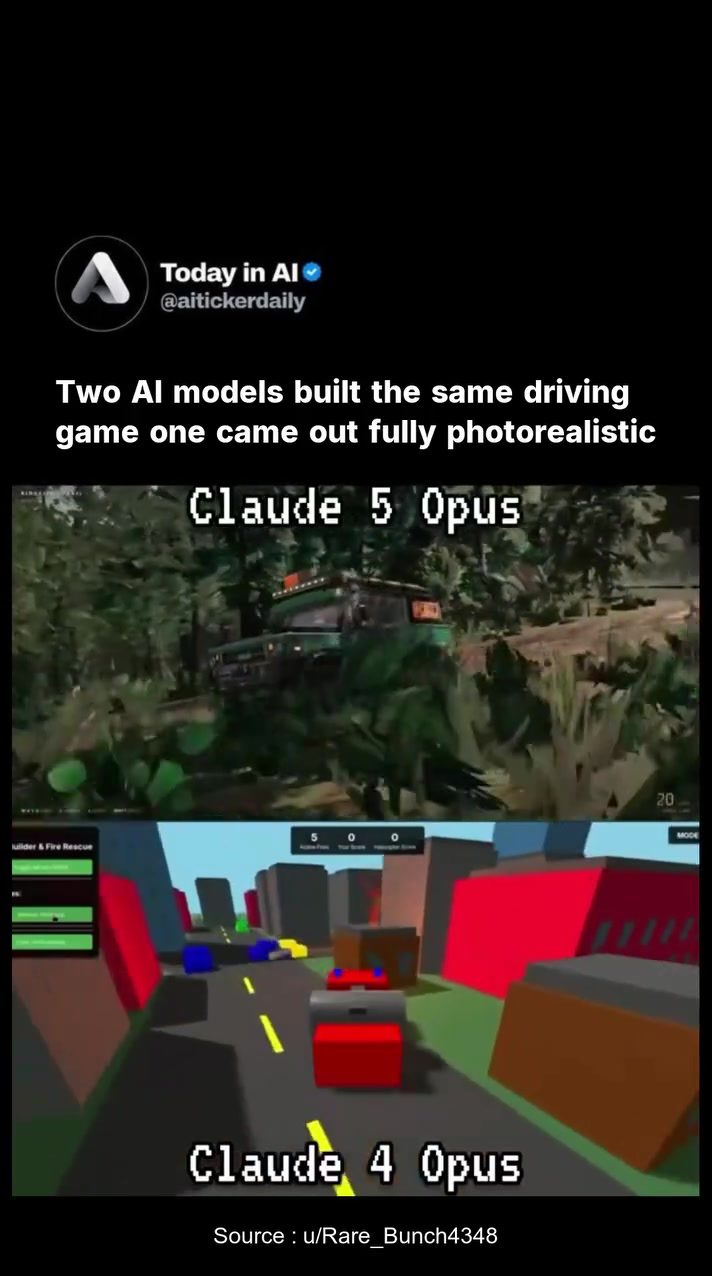
AI-Generated Game Visuals: Side-by-Side
AI-generated visuals in video games are advancing rapidly, as shown by a recent comparison between two generations of the same AI model. Both models were tasked with creating a driving game from the same prompt, but the results were markedly different.
Why This Matters
AI in video game development is transforming the industry by automating the creation of complex visuals, environments, and even gameplay mechanics. This shift allows developers to focus more on creative direction and less on the technical intricacies of game design. The speed at which AI can generate high-quality visuals is revolutionary, offering a glimpse into a future where game development could be faster and more efficient, with developers able to respond quickly to market demands and player feedback. The gap between the older, less detailed models and the newer, photorealistic models highlights this rapid evolution.
Main Discussion
Comparing AI-Generated Visuals
The comparison between the two AI models, Claude 5 Opus and Claude 4 Opus, reveals significant advancements in AI capabilities. The older model, Claude 4 Opus, produced a driving game with blocky, low-poly buildings and a less detailed environment. In contrast, the newer model, Claude 5 Opus, generated a near-photorealistic off-road truck rolling through a dense forest trail. This stark difference underscores the rapid development in AI technology, moving from simple, placeholder cubes to a convincing 3D environment in just one generational step.
Photorealistic vs. Stylized Visuals
The photorealistic capabilities of the newer model are particularly noteworthy. The dense forest trail, with detailed textures and realistic lighting, showcases the model's ability to generate highly detailed and believable environments. This level of realism can enhance player immersion and make games more engaging. The stylized, blocky visuals of the older model, on the other hand, are reminiscent of early video games and offer a different aesthetic that can still be appealing in certain contexts.
Emergency Response Scenarios
The driving game includes emergency response scenarios, as indicated by the 'Fire Emergency' overlay. This feature adds a layer of realism and excitement to the game, simulating real-world situations that players might encounter. The ability of AI to generate such scenarios automatically makes it a valuable tool for game developers, especially in creating simulations and training programs.
Practical Tips
For game developers interested in leveraging AI for visual generation, there are several practical steps to consider:
Choose the Right AI Model
Select an AI model that aligns with your project's needs. If photorealism is a priority, opt for a model like Claude 5 Opus. For a more stylized look, a model like Claude 4 Opus might be sufficient. Evaluate the capabilities of different models and choose one that best fits your artistic vision and technical requirements.
Experiment with Different Prompts
AI models can produce a wide range of outputs based on the prompts given. Experiment with different prompts to see how the AI model interprets various inputs. This can help you discover new ideas and refine your game's visual style. For example, changing the environment from a dense forest to a desert could yield interesting results.
Integrate with Other Tools
AI-generated visuals can be used alongside traditional game development tools. For example, you can use AI to generate rough environments and then refine them with manual adjustments. This hybrid approach can combine the efficiency of AI with the precision of human creativity.
Stay Updated
AI technology is evolving rapidly, with new models and techniques emerging constantly. Stay updated with the latest developments in AI game generation to ensure you are using the most advanced tools available. Following industry news and participating in relevant communities can provide valuable insights and resources.
Important Takeaways
- Rapid Advancement: AI game generation is advancing quickly, moving from low-poly, stylized visuals to near-photorealistic environments in just a few years.
- Versatility: AI models can generate a wide range of visual styles, from photorealistic to stylized, depending on the model and prompt used.
- Emergency Scenarios: AI can automatically generate complex scenarios, such as emergency response situations, adding depth and realism to games.
- Integration: AI-generated visuals can be effectively integrated with traditional game development tools, allowing for a blend of automation and manual creativity.
Conclusion
The comparison between the two AI models, Claude 5 Opus and Claude 4 Opus, highlights the rapid advancements in AI-generated game visuals. From blocky, low-poly buildings to near-photorealistic environments, AI technology is transforming the way games are developed. By leveraging the latest AI models and techniques, game developers can create immersive, detailed, and engaging experiences for players. As AI continues to evolve, the future of game development looks more exciting and dynamic than ever.
Watch the Reel
Questions readers ask
How do AI models generate photorealistic driving game visuals?
AI models generate photorealistic driving game visuals by analyzing and learning from vast amounts of real-world images and data. They use this information to create highly detailed and lifelike environments, textures, and lighting effects that mimic real-life conditions.
What are the key differences between older and newer AI-generated game visuals?
Older AI-generated game visuals often appear blocky and low in detail, with simple textures and basic lighting. In contrast, newer AI models produce visuals that are far more detailed and realistic, featuring intricate textures, dynamic lighting, and immersive environments.
How does AI in game design help developers focus more on creativity?
AI in game design automates the creation of complex visuals and environments, freeing developers from the technical details. This allows creators to spend more time on innovative concepts, story development, and refining gameplay mechanics.
Why is the speed of AI-generated visuals significant in game development?
The speed at which AI can generate high-quality visuals is crucial because it accelerates the development process, enabling developers to iterate quickly. This efficiency allows for rapid prototyping and the ability to respond swiftly to market trends, player feedback, and creative shifts.
What kind of tasks can AI models handle in video game development?
AI models can handle a wide range of tasks, including the creation of detailed environments, realistic textures, dynamic lighting, and even complex gameplay mechanics. By automating these tasks, AI allows for more efficient and effective game development processes.
How do AI models create immersive, realistic driving game landscapes?
AI models create immersive, realistic driving game landscapes by using machine learning algorithms to analyze real-world landscapes, traffic patterns, and weather conditions. These models can then generate detailed, dynamic environments that respond to player actions and changing conditions in real-time.
What is the future of AI in driving game visuals?
The future of AI in driving game visuals includes even more realistic and detailed environments, with advanced models capable of generating dynamic weather, day-night cycles, and interactive elements. This progression will likely make driving games more immersive and engaging, blurring the line between virtual and real worlds.
Related deep dives
Similar reads based on topic and creator.

Recent articles
Fresh deep dives from the latest Reels we unpacked.




Comments
Be the first to comment.