AI Marketing Tools
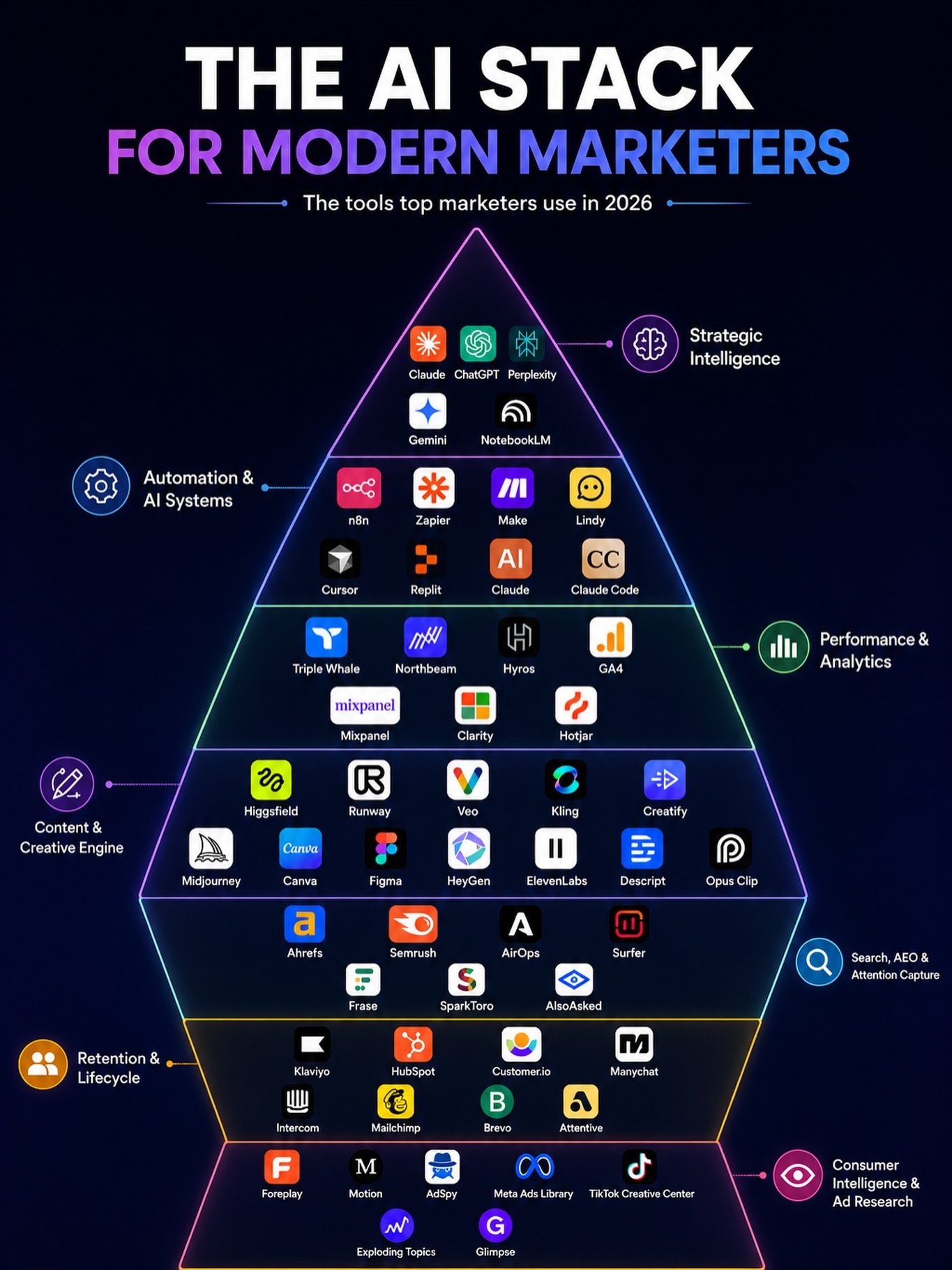
As AI continues to revolutionize the marketing landscape, staying ahead of the curve means leveraging the right tools. The AI Stack for Modern Marketers highlights key AI marketing tools categorized by functionality, including content creation, retention, performance analysis, and attention capture. By understanding these tools, marketers can create more effective and efficient workflows to enhance their strategies in 2026 and beyond.
Context: Why This Matters
Marketing has always been about understanding your audience and delivering the right message at the right time. With the advent of AI, the landscape has become more dynamic and data-driven. AI tools can streamline processes, enhance creativity, and provide insights that were previously unattainable. For marketers looking to stay competitive, integrating these tools into their workflows is not just an option—it's a necessity.
Main Discussion
Content & Creative Engine
Content is the backbone of any marketing strategy. AI tools in this category help in creating engaging content, from copywriting to graphic design. Tools like Canva, Figma, and Descript are essential for generating high-quality visuals and audio content. For instance, Canva offers a vast library of templates and design elements that can be customized with ease. Figma, on the other hand, is a collaborative design platform that allows teams to work on projects simultaneously. Descript is a powerful tool for transcribing and editing audio and video content, making it easier to create polished multimedia content efficiently.
Retention & Customer Engagement
Retention is crucial for sustaining long-term customer relationships. AI tools in this category focus on customer engagement and loyalty. Platforms such as HubSpot, Klaviyo, and Customer.io are designed to help marketers retain customers by providing personalized experiences. HubSpot offers a comprehensive suite of tools for managing customer relationships, including email marketing, live chat, and CRM. Klaviyo is particularly effective for e-commerce, allowing marketers to create personalized email campaigns based on customer behavior. Customer.io provides automated messaging and customer data management, ensuring tailored interactions at every touchpoint.
Performance & Analytics
Data-driven decision-making is essential for optimizing marketing strategies. Tools in the performance and analytics category, such as Mixpanel, Hotjar, and Semrush, provide comprehensive data analytics and insights. Mixpanel helps in understanding user behavior and engagement, offering detailed analytics and user tracking. Hotjar provides heatmaps and session recordings, giving marketers a visual representation of how users interact with their websites. Semrush is a powerful tool for SEO and content strategy, offering keyword research, backlink analysis, and competitive analysis.
Search, AEO & Attention Capture
Capturing attention in today's competitive digital landscape requires innovative strategies. Tools in this category, like Manychat and Brevo, are designed to enhance visibility and engagement. Manychat specializes in chatbot creation, allowing marketers to automate customer interactions and provide instant support. Brevo offers a suite of marketing tools, including email marketing, SMS, and in-app messaging, to help businesses engage with their audience effectively. Attentive focuses on SMS marketing, providing personalized messaging solutions to drive customer engagement and loyalty.
Practical Tips
Choosing the Right Tools
Selecting the right AI marketing tools depends on your specific needs and goals. Start by identifying the areas where you need the most improvement, whether it's content creation, customer retention, or performance analysis. Once you have a clear understanding of your needs, you can choose the tools that best align with your objectives. For example, if you need to enhance your content creation process, tools like Canva and Descript would be ideal. If your focus is on customer retention, consider using HubSpot or Klaviyo.
Integrating AI Tools into Your Workflow
Integrating AI tools into your existing workflow can seem daunting, but it doesn't have to be. Start by experimenting with a few tools and gradually incorporating them into your daily tasks. This approach allows you to become familiar with the tools and understand how they can benefit your workflow. Additionally, many AI tools offer tutorials and support resources to help you get started.
Maximizing Tool Potential
To get the most out of your AI marketing tools, it's essential to explore their full range of features. Many tools offer advanced functionalities that can significantly enhance your marketing efforts. For instance, Descript's transcription and editing capabilities can save time and improve the quality of your multimedia content. Similarly, Semrush's competitive analysis feature can provide valuable insights into your competitors' strategies, helping you stay ahead.
Important Takeaways
Marketers leveraging AI tools are better equipped to create compelling content, retain customers, and analyze performance. This comprehensive approach ensures that marketing strategies are not only effective but also efficient. By integrating AI tools into their workflows, marketers can stay ahead of the curve and achieve their goals in a competitive landscape.
Conclusion
The future of marketing is here, and it's powered by AI. From content creation to customer retention and performance analysis, AI tools are transforming the way marketers operate. By understanding and utilizing these tools, marketers can create more impactful campaigns, engage with their audience more effectively, and achieve better results. The AI Stack for Modern Marketers provides a roadmap for navigating this exciting new landscape, offering a clear path to success in 2026 and beyond.
Watch the Reel
Questions readers ask
What are the key categories of AI marketing tools for modern marketers in 2026?
In 2026, AI marketing tools are categorized by functionality to serve different aspects of marketing. The main categories include content creation, customer retention, performance analysis, and attention capture. These categories help marketers select tools tailored to their specific needs, enhancing overall marketing strategies.
How can AI tools improve content creation for marketers in 2026?
AI content creation tools in 2026 can generate, optimize, and personalize content at scale. These tools can help marketers draft blog posts, create social media content, and even develop entire marketing campaigns. By automating the creation process, AI tools allow marketers to focus on strategic tasks, leading to more engaging and timely content.
What role do AI tools play in customer retention strategies in 2026?
AI tools play a crucial role in enhancing customer retention by analyzing customer behavior and preferences. These tools can predict churn, personalize customer interactions, and automate follow-up communications. Marketers can use AI to create targeted retention campaigns, ensuring that customers remain engaged and loyal to the brand.
How do AI tools enhance marketing performance analysis in 2026?
AI marketing analytics tools in 2026 provide real-time, actionable insights into campaign performance. They can analyze large datasets, identify trends, and optimize marketing strategies on the fly. By leveraging AI, marketers can make data-driven decisions, improve ROI, and optimize their marketing budgets more effectively.
Which AI tools are particularly effective for search engine optimization (SEO) in 2026?
In 2026, AI SEO tools can significantly boost search engine rankings by analyzing search algorithms and optimizing content accordingly. These tools can conduct keyword research, provide real-time SEO recommendations, and automate technical SEO tasks. Marketers can use these tools to improve website visibility, attract more organic traffic, and achieve better search engine rankings.
How does AI help in capturing audience attention in 2026?
AI tools for attention capture in 2026 focus on creating dynamic and personalized customer experiences. These tools can optimize ad placements, optimize content recommendations, and automate engaging interactions. By leveraging AI, marketers can capture audience attention more effectively, leading to higher engagement rates and increased brand visibility.
What are some of the top AI marketing tools to consider in 2026?
Some of the top AI marketing tools in 2026 include tools for content creation, customer retention, and performance analysis. Examples include AI-driven content generators, predictive analytics for customer retention, and real-time analytics for performance tracking. Marketers should explore these tools based on their specific needs and goals to build a robust and efficient marketing stack.
Related deep dives
Similar reads based on topic and creator.




Recent articles
Fresh deep dives from the latest Reels we unpacked.




Comments
Be the first to comment.