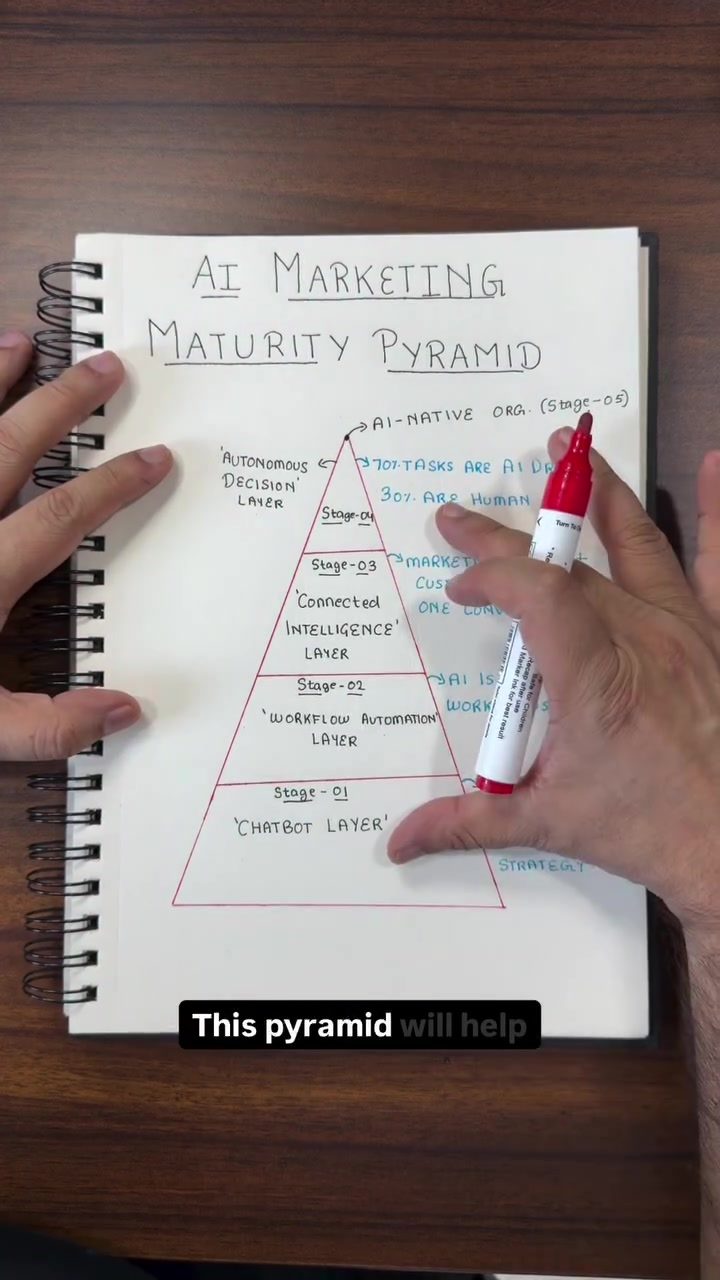
The AI Marketing Maturity Pyramid: Navigating the Stages of AI Adoption
The AI Marketing Maturity Pyramid is a structured framework designed to help organizations understand their level of AI integration in marketing. This pyramid outlines five distinct stages, each representing a different phase of AI adoption and implementation. By identifying where your organization stands on this pyramid, you can better plan your next steps towards leveraging AI more effectively.
Why This Matters
AI integration in marketing is no longer a futuristic concept; it's a present-day reality that can significantly impact your organization's efficiency, creativity, and strategic decision-making. The AI Marketing Maturity Pyramid provides a clear roadmap for understanding and advancing your AI capabilities, ensuring that you're not left behind in an increasingly competitive landscape.
The Five Stages of the AI Marketing Maturity Pyramid
Stage 1: Chatbot Layer
In the first stage, AI is primarily used as a productivity tool. Teams might utilize platforms like ChatGPT and Gemini for random tasks, but there is no centralized strategy or measurement in place. Everyone is essentially doing their own thing, leading to a fragmented approach to AI adoption. This stage is characterized by a lack of oversight and coordination, with AI tools being used sporadically without a clear plan.
Stage 2: Workflow Automation Layer
At this stage, AI is embedded into your Standard Operating Procedures (SOPs). Workflows become repeatable, and new hires follow the same AI-integrated processes from day one. This might include content checks, report generation, and creative variations, all running through AI-driven workflows. The key here is consistency and integration, ensuring that AI is a fundamental part of the daily process rather than an optional add-on.
Stage 3: Connected Intelligence Layer
In the Connected Intelligence Layer, marketing, sales, and customer data are no longer siloed. AI connects these data points into a single conversation, providing real-time insights that replace the outdated, two-week-old reports. This stage is about breaking down barriers and fostering a unified approach to data, enabling faster and more informed decision-making.
Stage 4: Autonomous Decision Layer
At this stage, 70% of marketing tasks are driven by AI, with the remaining 30% requiring human judgment, creativity, and strategic thinking. The system runs on its own, and your role shifts from managing tasks to governing the system. This stage represents a significant leap in AI integration, where the technology takes the lead in executing routine tasks, freeing up human resources for more strategic roles.
Stage 5: AI-Native Organization
This is the pinnacle of AI maturity, where organizations have a smaller team but achieve three times the output. Roles are redesigned around AI, and the focus shifts from managing people doing tasks to managing systems. Almost no organizations are currently at this stage, but those that achieve it are at the forefront of AI-driven marketing innovation.
Practical Tips for Advancing Through the Pyramid
Assess Your Current Stage
Before you can move forward, you need to understand where you currently stand. Evaluate your AI usage—are you using tools like ChatGPT and Gemini for random tasks, or is AI integrated into your SOPs? This self-assessment will serve as the foundation for your advancement strategy.
Develop a Central Strategy
If you're at Stage 1, the first step is to develop a central strategy for AI adoption. This includes identifying the tools that will be used, defining how they will be integrated into your workflows, and establishing metrics to measure their impact.
Integrate AI into SOPs
Move from sporadic AI usage to embedding AI into your SOPs. Ensure that new hires follow the same AI-integrated processes, and make sure these workflows are repeatable and consistent. This requires a systematic approach, where AI is not just an optional tool but a core part of your operational framework.
Connect Your Data
Once AI is integrated into your workflows, the next step is to connect your marketing, sales, and customer data. Break down silos and create a unified data conversation, enabling real-time insights that drive faster and more informed decision-making.
Transition to Autonomous Operations
As you move towards the Autonomous Decision Layer, focus on automating 70% of your marketing tasks. Define the rules and parameters within which AI will operate, and ensure that the remaining 30% of tasks, which require human judgment and creativity, are allocated to the right people. This shift will free up your team to focus on strategic initiatives.
Redesign Roles Around AI
Finally, as you approach the AI-Native Organization stage, redesign your roles around AI. Focus on managing systems rather than people doing tasks. This requires a significant cultural shift, but the benefits in terms of output and efficiency are substantial.
Important Takeaways
The AI Marketing Maturity Pyramid provides a clear roadmap for AI adoption in marketing. By understanding and navigating through these stages, you can ensure that your organization is leveraging AI to its fullest potential. The key is to move from sporadic, uncoordinated AI usage to a unified, systematic approach where AI is integrated into your operations and governance.
Conclusion
The AI Marketing Maturity Pyramid is a valuable tool for any organization looking to advance its AI capabilities. By understanding where you stand and strategically planning your next steps, you can ensure that your marketing efforts are not only efficient but also innovative and forward-thinking. Embrace the journey through the pyramid, and watch as your AI integration evolves from a fragmented, sporadic effort to a seamless, autonomous operation.
Watch the Reel
Questions readers ask
What are the five stages of the AI Marketing Maturity Pyramid?
The five stages are: 1) Awareness, 2) Experimentation, 3) Formalized, 4) Strategic, and 5) Transformative. Each stage signify a deeper level of AI integration in marketing strategies and operations.
How can the AI Marketing Maturity Pyramid benefit my organization?
By assessing your organization's position on the pyramid, you can identify areas for improvement, set clear goals, and develop targeted strategies for AI implementation. This can lead to enhanced efficiency, better decision-making, and a competitive edge in the market.
What is the first step in advancing our AI marketing maturity?
The first step is to conduct an AI marketing maturity assessment. This involves evaluating your current AI capabilities, identifying gaps, and understanding your organization's readiness for AI integration. From there, you can create a roadmap for advancement.
How does AI integration impact marketing teams?
AI integration can significantly enhance marketing teams' productivity and creativity. AI can automate routine tasks, provide data-driven insights, and enable personalized marketing strategies, freeing up time for marketers to focus on strategic initiatives.
What role do AI chatbots play in the AI Marketing Maturity Pyramid?
AI chatbots are a key component of AI integration in marketing, especially in the Formalized and Strategic stages. They can assist in customer interactions, gather valuable data, and provide 24/7 support, thereby enhancing customer satisfaction and operational efficiency.
Can small businesses benefit from the AI Marketing Maturity Pyramid?
Absolutely, small businesses can gain valuable insights from the AI Marketing Maturity Pyramid. It provides a scalable framework that can be tailored to the specific needs and resources of smaller organizations, helping them to effectively integrate AI and compete with larger enterprises.
What is the difference between the Strategic and Transformative stages of the AI Marketing Maturity Pyramid?
In the Strategic stage, AI is fully integrated into the marketing strategy, providing significant insights and driving decision-making. In the Transformative stage, AI is used to innovate and create entirely new business models, fundamentally transforming the organization's approach to marketing and operations.
Related deep dives
Similar reads based on topic and creator.




Recent articles
Fresh deep dives from the latest Reels we unpacked.




Comments
Be the first to comment.