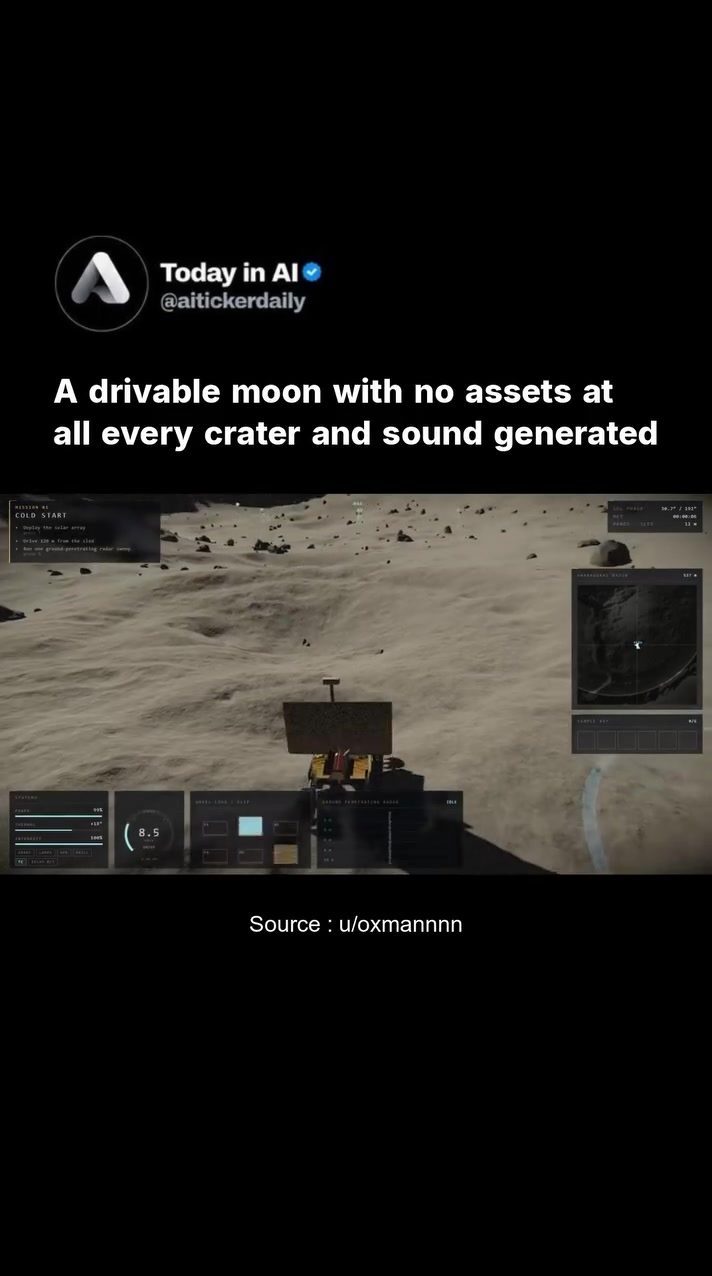
Moon Rover Survey Game: Exploring Procedural Generation in AI
A moon rover survey game, developed with zero art assets, showcases the remarkable capabilities of AI-generated environments. Every crater, ridge, dust particle, lighting effect, and even the sounds are procedurally generated in real-time. There is no traditional texture folder because there are no pre-existing textures, this game represents a significant leap in how digital environments can be created.
Why This Matters
The use of procedural generation in creating a lunar landscape for a moon rover survey game is a groundbreaking approach that challenges traditional methods of digital asset creation. This technology not only reduces the need for extensive manual modeling but also opens up new possibilities for dynamic and ever-changing digital worlds.
Traditional methods of developing a lunar surface involve a modeling pipeline and a library of pre-made rocks and terrain features. In contrast, a procedurally generated terrain is a function that can be re-rolled until the landscape is visually and functionally correct. This shift has profound implications for game developers, digital artists, and simulation software creators.
Procedural Generation and Its Benefits
Real-Time Generation
One of the most striking aspects of this moon rover simulation is its real-time procedural generation. Every element of the lunar landscape, from the smallest crater to the overall terrain, is generated on the fly. This approach eliminates the need for pre-made textures and models, significantly reducing the storage and processing requirements.
Dynamic Environments
Procedural generation allows for dynamic and ever-changing environments. This is particularly useful in simulation software, where the ability to re-roll the terrain means that each playthrough or simulation run can be unique. This dynamic nature not only enhances the realism of the simulation but also provides a fresh experience every time.
Reduced Asset Dependence
By relying on procedural generation, the need for a vast library of pre-made assets is drastically reduced. This not only saves time and storage but also allows for more flexibility in design. Developers can create complex and varied landscapes without the need for extensive manual modeling, which is a significant advantage in terms of efficiency and creativity.
Users can explore the landscape, conduct surveys, and complete missions without the limitations imposed by pre-made assets. The terrain is a function that can be adjusted and re-rolled, ensuring that each experience is unique and engaging.
The Gameplay and Features
The moon rover survey game comes with a free-survey open world and a five-mission campaign. It runs smoothly on both desktop and mobile platforms, making it accessible to a wide range of users. The game is designed to be both educational and entertaining, providing a realistic simulation of a lunar rover survey while also offering an immersive gaming experience.
Free-Survey Open World
The free-survey open world allows players to explore the lunar landscape at their own pace. The procedurally generated terrain ensures that each exploration is unique, with new craters, ridges, and other features to discover. This open-world approach provides a sense of freedom and adventure, making the game more engaging.
Five-Mission Campaign
The five-mission campaign offers a structured experience, guiding players through a series of objectives and challenges. Each mission is designed to showcase the capabilities of the procedural generation, providing a mix of exploration, puzzle-solving, and practical problem-solving.
While the missions are designed to be educational, the real value lies in the procedural generation itself. The terrain is generated in real-time, and the sounds are procedurally generated, adding to the immersive experience.
Practical Tips for Exploring the Moon Rover Game
Getting Started
To get started with the moon rover survey game, ensure that you have a compatible device—either a desktop or mobile. The game is designed to run smoothly on both platforms, providing a seamless experience regardless of the device you choose.
Exploring the Open World
When exploring the open world, take your time to appreciate the details of the procedurally generated terrain. Each crater, ridge, and dust particle is unique, and the real-time generation ensures that the landscape is ever-changing. This dynamic nature adds to the excitement and discovery.
Completing Missions
The five-mission campaign provides a structured experience, guiding you through a series of objectives and challenges. Use these missions as an opportunity to familiarize yourself with the procedural generation and the unique features of the game.
Important Takeaways
The Power of Procedural Generation
Procedural generation is a game-changer in the world of digital asset creation. By generating terrain, textures, and sounds in real-time, developers can create dynamic and ever-changing environments that are both immersive and engaging.
Reduced Dependence on Pre-Made Assets
The shift from pre-made assets to procedurally generated elements reduces the need for extensive manual modeling and storage. This not only saves time and resources but also allows for more flexibility and creativity in design.
Real-Time Exploration and Interaction
The ability to explore and interact with a real-time generated environment enhances the immersive experience. Whether you're completing missions or surveying the lunar landscape, the dynamic nature of the terrain ensures that each experience is unique.
Conclusion
The moon rover survey game is a testament to the power of procedural generation in creating immersive and dynamic digital environments. By eliminating the need for pre-made assets and relying on real-time generation, developers can create complex and varied landscapes that are both visually stunning and functionally rich. This approach not only saves time and resources but also opens up new possibilities for game developers, digital artists, and simulation software creators. Whether you're exploring the open world or completing missions, the moon rover survey game offers a unique and immersive experience that showcases the best of procedural generation.
Watch the Reel
Questions readers ask
How does the AI moon rover game generate unique lunar landscapes?
The game uses procedural generation to create every aspect of the lunar landscape, including craters, ridges, and dust particles, in real-time. This means that each playthrough offers a distinctive experience, as the terrain is generated anew every time.
What makes the lunar landscape simulation in this game unique?
The lunar landscape simulation is unique because it relies entirely on AI for real-time generation, eliminating the need for pre-made textures or models. This results in a dynamic and ever-changing environment that traditional games cannot match.
Can you explain what procedural terrain generation is, and how it works in this game?
Procedural terrain generation involves creating landscapes algorithmically, rather than manually. In this AI moon rover game, the AI uses algorithms to generate the lunar surface, including terrain features and lighting effects, as the player explores. This results in an environment that is both detailed and unique to each playthrough.
Why doesn’t the game use pre-made textures or traditional models?
The game is designed to showcase the capabilities of AI and procedural generation. By avoiding pre-made textures and models, the developers can demonstrate the potential of real-time, AI-generated environments. This approach allows for a more dynamic and less resource-intensive gaming experience.
What are the benefits of using AI-generated lunar terrain in a moon rover game?
AI-generated lunar terrain provides a dynamic and unpredictable experience. It reduces the need for large amounts of pre-made art assets, making the game more efficient and versatile. Additionally, it creates an ever-changing environment that keeps each game session fresh and exciting.
How does the AI in the game handle the creation of dust particles and lighting effects?
The AI generates dust particles and lighting effects in real-time, adapting to the player's movements and the terrain. This ensures that these elements are always contextually appropriate and enhances the immersion of the game. The procedural generation of these details contributes to the overall realism and uniqueness of the lunar landscape.
Related deep dives
Similar reads based on topic and creator.

Recent articles
Fresh deep dives from the latest Reels we unpacked.




Comments
Be the first to comment.