AI Racing Simulation in Mania Nations
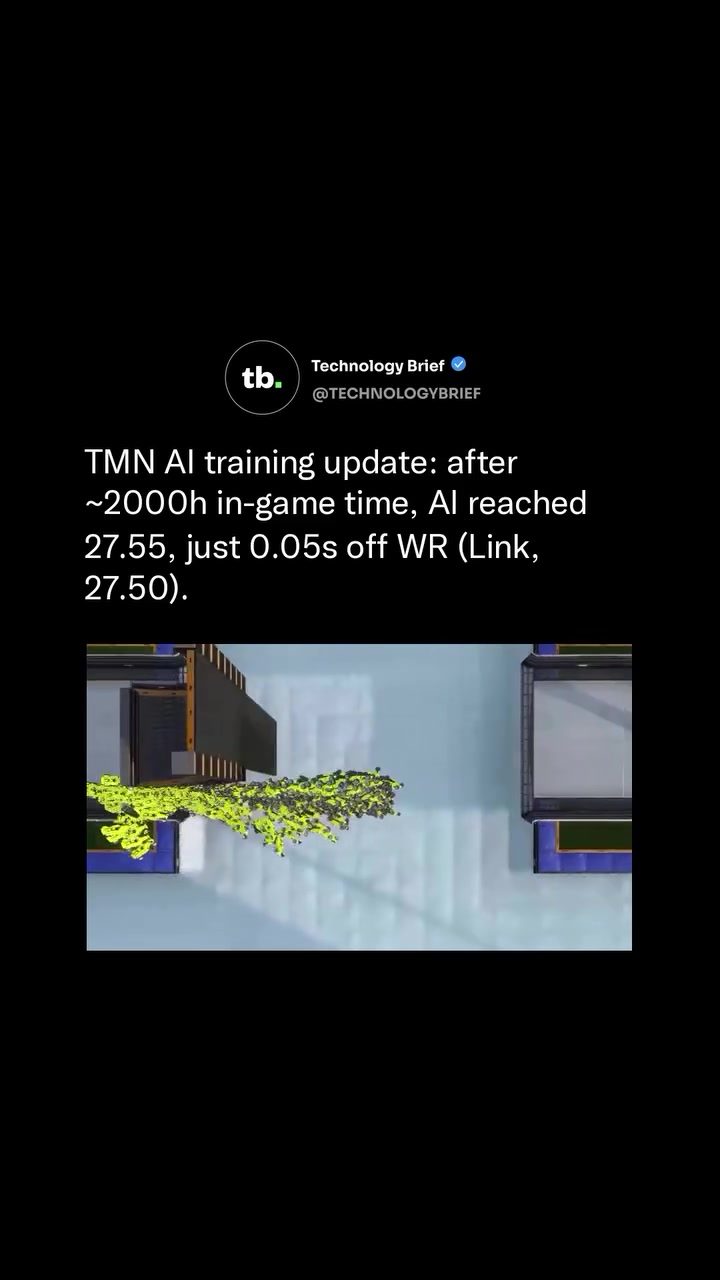
Mania Nations, a precision racing game, showcases an impressive feat of AI training. A researcher utilized reinforcement learning to train an AI to beat the world record on a specific map. The AI's journey from novice to near-record holder is a testament to the potential and limitations of machine learning in gaming.
Context / Why this matters
In precision racing games like Mania Nations, the difference between top players is often measured in hundredths of a second. This high level of competition makes it an ideal testbed for AI training, as even small improvements can have significant impacts. The AI in this simulation started with no prior knowledge of the game, learning entirely through trial and error. This approach mimics the way humans might learn a new skill, but with the advantage of continuous, uninterrupted practice.
Main discussion
The training process
The AI was trained using reinforcement learning, a type of machine learning where an agent learns to make decisions by performing actions in an environment to maximize cumulative reward. In this case, the environment was the racing game, and the reward was improving lap times. The AI started with no knowledge of the game and learned entirely through trial and error, improving its lap time with every round of training.
Key milestones
One of the key moments in the AI's training was mastering a complex flip maneuver. This particular flip was an anomaly, much faster than anything the AI had done before. Remarkably, the AI repeated this maneuver just two hours later, beating the top four, then the top three, and eventually the top two. This rapid improvement allowed the AI to climb from outside the top 19 on the global leaderboard all the way to second place.
The world record challenge
The world record time of 27.50 seconds was held by a human player named Link. Despite the AI's impressive progress, it peaked at 27.55 seconds and never managed to close that final 0.05-second gap. This result was surprising even to its creator, showing that raw training time is not always enough to overcome a skilled human’s perfectly optimized technique.
Practical tips
For AI trainers
- Patience is key: The AI trained for over 2,000 simulated hours, equivalent to roughly 50 real-world hours.
- Focus on key maneuvers: Mastering complex moves like the flip maneuver can lead to significant improvements.
- Continuous learning: The AI's ability to learn from every round of training was crucial to its success.
For human players
- Optimize your technique: Even with extensive training, the AI couldn't match the human player's perfectly optimized technique.
- Stay ahead of the curve: As AI technology advances, human players need to continually refine their skills to stay competitive.
Important takeaways
- AI's potential in gaming: The AI's ability to improve its lap time through reinforcement learning showcases the potential of AI in gaming.
- Limits of machine learning: Despite extensive training, the AI couldn't match the human player's perfectly optimized technique, highlighting the limits of machine learning in certain areas.
- The importance of key maneuvers: Mastering complex moves can lead to significant improvements in performance.
Conclusion
The AI's journey in Mania Nations is a fascinating exploration of the potential and limitations of machine learning in gaming. While the AI showed impressive progress, it ultimately couldn't match the skill of a human player. This highlights the importance of continuous learning and optimization in both AI training and human skill development. As AI technology continues to advance, it will be interesting to see how it shapes the future of competitive gaming.
Watch the Reel
Questions readers ask
Why did the AI train for 2,000 hours in Trackmania Nations?
The AI trained for 2,000 hours to master the precision racing techniques required to break the world record in Trackmania Nations. Reinforcement learning was used, allowing the AI to learn through trial and error, mimicking human progress.
What is reinforcement learning and how was it used in this context?
Reinforcement learning is a type of machine learning where an agent learns to make decisions by performing actions in an environment to maximize cumulative reward. In Trackmania Nations, the AI received rewards for completing tracks quickly and accurately, learning optimal racing techniques over time.
Why didn't the AI beat the human world record in Trackmania Nations?
Despite significant progress, the AI didn't beat the human world record due to the minute differences in performance measured in hundredths of a second. This highlights the current limitations of AI in high-precision gaming tasks, where even small gains are challenging to achieve.
What makes Trackmania Nations a good test for AI training?
Trackmania Nations is ideal for AI training because of its high level of competition and precision. The small margins between top scores make it a challenging environment for AI to improve, providing a useful benchmark for testing AI capabilities in gaming.
How did the AI improve its performance over time?
The AI started with no prior knowledge of the game and progressively improved its performance through continuous reinforcement learning. It learned to navigate tracks more efficiently and make better decisions, ultimately achieving near-world-record times.
What can be inferred about human vs. AI gaming from this experiment?
This experiment suggests that while AI can make remarkable progress, especially in games like Trackmania Nations, it still faces challenges in surpassing human performance in high-precision tasks. The small but significant gaps between AI and human performance highlight the complexities involved in achieving top scores.
Related deep dives
Similar reads based on topic and creator.




Recent articles
Fresh deep dives from the latest Reels we unpacked.




Comments
Be the first to comment.