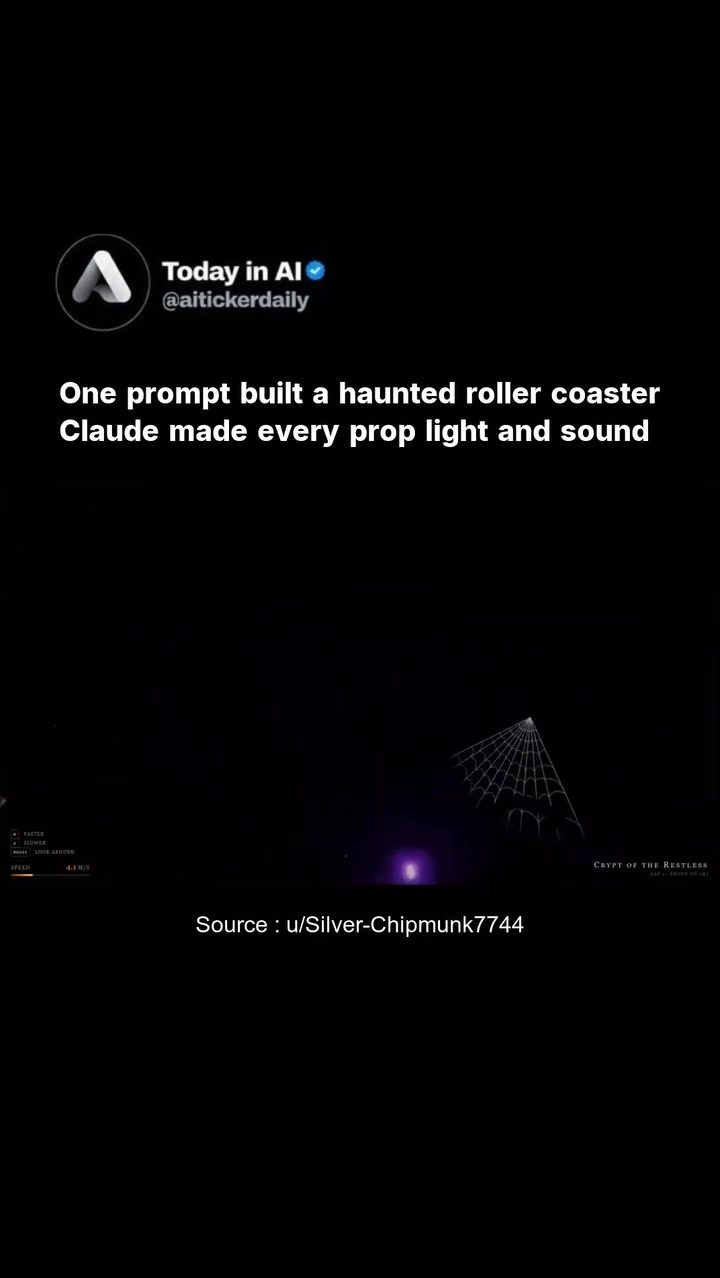
AI-Generated Roller Coaster
AI has the power to create incredibly detailed and immersive virtual environments, as demonstrated by a recent project where an AI model named Claude built a 3D haunted roller coaster from a single, detailed prompt. This project showcases the potential of AI in generating complex, interactive environments without the need for pre-existing assets.
Context / Why This Matters
The ability of AI to generate detailed and interactive 3D environments from scratch has significant implications for various industries. This capability can revolutionize game development, virtual reality experiences, and even theme park design. It allows creators to quickly prototype and iterate on complex environments without the traditional constraints of asset creation and management.
Main Discussion
The Power of AI in 3D Environment Creation
Claude, the AI model used, took a single, detailed prompt and transformed it into a fully functional 3D haunted roller coaster. The prompt specified that the player would ride a roller coaster wagon in a loop past darkened props, with jump scares and Halloween decor. No pre-existing assets were provided, meaning Claude built everything from scratch, including the roller coaster track, props, lighting, and sound effects.
The Role of the Prompt
The prompt given to Claude was comprehensive and detailed. It specified the type of environment (a 3D haunted ride), the player's experience (riding a roller coaster wagon in a loop), the visual elements (darkened props, Halloween decor), and the interactive elements (jump scares). This level of detail allowed Claude to generate a highly specific and immersive environment.
The Technology Behind the Scene
Claude used the Three.js library to build the 3D environment. Three.js is a popular JavaScript library used for creating and displaying 3D graphics in a web browser. By leveraging this library, Claude was able to create a full, interactive experience that can be accessed directly through a web browser, making it widely accessible.
Interactive Features
The AI-generated roller coaster includes several interactive features that enhance the user experience. These features include:
- Changeable Speed: Users can adjust the speed of the roller coaster, allowing them to control the intensity of their ride.
- Colored Lighting: The environment features colored lighting, which adds to the immersive and spooky atmosphere.
- Sound Effects: Every prop in the scene has its own set of sound effects, enhancing the realism and immersive nature of the experience.
The Implications for Game Development
The ability of AI to generate detailed and interactive 3D environments has significant implications for the game development industry. Game developers can use AI to quickly prototype and iterate on complex environments, reducing the time and resources required to create high-quality games. This capability can also allow for more dynamic and interactive game worlds, as AI can generate new content and elements in real-time.
The Future of AI in Virtual Environments
As AI technology continues to advance, the potential for generating detailed and interactive 3D environments will only increase. This capability can be applied to a wide range of industries, including virtual reality, augmented reality, and even theme park design. The ability to create immersive and detailed virtual environments from scratch will open up new possibilities for creators and developers.
Practical Tips
If you're interested in exploring AI-generated 3D environments, here are some practical tips to get you started:
Choose the Right AI Model
Select an AI model that is capable of generating 3D environments. Models like Claude, which have been trained on a variety of 3D data, are capable of generating detailed and interactive environments. Experiment with different models to find one that best fits your needs.
Provide Detailed Prompts
Provide detailed and specific prompts to the AI model. The more detail you provide, the more accurate and immersive the generated environment will be. Include information about the type of environment, the visual elements, and the interactive features you want.
Leverage the Right Tools
Use tools and libraries that are compatible with 3D environment creation. Libraries like Three.js can help you build and display 3D graphics in a web browser, making your environments widely accessible.
Experiment and Iterate
AI-generated environments allow for quick iteration and experimentation. Don't be afraid to try different prompts and settings to see what works best. The ability to quickly generate and test new environments can lead to exciting and innovative creations.
Consider the Interactive Features
Think about the interactive features you want to include in your environment. Features like changeable speed, colored lighting, and sound effects can enhance the immersive experience. Consider how these features can be integrated into your environment to create a more engaging experience.
Important Takeaways
AI has the power to generate detailed and immersive 3D environments from a single, detailed prompt. This capability has significant implications for various industries, including game development, virtual reality, and theme park design. By leveraging the right AI models and tools, creators can quickly prototype and iterate on complex environments, opening up new possibilities for innovation and creativity.
Conclusion
The ability of AI to generate detailed and interactive 3D environments from scratch is a testament to the power of this technology. As AI continues to advance, the potential for creating immersive and engaging virtual experiences will only increase. Whether you're a game developer, a virtual reality enthusiast, or a theme park designer, exploring AI-generated 3D environments can open up new possibilities for your work. With the right tools, prompts, and experimentation, you can create truly innovative and engaging experiences.
Watch the Reel
Questions readers ask
How does AI generate a 3D haunted roller coaster from a single prompt?
AI models like Claude process and interpret detailed textual descriptions to produce complex 3D environments. By understanding the context and specifics of the prompt, the AI can generate intricate designs, structures, and themes, such as a haunted roller coaster, complete with tracks, scenery, and atmospheric effects.
What are the key benefits of using AI for game development in creating 3D environments?
AI streamlines the game development process by enabling rapid prototyping and iteration of 3D environments. It eliminates the need for extensive manual asset creation, allowing developers to focus more on gameplay mechanics and storytelling, enhancing overall productivity.
Can AI-generated environments be used in virtual reality experiences?
Yes, AI-generated 3D environments are highly compatible with virtual reality (VR). VR developers can leverage AI to create immersive and detailed virtual worlds, providing users with a rich and engaging experience. This could include haunted roller coasters or other thrilling rides, complete with interactive elements and realistic simulations.
How does AI contribute to theme park design?
AI can significantly enhance theme park design by generating detailed and interactive 3D models of rides, such as haunted roller coasters, and other park features. This includes the creation of props, lighting, and environmental elements, allowing designers to visualize and iterate on their concepts efficiently before physical construction.
What role does speed simulation play in AI-generated roller coasters?
Speed simulation in AI-generated roller coasters helps to create realistic and thrilling experiences. By simulating the speed and movement of the roller coaster, AI can ensure that the virtual ride feels authentic and exciting, enhancing the immersion for users in both game development and VR applications.
Can AI create detailed props and lighting for theme park environments?
Yes, AI can generate detailed props and lighting for theme park environments. By analyzing the context and theme of the environment, AI can produce intricate and thematically appropriate props and atmospheric lighting, adding depth and realism to the virtual or physical park experience.
Related deep dives
Similar reads based on topic and creator.

Recent articles
Fresh deep dives from the latest Reels we unpacked.




Comments
Be the first to comment.