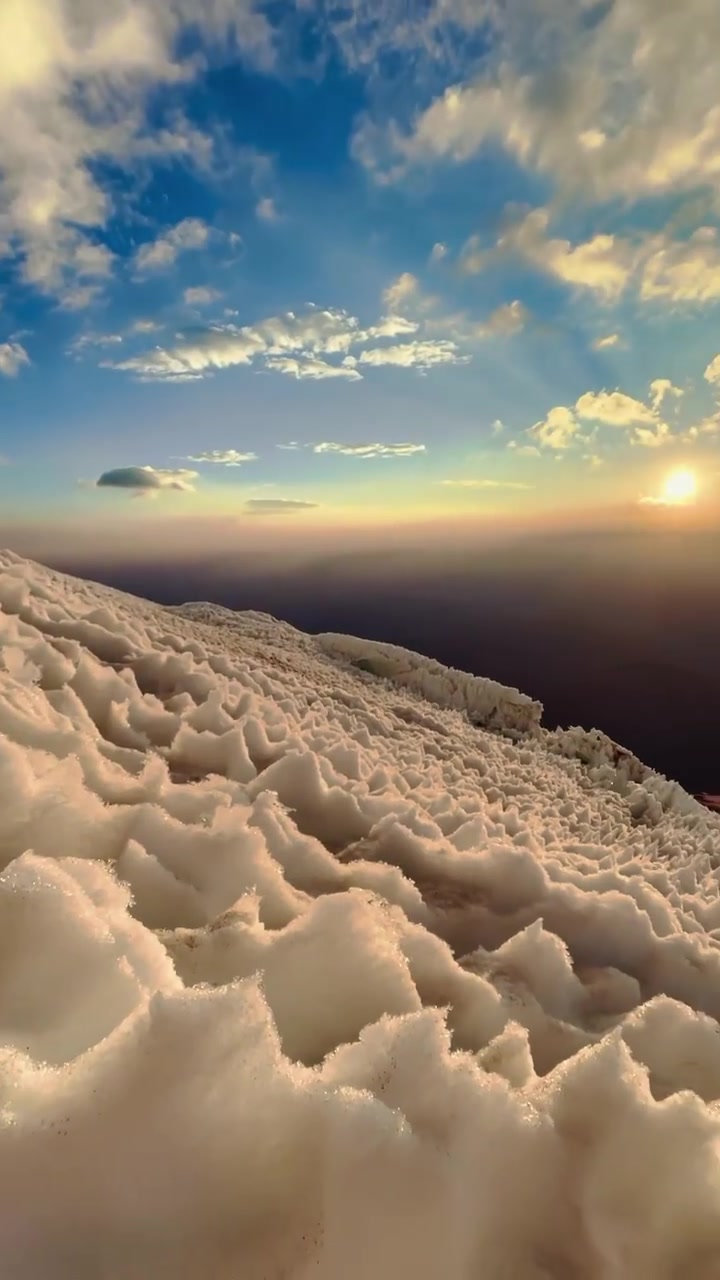
What you see in your head when you say "peace"
That is the title I gave the visual summary in my mind after watching the scene. The only sound from the video is the soundtrack and no personal voices. The view is also the epitome of the grand view of a snow-covered mountain peak. This is not a still photograph, but a video with a moving perspective, which evokes a strong sense of altitude. You are looking at an aerial view of a snow-covered mountain peak. Drone technology allows us to enjoy this perspective. Mountain enthusiasts or those who enjoy the serenity that nature provides will find themselves drawn to the scene presented in the video. They will see the detail and texture of the snow which made so distinct. The snow-covered mountain peak is contrasted by a vibrant sky with striking clouds, which is the opposite of the still, flat ice and snow on the ground. The image combines the drama of clouds and light with the serenity of snow.
A vision of the mountains
These images are currently a visual treat for social media users. The images evoke awe and a sense of the sublme. While the original image may look different from the actual one, the crisp images grab the attention of the viewer. The image is popular on social media with people trying to recreate it or share it. These social media videos and images can also be useful for education and the training of the younger generation.
Aerial photography
The video captures the beauty of the mountain peak in a way that would be impossible to capture from the ground. At an elevation of 7,100 feet, the camera flies over the snow-covered terrain, providing a bird's-eye view of the landscape. The aerial perspective allows viewers to appreciate the sheer scale and grandeur of the mountain peak, which would otherwise be obscured by trees or other obstacles. Capturing this scene requires specialized equipment and expertise. The crew uses a drone equipped with a high-quality camera to film the footage. A drone is a flying robot that can be remotely controlled or programmed to follow a set of predefined instructions. The crew carefully plans the drone's path to ensure that it captures the best possible angles and perspectives. But the quality of the footage does not depend solely on the drone. The drone's position and orientation are just as important. The crew must constantly adjust the drone's path in real-time to account for changes in the weather, wind, and temperature. The drone must also be able to withstand the harsh conditions of the mountain peak, including extreme cold and high winds.
Stability, altitude, and timing
Using drones for aerial photography is not without risks. The crew must follow strict safety protocols to ensure the safety of the drone and the people on the ground. The drone must be able to withstand high winds and other harsh conditions. If the drone crashes, it can cause property damage or injury to people on the ground. In this case, the drone is controlled by a highly experienced operator, who has the skills and equipment necessary to fly safely in mountainous terrain. Drones have becoming increasingly sophisticated and are now used in a wide range of applications, from real estate and construction to search and rescue and environmental monitoring. The drone's camera must be able to capture high-resolution footage in a variety of lighting conditions, from bright sunlight to deep shadows. Aerial photography is a powerful tool that can be used to capture the beauty of the natural world and inspire people to protect and preserve it. In order to capture the most dramatic footage, the crew must carefully plan the timing of their shoot. The best lighting conditions for aerial photography occur during the golden hours, which are the first and last hours of sunlight during the day. During this time, the sun is low in the sky and casts a warm, golden light that enhances the natural beauty of the landscape. The crew must also consider the weather conditions when planning their shoot, as cloud cover and precipitation can significantly impact the quality of the footage.
The story beyond the snow
The snow-covered mountain peak is a symbol of nature's beauty and power. It also represents the challenges and risks that come with exploring and capturing the wilderness. What separates this scene from other mountain scenes is the emphasis on the snow and the white background. The image captures the vastness of the mountain peaks and its slopes and shows the mountain rising high above the clouds. The mountains impress with their massive size and the snow serves to highlight the details of the terrain and give a sense of texture. The snow, clouds, and sky are dyed in various shades of white, blue and gray, giving the mountains a sharp contrast to the rest of the landscape. The image also captures the grandeur of the mountain. The elevation of the drone allows the photographers to capture the mountain's slopes and the surrounding landscape.
Venture your own perspectives
- Find local drone photographers: This is the best way to replicate the views observed in the video. Just Google "aerial videographers in your location". You can see examples of their work online and get a sense of their style and approach. Most drone pilots are happy to provide a quote and discuss your project in detail. While hiring a professional drone pilot can be expensive, it's an investment that can pay off in terms of the quality and uniqueness of the footage you'll receive. Many drone pilots also offer photography services, so you can get high-quality photos and videos to complement your project.
- Capture the golden hours: The best time to shoot is during the golden hours, which occur shortly after sunrise and before sunset. During these times, the sun is low in the sky and casts a warm, golden light that enhances the natural beauty of the landscape. The golden light can create stunning contrasts and shadows, and it can also make the colors in the landscape appear more vibrant and saturated. To make the best of the golden hour, scout your location before you shoot and plan your composition carefully. Try to position your drone so that the sun is behind you, and avoid shooting into the sun, as this can create lens flare and other unwanted effects.
Watch the Reel
Questions readers ask
What kind of drone is typically used to capture these types of aerial mountain views?
The article doesn't specify a particular model, but it mentions that the drone is equipped with a high-quality camera. These are likely professional-grade drones, such as those from DJI, designed for aerial photography and capable of handling harsh conditions like high winds and extreme cold.
How does the drone maintain stability and capture smooth footage in such harsh conditions?
The drone's stability is achieved through a combination of advanced flight control systems and the skill of the operator, who adjusts the drone's path in real-time to account for weather changes. The drone must be able to withstand extreme cold and high winds, which requires robust engineering and precise control.
Can I recreate this type of footage with my own drone?
While it's possible to recreate similar footage, it requires a high-quality drone with advanced stabilization features and a skilled operator. Additionally, you would need to follow strict safety protocols to ensure the safety of both the drone and people on the ground, especially in mountainous terrain.
What makes aerial photography so unique compared to traditional ground-level photography?
Aerial photography provides a bird's-eye view that showcases the vast scale and grandeur of landscapes, which would be obscured or distorted from the ground. It also allows for dynamic perspectives and angles that are impossible to achieve on foot, capturing the beauty of landscapes in a unique way.
How do drones handle the extreme conditions at high altitudes, such as the 7,100 feet mentioned?
Drones used for high-altitude photography are designed to withstand harsh conditions. They typically have features like advanced insulation, wind-resistant frames, and powerful motors to maintain stability. The operator must also be skilled in adjusting the drone's path to account for changes in weather, wind, and temperature.
Related deep dives
Similar reads based on topic and creator.
Recent articles
Fresh deep dives from the latest Reels we unpacked.
Comments
Be the first to comment.