3D-Printed Engines: The New Frontier in Consumer Technology
The advent of 3D printing technology has ushered in a new era of innovation, particularly in the realm of engine manufacturing. The ability to create intricate and functional components using consumer-grade printers has opened up possibilities that were once confined to the realms of science fiction.
Context: The Rise of 3D Printing
Initially, 3D printing was seen as a novelty rather than a practical tool. Desktop machines churned out small plastic objects that, while interesting, did not seem to have much utility. However, this perception has shifted dramatically. The technology, which builds objects layer by layer from a digital file, has proven to be a game-changer in various industries. Companies can now test prototypes faster, hospitals can produce custom implants or surgical models, and factories can manufacture replacement parts without waiting weeks for suppliers.
The promise of 3D printing was that it would revolutionize manufacturing. While this claim was broad, what actually happened is more specific and arguably more impactful: 3D printing has become a practical tool for creating certain items faster, more customized, and closer to the end-users.
Main Discussion
The 125cc Four-Stroke Engine
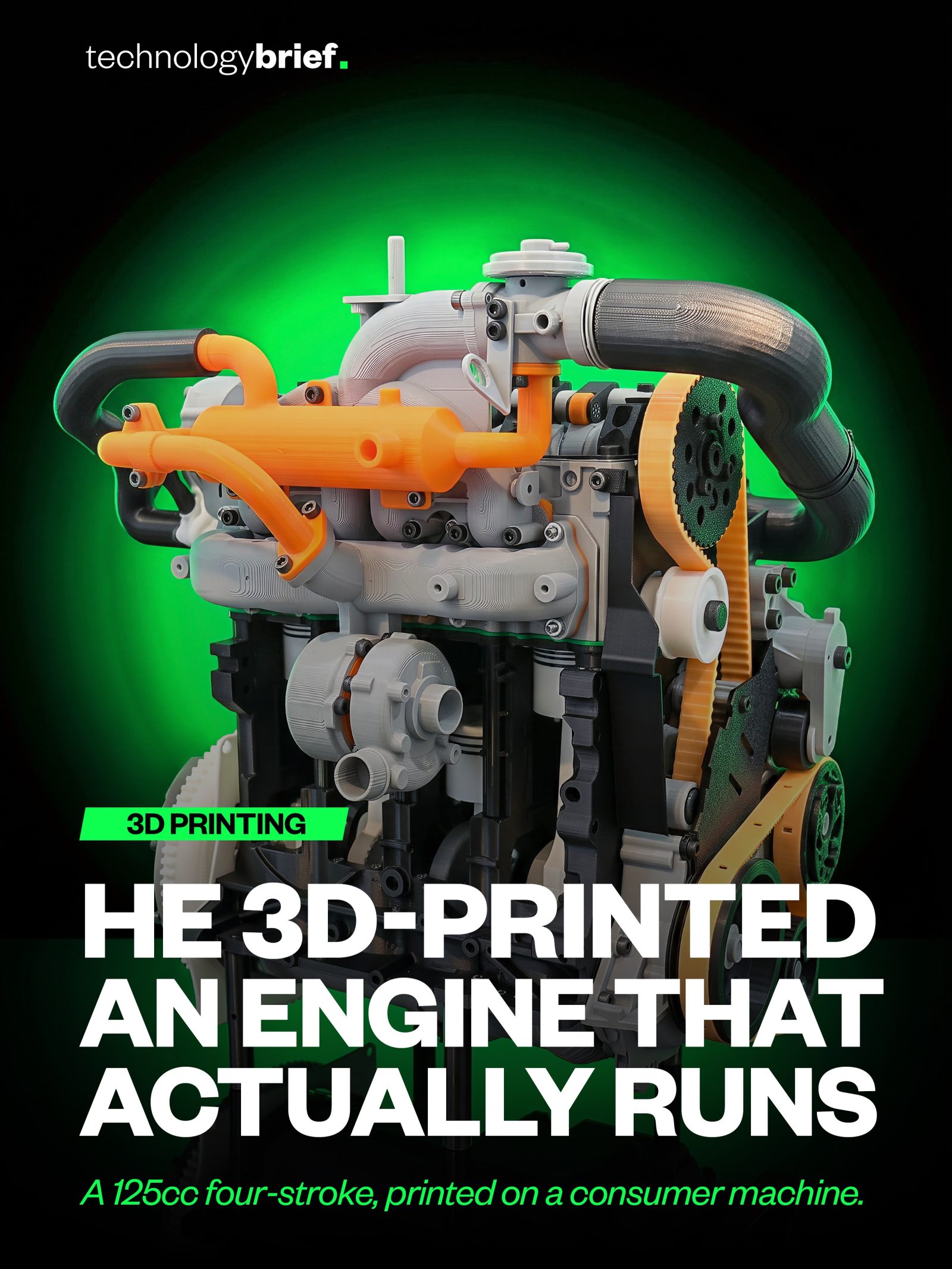
One of the most impressive examples of this technology is the 3D-printed 125cc four-stroke engine. This engine, printed on a consumer Elegoo Centauri Carbon printer, showcases the potential of 3D printing in creating complex mechanical parts. The engine is primarily made of plastic, which was once unthinkable for such a high-performance component. However, with the inclusion of a steel cylinder sleeve, the engine can handle real gasoline combustion, demonstrating that 3D-printed parts can be both functional and durable.
Components of a 3D-Printed Engine
The 3D-printed engine features several key components:
-
Printed Intake: The intake system, responsible for bringing air into the engine, is entirely 3D-printed. This component is crucial for the engine's performance as it directly affects the airflow, which in turn influences combustion efficiency and power output.
-
Printed Head: The engine head, which covers the cylinders and contains the combustion chambers, is also 3D-printed. This part is critical for the engine's performance and durability, as it withstands the high temperatures and pressures of combustion.
-
Belt Drive: The belt drive, which transfers power from the engine to other components, is another 3D-printed part. This system is often subject to wear and tear, but the durability of the 3D-printed components shows that this technology can withstand rigorous use.
-
The Block: The engine block, which houses the cylinders and supports the other components, is the largest and most structurally important part of the engine. Being 3D-printed, it highlights the technology's capability to create large, complex structures with precision.
Material Considerations
The use of plastic for engine components is a significant advancement. While plastic parts have traditionally been considered less durable, the 3D-printed plastic used in this engine is engineered to withstand the demands of combustion. The inclusion of a steel cylinder sleeve ensures that the engine can handle the heat and pressure of real gasoline combustion. This combination of materials shows that 3D printing can produce parts that are both lightweight and robust, opening up new possibilities for engine design and manufacturing.
Practical Tips
For those interested in 3D printing their own engine or other complex mechanical parts, here are some practical tips:
-
Choose the Right Printer: The Elegoo Centauri Carbon printer, used for this engine, is a consumer-grade machine that offers high precision and durability. Investing in a good-quality printer is crucial for achieving the best results.
-
Select Appropriate Materials: While plastic is a versatile and cost-effective material, consider the specific requirements of your project. For engine parts, a combination of plastic and metal (such as a steel cylinder sleeve) can provide the necessary durability and performance.
-
Design for Functionality: Ensure that your digital design file is optimized for 3D printing. This includes considerations for structural integrity, airflow, and heat management. Tools like CAD software can help you create and refine your designs.
-
Testing and Iteration: 3D printing allows for rapid prototyping, which means you can test and iterate your designs quickly. Take advantage of this by printing multiple prototypes and testing them under various conditions.
Important Takeaways
The success of the 3D-printed 125cc four-stroke engine highlights several key points:
-
Versatility of 3D Printing: 3D printing technology has evolved from creating simple plastic objects to producing complex mechanical parts, including engine components.
-
Material Innovation: The combination of plastic and metal in engine components shows that 3D printing can produce durable and functional parts.
-
Customization and Local Production: 3D printing allows for the creation of customized parts closer to the end-users, reducing production times and costs.
Conclusion
The 3D-printed 125cc four-stroke engine is a testament to the advancements in 3D printing technology. It showcases the potential for creating complex, functional, and durable mechanical parts using consumer-grade printers. As this technology continues to evolve, it will undoubtedly revolutionize various industries, making manufacturing more efficient, customized, and accessible.
Watch the Reel
Questions readers ask
What types of engines can be created using 3D printing technology?
3D printing can produce a variety of engines, including small displacement engines like a 125cc four-stroke engine. Additionally, the technology can create larger and more complex engines, such as those used in vehicles, depending on the printer's capabilities.
How does 3D printing enhance the prototyping process in engine manufacturing?
3D printing accelerates prototyping by allowing engineers to create and test physical models of engine components directly from digital designs. This rapid iteration process enables quicker design improvements and reduces the time needed to bring a new engine to market.
Can consumer-grade 3D printers be used to make functional engine parts?
Yes, consumer-grade 3D printers are capable of producing functional engine parts. These printers can create intricate and precise components, such as valves, pistons, and even entire engine blocks, using materials like plastics and metals suitable for engine functionality.
What are the benefits of 3D printing for custom engine production?
3D printing allows for high levels of customization in engine production, enabling the creation of parts tailored to specific performance needs. This technology facilitates the production of unique designs and modifications, making it easier to develop custom engines for specialized applications.
How does 3D printing support localized engine manufacturing?
3D printing enables localized production by allowing manufacturers to create engine parts on-site using digital files. This decentralizes production, reducing the need for large-scale manufacturing facilities and minimizing the costs and time associated with shipping components from distant locations.
What are the advantages of 3D printing engine components over traditional manufacturing methods?
3D printing offers several advantages, including the ability to produce complex geometries that are difficult or impossible to achieve with traditional methods. Additionally, 3D printing reduces material waste, lowers production costs for small batches, and allows for swift changes to design specifications.
Can 3D printing be used to create entire cars, including the engine?
While 3D printing is capable of producing many engine components, creating an entire car, including the engine, is currently impractical due to size and material constraints. However, 3D printing is increasingly used in the automotive industry to manufacture crucial engine parts and for prototyping entire vehicles.
Related deep dives
Similar reads based on topic and creator.




Recent articles
Fresh deep dives from the latest Reels we unpacked.




Comments
Be the first to comment.