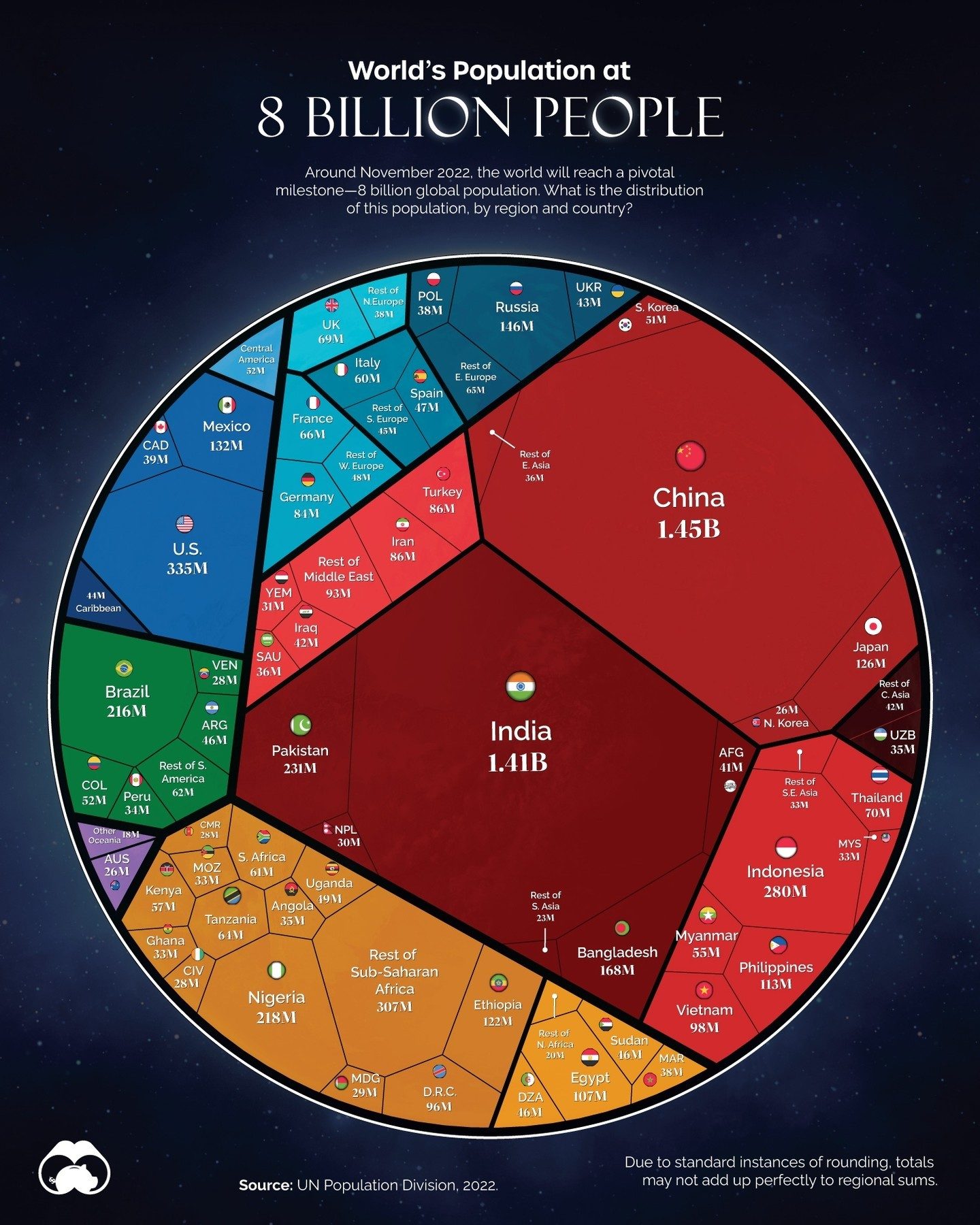
World Population Distribution
In late 2022, the global population reached an unprecedented milestone of eight billion people. This significant growth, doubling from four to eight billion in just 48 years, highlights the rapid pace of human population expansion. However, this population is not evenly distributed across the planet. Understanding the distribution of these eight billion people by region and country provides valuable context and insights into the global demographic landscape.
Context / Why this matters
The distribution of the world's population is influenced by a variety of factors, including geography, historical events, and economic development. Knowing where people live can help inform policies related to resource allocation, urban planning, and environmental sustainability. It also provides a clearer picture of global demographics, which can be crucial for international relations, trade, and cultural exchange.
Main discussion
The Distribution by Region
The world is divided into several distinct regions, each with its unique population characteristics.
Asia
Asia, the most populous continent, is home to nearly 4.7 billion people, which accounts for more than half of the global population. This region includes two of the world's most populous countries: China and India.
China, with a population of approximately 1.45 billion, is the world's most populous country. India, closely following with around 1.41 billion people, is expected to surpass China in the coming years. Other notable countries in Asia include Japan (126 million), Pakistan (231 million), and the Philippines (113 million).
Europe
Europe, with a population of around 750 million, is another significant region. The most populous countries in Europe include Germany (81 million), France (67 million), and Italy (60 million).
North America
North America, including the United States and Canada, boasts a population of roughly 592 million. This is a relatively smaller population compared to Asia and Europe but includes some of the world's most economically influential countries.
Africa
Africa, with a burgeoning population of over 1.4 billion, is experiencing rapid growth and has the youngest population on average. Countries like Nigeria (211 million) and Ethiopia (118 million) are among the most populous in the region.
South America
South America, with a population of approximately 433 million, includes countries like Brazil (214 million) and Colombia (51 million). The region is known for its diverse cultures and rich natural resources.
Oceania
Oceania, which includes Australia and New Zealand, has a relatively small population compared to other regions, with only around 42 million people.
Factors Influencing Population Distribution
Several factors contribute to the uneven distribution of the global population. These include:
-
Historical Settlement Patterns: Countries with long histories of human habitation, such as China and India, tend to have larger populations. Historical migration patterns, such as those during the colonial era, also influenced population distribution.
-
Economic Opportunities: Economic opportunities play a significant role in attracting people to certain regions. For instance, countries with robust economies, such as the United States and Germany, often see higher immigration rates.
-
Geographical Features: Natural barriers, such as mountains and deserts, can limit population density. For example, the sparse population in regions like Central Asia and the Sahara Desert is largely due to geographical constraints.
-
Political Stability and Conflict: Political stability and conflict can also influence population distribution. Regions with prolonged conflicts, such as the Middle East, may see population shifts as people seek refuge in safer areas.
Noteworthy Countries and Their Populations
-
China and India: As mentioned, China and India are the world's most populous countries. Their combined population of over 2.8 billion represents a significant portion of the global total, making them crucial players in global affairs.
-
Europe: The European Union, with a combined population of over 447 million, is a significant economic and political bloc. Countries like Germany and France, with their large populations, contribute significantly to the EU's economic and cultural landscape.
-
Nigeria and Ethiopia: In Africa, Nigeria and Ethiopia are among the most populous countries. Their large and growing populations present unique challenges and opportunities for development.
-
United States and Canada: North America's two largest countries, the United States and Canada, have a combined population of over 373 million. Their economic and political influence extends far beyond their borders.
Practical tips
When analyzing population data, it's essential to understand the nuances of population distribution. Here are some practical tips for interpreting and using this information:
-
Consider Regional Differences: Recognize that population distribution varies significantly by region. Focus on the specific characteristics and challenges of each region rather than relying on global averages.
-
Analyze Historical Trends: Look at historical population data to understand how and why populations have changed over time. This can provide insights into future trends and help inform long-term planning.
-
Account for Economic and Social Factors: Consider the economic and social factors that influence population growth and distribution. For example, high birth rates in some regions may be influenced by economic opportunities or lack thereof.
-
Use Multiple Data Sources: Use a variety of data sources, including census data, surveys, and satellite imagery, to gain a comprehensive understanding of population distribution.
-
Understand the Impact of Migration: Recognize the impact of migration on population distribution. People move for various reasons, including economic opportunities, family reunification, and political stability.
Important takeaways
-
Asian Dominance: Asia is the most populous continent, with China and India being the most populous countries in the world.
-
Europe's Significance: Europe, despite having a smaller population, is economically and politically influential, with countries like Germany and France playing significant roles.
-
Africa's Growth: Africa, with its rapidly growing population, presents unique opportunities and challenges, including the need for sustainable development and resource management.
-
North America's Influence: North America, with its economic powerhouses, is a major player in global politics and economics.
-
Regional Disparities: Understanding the distribution of the world's population by region and country is essential for addressing global issues and planning for the future.
Conclusion
The world's population reaching eight billion in late 2022 marks a significant milestone in human history. This population is distributed unevenly across the globe, with Asia leading the way in terms of sheer numbers. By understanding the distribution and factors influencing population dynamics, we can better address global challenges and opportunities. Whether it's through economic development, sustainable resource management, or political diplomacy, the distribution of the world's population plays a crucial role in shaping our collective future.
Watch the Reel
Questions readers ask
Which continent has the highest population in 2022?
Asia is the most populous continent, with over half of the global population residing there. This makes it the most populous region in 2022.
What factors influence the distribution of the global population?
The distribution of the world's population is influenced by several factors, including geography, historical events, and economic development. These elements shape where people live and contribute to the uneven distribution of the global population.
How has the world population changed in recent decades?
The world population has grown rapidly, doubling from four to eight billion people in just 48 years. This significant growth highlights the pace of human population expansion and the need to understand population trends.
Why is knowing the world population distribution by region important?
Understanding the distribution of the world's population by region is crucial for informing policies related to resource allocation, urban planning, and environmental sustainability. This information helps policymakers address the needs of different regions effectively.
Which areas have the least population density in 2022?
Regions with sparse populations tend to be in remote or difficult-to-access areas, as well as places with harsh climates. These areas can include parts of the Arctic, Sahara, and certain remote islands. However, the exact distribution of the world's least populous areas may vary.
What are some reliable sources for global population data in 2022?
For reliable global population data, sources such as the United Nations Population Division, the World Bank, and the U.S. Census Bureau are highly recommended. These organizations provide detailed and up-to-date statistics on world population distribution by region and country.
How can a global population map be useful in understanding population trends?
A global population map provides a visual representation of where people live, highlighting densely and sparsely populated areas. This can help identify population trends, such as urbanization and migration patterns, and support informed decision-making in various fields, such as healthcare, infrastructure, and policy development.
Related deep dives
Similar reads based on topic and creator.

Recent articles
Fresh deep dives from the latest Reels we unpacked.




Comments
Be the first to comment.