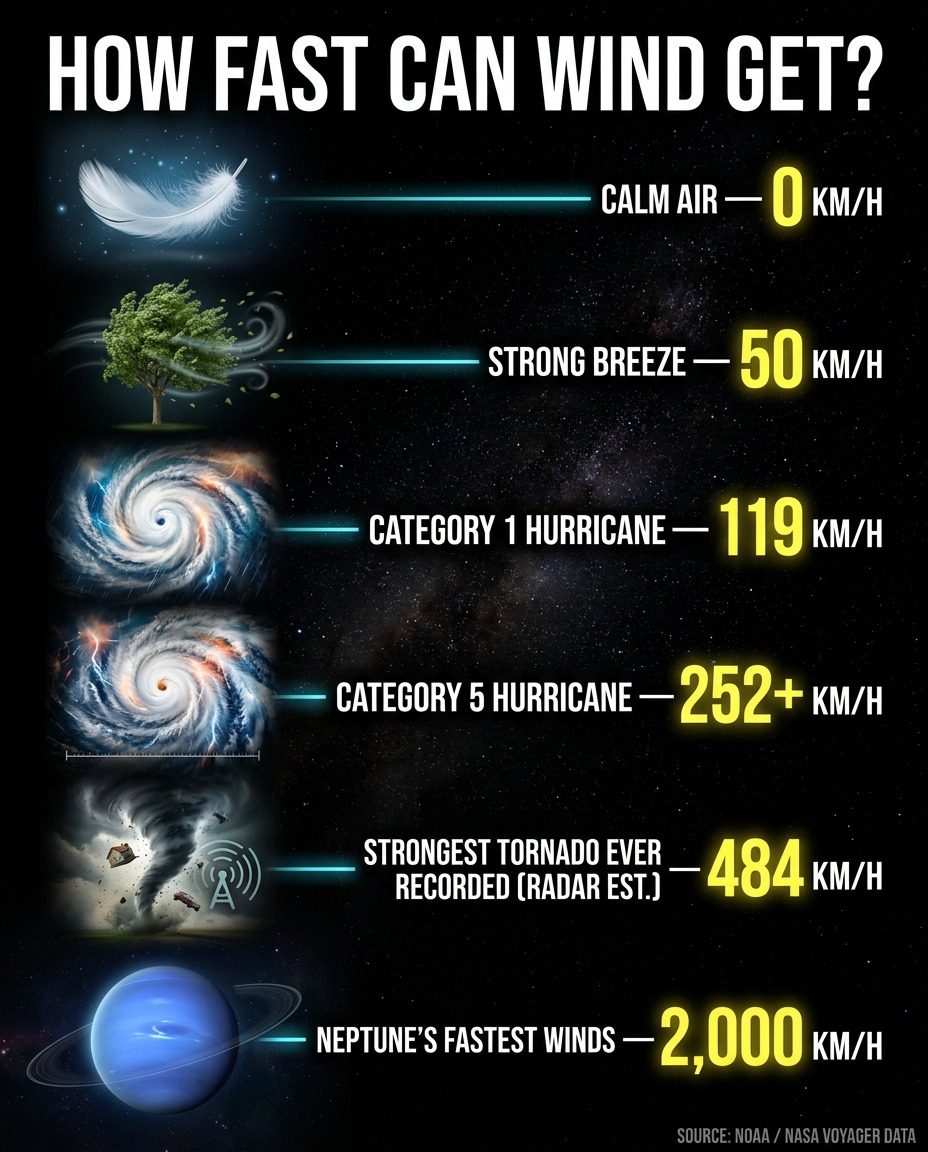
Humanity's Wind Spectrum
A strong breeze at 50 km/h can send leaves and small branches rustling, but it rarely causes significant damage. In contrast, hurricanes are far more violent. A Category 1 hurricane, the weakest classification that begins at a sustained wind speed of 119 km/h, can snap large branches and uproot trees. The strongest tornado ever recorded on Earth had winds exceeding 484 km/h. The tornado is the most unpredictable. From 50 km/h to 484 km/h, the human perspective of winds is reshaped, showing no two phenomena are the same. Extreme wind speeds are not observed in the context of the tornado, but in the context of the storm. The strength of a hurricane depends on its wind speed, and it increases with its category. Although a Category 1 hurricane has winds exceeding 119 km/h, a Category 5 hurricane has sustained winds that exceed 252 km/h. While these storms tend to be more powerful, they are smaller than the tornado. The strength of a hurricane depends on the pressure of the atmosphere, the temperature of the water, and the wind. The pressure of the atmosphere is less at the center of the storm and increases with height. The temperature of the water changes the wind speed and direction. The wind speed and direction are influenced by the pressure of the atmosphere and the temperature of the water.
Earth v. Neptune
The Earth's atmosphere has a distinct boundary with outer space. Neptune, however, lacks a distinct boundary at its outer atmosphere. Usually, wind speed can be measured by using an anemometer, a device that measures wind speed, or by the Doppler effect. However, the wind speed of an object, like clouds, can be measured by using an anemometer or by the Doppler effect. The Doppler effect is a change of the frequency of light or sound caused by the motion of the object emitting the waves. The wind speed on the Earth can be measured by using an anemometer or by the Doppler effect. On Neptune, however, the wind speed is measured by using a spacecraft that passes by the planet and measures the Doppler shift of the radio signal. The fastest winds on Earth are found in tornadoes, which can exceed 484 km/h. In contrast, Neptune has winds that reach up to 2,000 km/h. The planet is far from the sun, and its core is cold. The outer atmosphere of Neptune is heated by the Sun. The wind speed on Neptune is influenced by the heating of the outer atmosphere and the temperature of the core. Although hurricanes and tornadoes are destructive, they do not reach 20% of Neptune's maximum wind speed.
Measuring Wind
Two hurricanes require a logarithmic scale, but a simple mathematical relationship can describe the precise wind speed of a breeze or calm air. They say the logarithmic scale is a way to describe the wind speed of a hurricane. In this scale, the speed of the wind is described by a logarithmic relationship to the pressure difference between the center of the storm and the surrounding atmosphere. The pressure difference is a function of the temperature of the surrounding air. The logarithmic relationship is a way to describe the wind speed of a hurricane. The wind speed of the strongest tornado is measured by a "Doppler radar". According to the National Oceanic and Atmospheric Administration, the "National Hurricane Center", measures the wind speed of a hurricane using a system called Doppler radar. The Doppler radar sends out a beam of radio waves that bounce off the precipitation in the storm and return to the radar. The frequency of the returned signal is shifted due to the motion of the precipitation. The shift in frequency is used to calculate the wind speed. The Doppler radar measures the wind speed of the strongest tornado ever recorded, which was 484 km/h, and the wind speed of a Category 5 hurricane ranges from 119 km/h to 252+ km/h.
Studying Wind
National Oceanic and Atmospheric Administration (NOAA) and NASA Voyager data reveal how wind speeds compare. The hurricane is not the only factor to consider when studying wind. The temperature and the pressure of the atmosphere also play a role in the wind speed of different phenomena. The pressure of the atmosphere is the force exerted by the air on a surface, and the temperature of the air affects the pressure. In a hurricane, the pressure of the atmosphere is lower at the center of the storm and increases with height. Science has never predicted the speed of Neptune’s winds by using a mathematical model of the Earth's atmosphere. The Voyager mission used a different method to determine the wind speeds on outer planets. Voyager 2 measured the Doppler shift of the spacecraft's radio signals. The wind speed of Neptune is calculated by using a mathematical model of the Earth's atmosphere. The Voyager mission used a different method to determine the wind speeds on outer planets. Unlike Earth's winds, Neptune’s are influenced by the temperature of the core and the heating of the atmosphere. Although NASA has developed a model for the Earth, it could not be applied to Neptune's atmosphere.
Watch the Reel
Related deep dives
Similar reads based on topic and creator.


Recent articles
Fresh deep dives from the latest Reels we unpacked.



Comments
Be the first to comment.