WhatsApp vs Email Marketing: Choosing the Right Tool
Digital marketing offers a variety of channels to reach audiences, with messaging apps and email being two of the most effective. WhatsApp and email marketing each have unique strengths and weaknesses, making them suitable for different strategies and goals.
Context / Why this matters
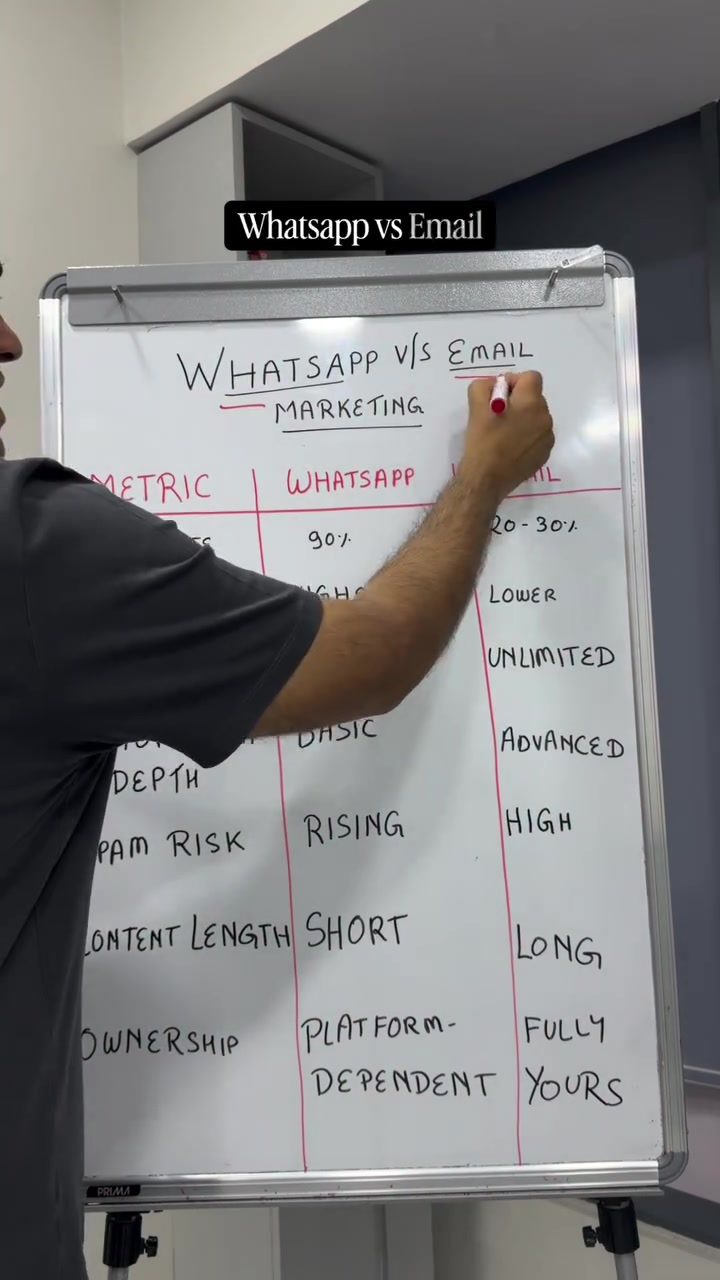
Selecting the right marketing channel is crucial. It affects your ability to engage with your audience, scale your campaigns, and ultimately drive conversions. With 90% open rates, WhatsApp stands out for its high engagement. On the other hand, email, with its 20-30% open rates, offers advanced automation and unlimited scalability. Understanding these differences helps tailor marketing efforts to specific needs and objectives.
Main discussion
When comparing WhatsApp and email marketing, the key metrics to consider include open rates, click rates, scalability, automation depth, spam risk, content length, and ownership.
Open Rates and Click Rates
Open Rates
WhatsApp boasts a 90% open rate, which means almost everyone who receives a message on WhatsApp is likely to open it. This is significantly higher than the 20-30% open rate seen with email marketing. The high open rate on WhatsApp can be attributed to its status as a personal messaging platform, making it less likely for users to ignore messages.
Click Rates
The click rates for WhatsApp are also higher compared to email. This means that users who receive messages on WhatsApp are more likely to click on the links provided, driving higher engagement and potential conversions.
Scalability
When it comes to scalability, email clearly has the upper hand. Email marketing offers unlimited scalability, allowing businesses to reach a vast number of recipients without significant limitations. WhatsApp, while effective, has limited scalability. This is due to platform restrictions and user engagement patterns, making it less suitable for large-scale campaigns.
Automation Depth
Email marketing provides advanced automation capabilities. This means you can create complex workflows, including personalized messages, automated responses, and timed campaigns. WhatsApp, on the other hand, offers basic automation, which is simpler and less customizable. This makes email a better choice for businesses that rely on advanced automation for their marketing strategies.
Spam Risk
Spam is a significant concern for both platforms, but the risks differ. While the spam risk on WhatsApp is rising, it is still generally lower than the spam risk associated with email. Users are more likely to trust messages on WhatsApp, which is perceived as a personal communication channel. In contrast, emails are often filtered by spam filters, which can reduce the effectiveness of email campaigns.
Content Length
The length of content is another critical factor. WhatsApp messages need to be short and concise, typically limited to 600 characters. This makes it ideal for quick updates, notifications, or brief promotional messages. Email, however, allows for longer content, making it suitable for detailed newsletters, in-depth information, and extensive promotions.
Ownership and Platform Dependency
Ownership plays a significant role in choosing between WhatsApp and email. With WhatsApp, the platform is owned by Meta (formerly Facebook), which means the data and messages are dependent on the platform's policies and availability. In contrast, an email database is fully yours, offering more control and independence. This makes email a better choice for businesses that value data ownership and autonomy.
Practical tips
Choosing the right marketing channel depends on your specific needs and goals. Here are some practical tips to help you make an informed decision:
-
Evaluate your audience: Understand your audience's preferences and behaviors. If they are more likely to engage with personal messages, WhatsApp might be the better choice. If they prefer detailed information, email could be more effective.
-
Consider your content: Think about the type of content you need to deliver. For short, quick messages, WhatsApp is ideal. For longer, more detailed content, email is the way to go.
-
Plan for scalability: If you need to reach a large audience, email marketing's unlimited scalability makes it a better option. If your target audience is smaller and more personalized, WhatsApp can be more effective.
-
Automation needs: Assess your automation requirements. If you need advanced automation features, email is the superior choice. For basic automation, WhatsApp can suffice.
-
Spam concerns: Be aware of spam risks and take steps to minimize them. For a more personal touch, WhatsApp may reduce the likelihood of being marked as spam, while email strategies should prioritize engaging content to avoid spam filters.
-
Ownership and control: Consider the importance of data ownership and control. If having full control over your data is crucial, email is the better option.
Important takeaways
- WhatsApp: High open and click rates, limited scalability, basic automation, rising spam risk, short content, platform-dependent ownership.
- Email: Lower open and click rates, unlimited scalability, advanced automation, high spam risk, long content, full ownership.
Both platforms have their strengths and weaknesses, and the best choice depends on your specific marketing needs. It's also worth considering that the two platforms can complement each other. For instance, using WhatsApp for quick updates and personalized messages, while relying on email for detailed information and advanced automation, can create a robust and effective marketing strategy.
Conclusion
Choosing between WhatsApp and email marketing involves weighing various factors, including open rates, scalability, automation, spam risk, content length, and ownership. Understanding these differences can help you tailor your marketing efforts to achieve the best results. Whether you opt for the high engagement of WhatsApp or the advanced automation and scalability of email, both platforms offer unique advantages that can enhance your marketing strategy.
Watch the Reel
Questions readers ask
What are the key benefits of using WhatsApp for marketing?
WhatsApp marketing boasts impressively high open and click rates, often reaching 90% and above. This makes it an excellent choice for delivering personal, engaging messages that can drive immediate action. Additionally, messages sent over WhatsApp are often perceived as more intimate and direct, fostering a stronger connection with your audience.
How does email marketing compare to WhatsApp in terms of scalability?
Email marketing offers unlimited scalability, making it ideal for broad, large-scale campaigns. This means you can reach a vast number of people at once without compromising on the effectiveness of your messages. In contrast, WhatsApp marketing has limited scalability, which can make it less suitable for very large campaigns.
Why is email marketing considered to have a lower spam risk?
Email marketing platforms often provide advanced automation features that can help you segment your audience and tailor messages to specific groups. This personalization reduces the likelihood of your messages being marked as spam. Additionally, many email providers use filters and algorithms to detect and block spam, ensuring a safer experience for users.
Can I use both WhatsApp and email marketing in the same campaign?
Yes, combining WhatsApp and email marketing can be a powerful strategy, especially for complex campaigns. You can use WhatsApp for personalized, high-engagement messages and email for broader campaign outreach. This dual approach can help you leverage the strengths of both channels to maximize your reach and impact.
Which platform is better for quick, time-sensitive messages?
WhatsApp is generally better for quick, time-sensitive messages due to its high open rates and immediate delivery. When you need to ensure your message is seen and acted upon quickly, such as for flash sales or urgent updates, WhatsApp’s direct and engaging format can be more effective.
What advanced automation features does email marketing offer?
Email marketing platforms often include advanced automation features like drip campaigns, triggered emails, and workflows. These tools allow you to send targeted messages based on user behavior, time of day, or specific actions. This level of automation can significantly enhance your campaign’s efficiency and effectiveness.
How does WhatsApp's engagement rate compare to email's?
WhatsApp typically has a much higher engagement rate compared to email, with open rates often reaching 90% or more. This is due to the personal and direct nature of WhatsApp messages, which are more likely to be read and acted upon by users. In contrast, email open rates typically range from 20-30%, making WhatsApp a stronger choice for immediate, high-engagement messaging.
Recent articles
Fresh deep dives from the latest Reels we unpacked.




Comments
Be the first to comment.